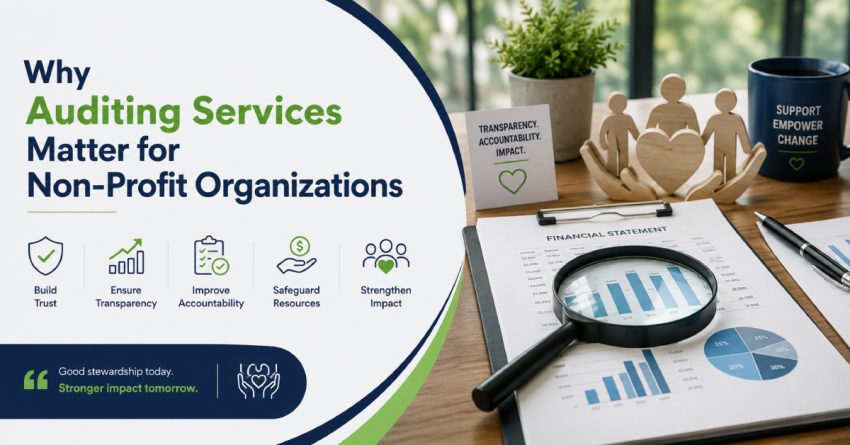
The non-profit organization is an important part of the solution to social, educational, healthcare and environmental problems. These are the entities that are frequently dependent on donations, grants, sponsorships, and volunteers, to accomplish their goals. They are managing funds received by multiple stakeholders; therefore, it’s crucial to ensure financial transparency and accountability. It’s in those instances when auditing services come in very handy.
Auditing services provide non-profit organizations with the opportunity to showcase trust and responsible fund management by analyzing financial records, processes and controls.
Promoting Financial Transparency
Transparency is one of the most critical elements to success in any non-profit organization. Donors and funding agencies want to be sure that their funds are being spent for the reasons they give for funding.
Professional auditing services involves an independent examination of financial transactions and statements. This enables the possibility of verifying income and expenditures were recorded and reported correctly. When clear financial reporting is delivered, stakeholders’ trust can be gained in relation to the organization’s operations and governance.
Transparency also makes it easier to get funding from future donors, since the donors want to know that the organization is financially responsible.
Strengthening Donor Confidence
Donations and grants are vital to many non-profit organizations. Reliability of an organization’s financial management is often a consideration before contributing.
The regular audit services reveal that the company is accountable and managing its finances appropriately. Audit reports are going on to prove that all the donated money is handled properly and that there is transparency within the organization.
The more confident donors become in an organization, the more likely it is that the organization will be able to use the donors’ money long-term and develop a strong relationship.
Ensuring Regulatory Compliance
There are a number of legal, financial and taxation parameters that must be met by non-profit organizations. If these requirements are not fulfilled, penalties, damage to reputation or loss of tax privileges may be incurred.
Professional auditing services are used to check the compliance of an organization to the applicable laws and reporting requirements. Auditors look for opportunities for improvement and suggest corrective actions.
This proactive measure ensures that non-profits do not face compliance issues and continue to have the trust of both regulators and stakeholders.
Identifying inaccuracies and irregularities
In any organization regardless of the size, there can be financial errors. In a few instances, internal control issues could also provide opportunities for fraud or misuse of resources.
A major advantage of auditing is its ability to uncover discrepancies, accounting mistakes and odd transactions. Auditors scrutinize records closely and determine if the financial processes are working well.
When things go wrong, the sooner it is caught, the sooner it can be resolved and the more likely the problem won’t affect operations or stakeholder trust.
Improving Internal Controls
Internal controls are well established to ensure that financial activities are properly and consistently carried out. These are the controls that involve approval processes, documentation and monitoring.
Auditing services involve conducting a thorough evaluation and audit of the effectiveness of already established control systems. Auditors can make suggestions to improve risks and operations.
Improved internal control benefits not only in ensuring that organizational resources are protected but also help in the responsible decision-making process for the whole institution.
Supporting Better Governance
All non-profit organizations must have good governance. The board, management teams and stakeholders require accurate financial data to make good decisions.
The benefit of regular auditing services is that it gives an objective analysis of the financial well-being and working methods. Audit findings assist the head of the businesses/ in-charge of the NGO to gain insights on what the strengths, weaknesses are and the areas that can be improved.
This information helps the organization with strategic planning and make sure their resources are focused on their mission and long-term goals.
Enhancing Organizational Reputation
Non-profit organizations have valuable assets in the form of reputation. Fundraising, partnerships, volunteerism and community support are all impacted by public trust.
Businesses that employ the services of professional auditors show that they are committed to doing business with ethical standards of financial management. Independent audits convey a good message to donors, grant providers and the general public about the organization’s commitment to accountability and transparency.
Having a good reputation can lead to new funding sources and joint projects that benefit the expansion of the organization.
Conclusion
Non-profit organizations are not a business that can rely on trickery to remain in business, and accountability and transparency are paramount to their success. The audit provides professional assistance to maintain accurate financial reporting, compliance with the regulatory requirements, good internal controls, and responsible fund management. They also build donor trust and promote good governance.
Trust, resource protection, and long-term sustainability are all vital to non-profits that serve communities and solve social issues; and investing in reliable auditing services is always a key component of those goals.
Frequently Asked Questions
Also Read: Auditing And Assurance Services: Ensuring Trust And Confidence