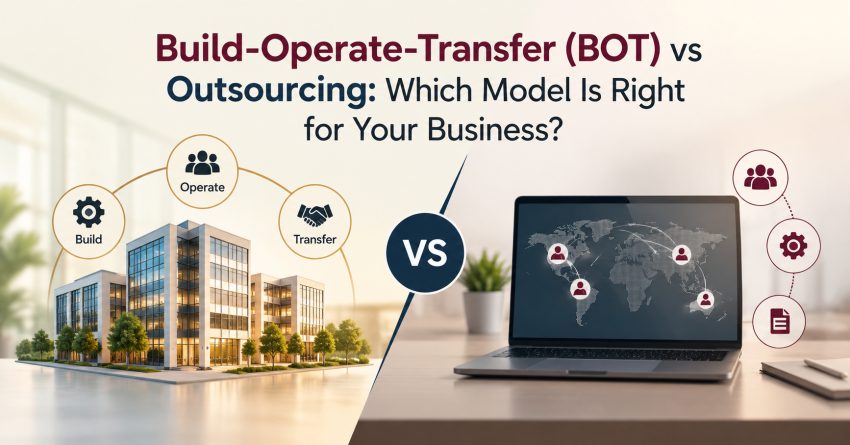
Firms that venture into new markets or set up special operations need to consider how they can manage their resources, infrastructure, and operations. They include the build operate transfer and the outsourcing model. Both models require firms to work with external parties; however, the two models vary significantly when it comes to the ownership and control of businesses and business objectives. This is the knowledge needed by firms to select one of the models that fit their needs.
Understanding the Build-Operate-Transfer (BOT) Model
The build operate transfer model enables a firm to set up an operation using the help of an external partner and then take over and take full control at a negotiated point in time.
This process involves the following stages:
- Build: The partner establishes the required infrastructure, recruits staff and develops operational processes.
- Operate: The partner manages the operation for a predetermined period while working towards agreed objectives.
- Transfer: Ownership, assets and operational responsibilities are transferred to the client according to the terms of the contract. .
It is common for firms setting up technology centers, shared service centers, research labs, and special business operations to go for this model.
Understanding Outsourcing
Outsourcing involves assigning specific business activities or functions to an external service provider. They may be related to customer support, accounting, IT services, payroll and data processing.
The supplier carries out the duties defined by the contract and service level agreement. In comparison with BOT, the outsourcing model does not involve any planned transferring of the operation to the customer. The relationship lasts as long as it is demanded by the business.
BOT vs Outsourcing: Key Differences
| Comparison factor | BOT model | Outsourcing |
| Primary objective | Establish and eventually transfer an operation | Delegate selected activities to an external provider |
| Ownership | Intended to transfer to the client under the agreement | The provider generally retains ownership of its operation |
| Initial investment | The partner may support infrastructure setup | Usually avoids the need to establish a dedicated operation |
| Operational control | Transitions to the client according to the agreement | Governed by the service agreement |
| Long-term approach | Builds internal operational capability | Provides continued access to external expertise |
| Best suited for | Businesses planning to take over an operation long-term | Businesses seeking flexibility and specialised services |
Which Model Should Your Business Choose?
It all depends on the company’s goals, the company’s resources, and the anticipated length of the relationship.
The BOT approach may work well for businesses that plan for expansion over the long term and wish to create their own entity. The process gives enough time to set up systems, train the workforce, and learn what is required prior to taking over. Nevertheless, a lot of planning is needed in order to make the transition smooth.
Outsourcing might be better for companies that need special knowledge or wish to avoid managing routine tasks. It will allow firms to have access to already developed skills instead of creating their own operations.
There are some other aspects that need to be considered.
Conclusion
Both BOT and outsourcing help businesses access external expertise and improve operational efficiency, but they serve different purposes. The BOT model allows a business to establish an operation with a partner’s support before taking it over, while outsourcing enables businesses to delegate selected functions to an external provider. Evaluating long-term objectives, available resources and the desired level of control can help businesses choose the right model.
FAQs
Q: What happens during the build stage of BOT?
In the build stage, the partner establishes infrastructure, recruits staff and develops the required operational processes.
Q: Which operations commonly use the BOT model?
BOT is often used for technology centres, shared service centres, research facilities and specialised business operations.
Q: Does outsourcing involve transferring ownership?
Unlike BOT, outsourcing normally has no planned transfer of the service operation or ownership to the client.