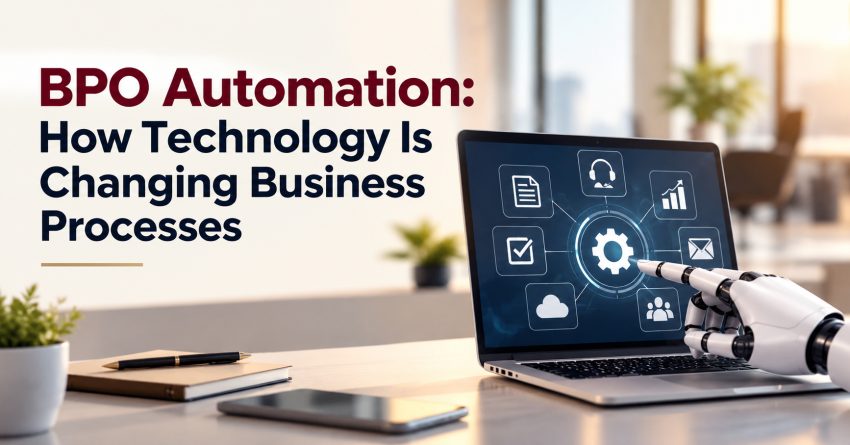
Many businesses use technology to automate routine tasks, improve accuracy and reduce delays. Activities such as invoice processing and customer inquiry management can be automated to improve efficiency. For businesses involved in business process outsourcing (BPO), automation creates opportunities to deliver services faster and more consistently.
What Is BPO Automation?
BPO automation refers to the adoption of certain technologies such as robotic process automation (RPA), artificial intelligence (AI), machine learning and workflow management tools in order to automate repetitive business activities. Automation of business processes does not mean that people will no longer be needed; rather, people can focus on tasks requiring critical thinking and communication skills, among others.
Key Areas Where Automation Is Making a Difference
Customer Service Operations
Virtual assistants powered by AI and chatbots can answer routine questions, walk clients through standard procedures and provide information around the clock. Automated ticketing systems can streamline the entire process of raising concern to the relevant department on the basis of how urgent the queries of the customer are.
Nevertheless, customer service operators can still play an important role in handling complicated complaints and grievances that require direct human interaction. The combination of automation with human operators may speed up response time while preserving the level of customer service.
Finance and Accounting
There are several repetitive tasks within the framework of financial operations including processing of invoices, tracking payments, classification of expenses and data entry. The automation system can extract information from documents, match invoices to purchase orders and identify discrepancies.
This may be helpful to save accountants’ time and keep information consistent. It is worth noting that exceptions management and financial approvals need proper controls.
Data Management and Processing
A large volume of data is processed daily in the organization across multiple departments. Automated systems can collect, validate, organize and move data between applications avoiding duplicates and routine mistakes.
For organisations relying on business process outsourcing, these capabilities can support faster processing and more consistent workflows, particularly when managing high volumes of standardised transactions.
Human Resources and Administrative Tasks
Automation can ease the process of onboarding, conducting interviews, monitoring attendance, calculating salaries and managing routine documents. Workflow applications can set reminders, approve and notify employees when certain actions need to be done.
Such changes will allow the administrative department to perform repetitive tasks easily while keeping better track of things.
Benefits of Automation in BPO
There are many possible benefits of automation if done correctly:
- Increased efficiency: Routine tasks can be completed faster.
- Consistency: Standardised workflows help ensure consistent results.
- Scalability: Automation can handle higher transaction volumes with less manual intervention.
- Visibility: Digital records and dashboards help managers monitor performance.
- Resource optimisation: Employees can focus more on customer relationships, analysis and decision-making.
These depend on complexity of the process, cost of automation, quality of data and choice of technologies.
Challenges Businesses Must Consider
Careful planning is essential when implementing automation. Poorly defined workflows can create inefficiencies, while inaccurate data can affect the reliability of automated outputs. Integration with old systems, cybersecurity threats and staff training are additional aspects to consider.
It is important to start with selecting processes that are appropriate for automation, setting up measurable goals and conducting an automation pilot project.
Conclusion
Automation of BPO is revolutionizing the way that businesses handle their customer services, financial dealings, data handling, and administrative processes. By using the right technology with competent staff, firms can be more efficient yet still retain control over critical decision-making processes. In light of the development of BPO in the coming years, an intelligent automation strategy will play a key role for businesses.
FAQs
Q: What is BPO automation?
BPO automation uses technologies such as RPA, AI, machine learning and workflow tools to automate repetitive business tasks.
Q: Does BPO automation replace employees?
Automation handles routine work while employees focus on activities requiring judgement, communication and critical thinking.
Q: Which finance tasks can BPO automation handle?
Finance automation can support invoice processing, payment tracking, expense classification and routine financial data entry.
Q: What are the benefits of BPO automation?
BPO automation may improve processing speed, workflow consistency, scalability, visibility and the use of employee resources.
Q: How does BPO automation improve data processing?
Automated systems can collect, validate, organise and transfer data between applications while reducing duplication and routine errors.