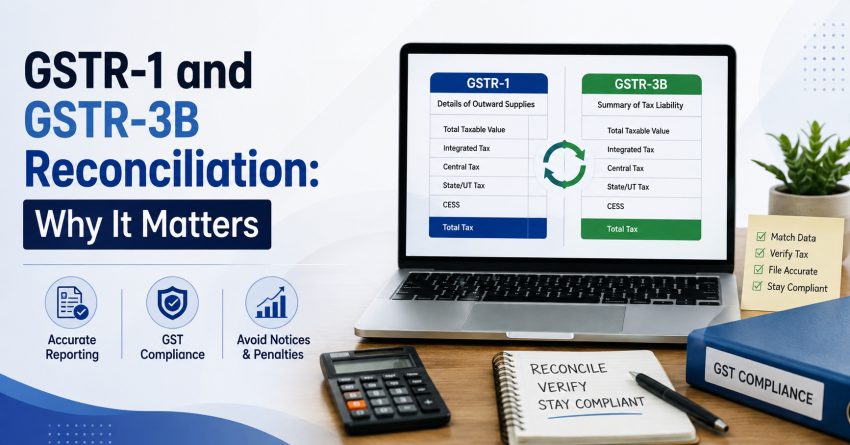
Good GST compliance is about much more than timely filing. The businesses should also ensure that the details provided in GSTR-1 are in sync with the details provided in GSTR-3B. If there is a discrepancy in these returns, it may result in notices from the tax authorities, wrong tax filing and compliance issues. This is the reason why every GST audit includes reconciliation which can assist businesses to hold accurate records and avert costly errors.
Understanding GSTR-1 and GSTR-3B
GSTR-1 is a statement of outward supplies, which reflects invoice wise details of outward supplies made during a tax period. The other one is GSTR-3B, which is a summary return in which businesses report on tax liability and pay GST.
The two returns are for the same transactions but have different uses. This is because the data is integrated into different GST systems and there needs to be consistency between systems. The most important part that is to be performed during a GST audit is whether the numbers mentioned in these returns are aligned.
Why is Reconciliation important?
By reconciling GSTR-1 with GSTR-3B, businesses can ensure that it is possible to detect any discrepancies before they turn into compliance challenges. Differences can occur because of errors in reporting, unmatched invoices, misclassification of taxable items, any changes to the information, or due to timing between returns.
Some of the major advantages of regular reconciliation are:
- Conducts accurate reporting of taxes.
- Reduces the probability of departmental notices.
- Helps avoid underpayment or overpayment of GST.
- Ensures the right financial reporting.
- Enhances the accuracy of GST records.
In case of GST audit, reconciliation also helps in documentation as a systematic reconciliation process allows businesses to easily resolve and explain any discrepancies.
Common Reasons for Mismatches
There may be discrepancies between GSTR-1 and GSTR-3B for various reasons. The most frequent ones are:
- Omission of sales invoices.
- The incorrect selection of the GST rate.
- Rejected records due to data entry errors.
- Timing differences when invoices are reported in different tax periods.
- Un-adjusted credit notes or debit notes.
- Amendments made to returns after filing.
Reconciliation is not only a year-end activity but is also important for the month as you can make mistakes in the course of the year and these can add up.
Best Practices for Effective Reconciliation
A structured reconciliation process can enhance the GST compliance of businesses.
Reconcile returns monthly prior to the next GST returns. To reduce manual effort, use accounting software that is compliant with GST reporting. Check invoice documentation thoroughly, confirm tax calculations and look for discrepancies as soon as possible.
Reconciliation is more efficient when all your documentation – such as any invoices, debit notes, credit notes and payment records – are complete, and you will be better prepared for a seamless GST audit if one is required.
How Professional Support Adds Value
GST laws are still evolving and continue to become more complex. They will advise businesses on effective reconciliation processes, reporting errors and how to ensure an accurate return is prepared based on the financial data.
They also help review tax positions, identify discrepancies, and help with documents that may be needed if a tax assessment or audit is performed. By adopting this proactive approach, the risk of compliance will be lowered, and effective financial governance ensured.
Conclusion
Reconciliation of GSTR-1 and GSTR-3B is an important activity for GST compliance. It is also an integral part of having correct GST records and ensuring there are no issues in reporting. In this respect, reconciliation will allow organizations to discover any mistakes in the accounts, pay the correct tax, and improve financial reporting.
Reconciliation of data is the cornerstone of any GST audit process. Reconciliations would become part of the compliance process and result in reduced risks for businesses, increased operational efficiency and increased confidence in financial reporting.
Frequently Asked Questions
Q: What is the difference between GSTR-1 and GSTR-3B?
GSTR-1 is a monthly or quarterly statement of outward supplies that contains invoice-wise details of sales made during a tax period. GSTR-3B, on the other hand, is a summary return where businesses calculate their total tax liability, claim input tax credits, and pay GST.
Q: What are the main causes of mismatches between GSTR-1 and GSTR-3B?
Discrepancies usually stem from:
- Omission of sales invoices or data entry mistakes
- Applying incorrect GST rates or misclassifying taxable items
- Timing differences when reporting invoices across different tax periods
- Unadjusted or improperly recorded credit and debit notes
- Manual entry errors or tax amendments made after filing
Q: How does GSTR-1 and GSTR-3B reconciliation assist during a GST audit?
During a GST audit, tax auditors closely verify whether the figures reported across different GST returns align. Having a systematic, up-to-date monthly reconciliation supported by complete invoice documentation allows businesses to easily substantiate their tax positions and resolve departmental inquiries.
Q: How does accounting software simplify GST reconciliation?
GST-compliant accounting software automates data matching between invoice-level records and tax summary files. This eliminates manual data entry errors, identifies rate or turnover discrepancies instantly, and saves time prior to filing.
Q: What documentation is required to support GST return reconciliation during an audit?
To substantiate tax returns during a GST audit, organizations should maintain complete documentation, including:
- Sales and purchase invoices
- Issued debit and credit notes
- Payment records and bank receipts
- Monthly GSTR-1 and GSTR-3B reconciliation statements
Also Read: GST Updates for E-Commerce Seller in 2026