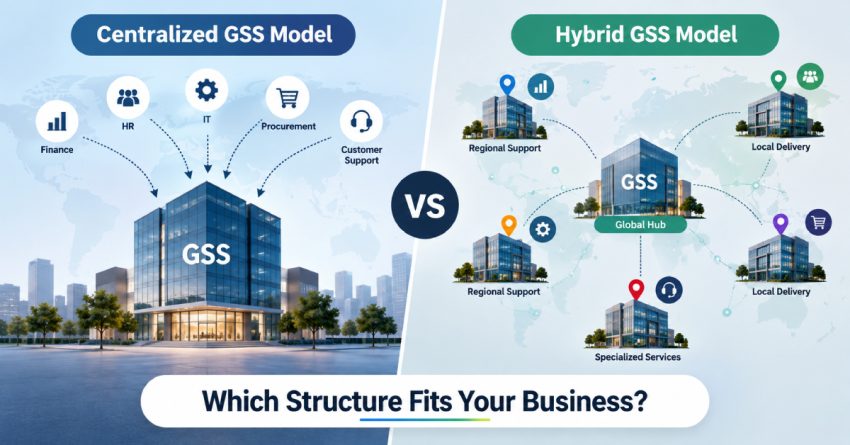
When businesses expand across countries and functions, it may be difficult to handle the finance, human resources, procurement, IT and other support activities. Global Shared Services (GSS) provides a mechanism to centralize and harmonize these services, increase efficiency and enhance service quality. But the question for organizations is how much of their business should be centralized. The centralized and hybrid GSS models are two popular approaches. The decision of which to use depends on several factors, such as organizational size, geographic complexity, technology, service requirements and long-term business goals.
Understanding the Centralized GSS Model
Centralized GSS model is one where similar support function is organized into a shared services organization. Business units do not run their own processes but do activities through a central team responsible for activities across multiple locations/divisions.
This can help to establish more uniformity in processes, policies, reporting, and technology. It will help to minimize duplicate effort, as all the similar efforts will not be required to be done by different teams across various locations.
For firms that have homogeneous process flow and advanced technology infrastructure, centralization is a viable solution.
What Is a Hybrid GSS Model?
This is a model which combines the centralized model with some local or regional activities.
The processes which require local understanding can be retained locally, while the core processes can remain centralized.
For example, there can be one department for accounts payable, one department for payroll processing, and one department for procurement, where the members of the department can handle all the processes relevant to their own country’s needs.
This model can provide a balance between standardization and flexibility.
| Aspect | Centralized GSS | Hybrid GSS |
| Structure | Most of the shared functions occur through one single organization. | There is centralization of core functions and select functions which are left at the local/regional level. |
| Standardization | The degree of process and policy standardization is high. | There is a combination of standardization with local flexibility. |
| Control | Strong centralized control can be achieved through central leadership. | There is shared responsibility between the central and local teams. |
| Local Adaptability | May not be flexible where there are specific needs of the country. | More appropriate for organizations working in diverse markets with different needs. |
| Operational Complexity | The organizational structure becomes simple after implementation. | Necessary coordination between the central and local teams is needed. |
| Best Suited For | Organizations with highly standardized processes and similar operating requirements. | Organizations operating across diverse markets with varying regulatory or business needs. |
Benefits of Centralization
Centralization of the GSS structure can create economies of scale for the activities. Standardized workflows can minimize process variance, and central technology can enhance reporting and the visibility of data.
Centralization also can facilitate common service level agreements (SLAs) and key performance indicators (KPIs.)
This model can be a solid starting point for organizations looking to achieve substantial cost savings and streamline their processes.
The application of Hybrid Models Add Value
While standardization is great, not all business processes can be effectively managed from one place. The tax regimes, employment laws, language requirements and market conditions vary widely from country to country.
Using a hybrid GSS model, an organization can focus on activities that can be done more effectively with a central team and still utilize the local capabilities for activities that make a real difference to the situation.
The versatility of this model can make it an excellent choice for multinational companies with varying locations.
Selecting the appropriate model
There is no one, single, universal GSS structure that is suitable for all organizations. There are a number of factors for businesses to consider when choosing a model.
Process Standardization
Centralizing processes might be less challenging if they are already consistent in other locations. Significant differences may indicate a need for a hybrid approach.
Geographic Complexity
Firms with significant variations in regulations across different markets may wish to keep some local skills.
Technology Infrastructure
Centralized infrastructure can be better realized for systems and automation as standardized data can be accessed in real-time.
Service Requirements
Businesses need to think about the need for highly tailored or locally responsive customer support in internal customers.
Successful transitioning
In either case, it is important to establish ownership and clarity of process. Service-level expectations, governance bodies, escalation procedures, performance measures and technology needs should be defined by organizations.
Additionally, a phased approach can allow businesses to pinpoint problems within the system before rolling it out to new departments or sites.
Conclusion
For some, a centralized shared service model will be more effective in enhancing operational efficiencies while others may find that a hybrid, global shared services model is better suited to their needs. Centralization brings about more standardization, scale and centralized control, while hybrid structures make more sense for companies who serve in different markets.
It is not always the centralization of the greatest number of functions that is the most effective approach. Instead, companies need to identify those activities that can benefit from scale and consistency, and those that need local expertise. The GSS structure, which is designed to meet the complexity of the business, the technology’s capacity and the demands of the services, allows organizations to establish a shared services model that meets the demands of efficiency and flexibility to respond to the changing demands of the business.
Frequently Asked Questions
Q: What is the difference between a Centralized and a Hybrid Global Shared Services (GSS) model?
A Centralized GSS model consolidates support functions (such as HR, finance, and IT) into a single central organization, standardizing processes across all locations. A Hybrid GSS model centralizes core functions while leaving specific activities at the local or regional level to handle unique market, legal, or language requirements.
Q: When should a business choose a Centralized GSS model?
A business should choose a Centralized GSS model if it operates with highly homogeneous process flows and has an advanced technology infrastructure. It is best suited for organizations aiming to maximize economies of scale, eliminate duplicate effort across divisions, and establish uniform key performance indicators (KPIs).
Q: What are the main advantages of a Hybrid GSS model?
- Local Adaptability: Allows regional units to handle complex local tax regimes, country-specific employment laws, and localized language needs.
- Balanced Governance: Combines central efficiency for core tasks with regional operational flexibility.
- Market Responsiveness: Suits multinational businesses operating across diverse geographic markets where a single rigid standard is ineffective.
Also Read: How Employee-Centric Workplaces Strengthen Global Shared Services Organizations