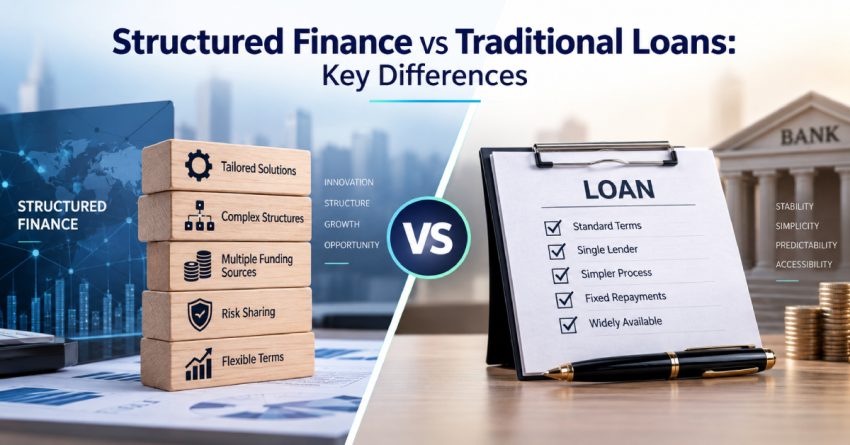
The financial requirements of different firms and circumstances vary, whether it may be expanding business, purchasing assets or even funding major infrastructural projects. Financing through traditional lending is one of the methods of securing funds for a business but this does not work in all cases when dealing with complex or expensive funding requirements. Structured finance is another financing approach that can be tailored to specific assets, cash flows or transactions. In order to choose the right approach to finance, it is important to know the differences between them.
What is Structured Finance?
Structured finance is an approach where a financial arrangement is customized according to the purpose of and/or financial requirement, which may not necessarily be part of the typical financial structures. Apart from assessing the overall financial strength, structured finance will include certain assets, receivables, cash flows and the project economics.
Structured finance transactions may involve various financial instruments, special-purpose entities, asset-backed structures and customized repayment arrangements.
These are generally characterized by large projects, infrastructure projects, acquisitions, securitization transactions, and businesses with predictable but specialized cash flows and are typically thought to be candidates for structured financing.
Understanding Traditional Loans
Traditional business loans are typically loans issued by lenders that are based on predetermined terms and conditions that they agree to with the borrower. The borrower normally pays back the amount borrowed plus interest for a specified time.
Creditworthiness, financial statements, cash flow, collateral, and repayment abilities are commonly some of the aspects considered in eligibility and borrowing limitations.
Traditional financing may be suitable where a company has relatively straightforward financing requirements and predictable cash flows.
| Aspect | Traditional Loans | Structured Finance |
| Financing Approach | Uses conventional financing approach considering creditworthiness and repayment capacity of the borrower. | Financial arrangement based on the structure of the specific asset, cash flow, transaction, or project. |
| Customization | Borrowing structures are usually standard | The financing can be highly customized depending on the nature of the transaction. |
| Risk Assessment | Primarily focuses on borrower credit risk and available collateral. | Can distribute or isolate risks across assets, cash flows, and participating parties. |
| Repayment | Typically follows a predetermined repayment schedule. | May be linked to the performance or cash flows of specific assets or projects. |
| Complexity | Generally simpler to structure and administer. | Often requires detailed financial, legal, and operational structuring. |
| Cost | Will generally entail relatively low structuring and transaction costs. | May entail higher legal, advisory, modelling and monitoring costs. |
| Best Suited For | Small loans, short-term financing, expansion, working capital, equipment, routine business financing. | Large volumes of money, complex projects, specialized financing needs, asset-backed financing, and loans for large transactions. |
Key Difference: Financing Structure
The primary difference is in the structure of the financing.
Traditional loans are usually structured in a fixed manner, but it may be negotiated with the borrower in view of their situation. Structured finance is structured around the transaction itself.
Financing, for example, may be based on a pool of receivables or cash flows of some specific projects rather than being linked to the balance sheet of the company.
Different distribution of risks among participants
In the case of conventional lending, one of the very crucial factors could be the ability of a borrower to repay the loan back. It can also imply providing some collateral or guarantees for the purposes of mitigating the credit risk.
A structured transaction involves sharing risk between several parties and/or linking the payments to some assets or cash flows. This structure may be considered where conventional lending does not adequately reflect the underlying assets, cash flows or risk profile of the transaction.
Flexibility and customization
It is usually easier to understand and deal with conventional loans because the terms of the loan are based on typical processes in lending. It may, however, reduce flexibility for borrowers with some uncommon requirements.
It implies some customization in the case of structured finance because the peculiarities of the transaction can be incorporated into payment schedules, security arrangements, cash flows, etc.
Such flexibility can be useful in the cases when the company conducts some major projects or deals which involve different sources of revenue.
Complexity and Cost
Moreover, flexibility may also mean that there should be increased complexity. Complex financial models, legal structures, due diligence and monitoring may become essential for structured financing. Therefore, there may be additional costs to having a conventional loan. So the question is for the business whether the advantages of customization are worth the extra complexity and cost.
When should each option be considered by businesses?
In cases where the business requires simple financing to cover working capital, equipment, expansion or other traditional needs, traditional loans might be suitable.
Structured finance may be considered where the transaction involves substantial assets, predictable contractual cash flows, complex projects or a need for tailored risk allocation.
The appropriate financing structure depends on the business’s financial position, objectives, risk profile and financing requirements.
Conclusion
The financing requirements of traditional loans and structured finance differ. While conventional loans are easier to understand, have well-defined processes and predictable repayment terms, structured finance is more flexible when financing a complex transaction by structuring the funding around the particular asset, cash flow or risk.
Before making a decision, businesses must consider the amount of capital needed, the structure of the financing, the costs, how the capital will be distributed (shared or transferred), the mechanism by which the capital will be remunerated, the administrative requirements, and the level of risk. A financing decision should therefore consider the capital required, associated costs, risks, contractual terms and administrative requirements in the context of the organisation’s objectives.
Frequently Asked Questions
Q: What is the main difference between structured finance and traditional loans?
The core difference lies in the financing structure. Traditional loans rely on standard, fixed terms based on the borrower’s overall creditworthiness and balance sheet. In contrast, structured finance is a highly customized arrangement built around specific assets, cash flows, or transaction risks rather than just the business’s general credit.
Q: How does risk assessment differ between traditional and structured financing?
- Traditional Loans:Primarily evaluate the borrower’s overall credit score, financial statements, and collateral to assess default risk.
- Structured Finance:Isolates or distributes risks across multiple parties, specific assets, and dedicated cash flows.
Q: When should a business choose a traditional loan over structured finance?
A business should choose a traditional loan for simple, routine capital needs such as working capital, purchasing standard equipment, or straightforward business expansions. Traditional loans offer lower administrative complexity and reduced transaction costs.
Q: When is structured finance the better option for a business?
Structured finance is best suited for large-scale, complex transactions, such as major infrastructure projects, acquisitions, securitization deals, or financing tied to specialized, predictable cash flows.
Q: Why is structured finance generally more expensive than traditional lending?
Structured finance incurs higher costs due to its complexity. It requires extensive legal structuring, detailed financial modeling, specialized due diligence, and ongoing monitoring to tailor the agreement to specific assets or projects.
Also Read: Structured Finance: A Smarter Way to Manage Long-Term Assets