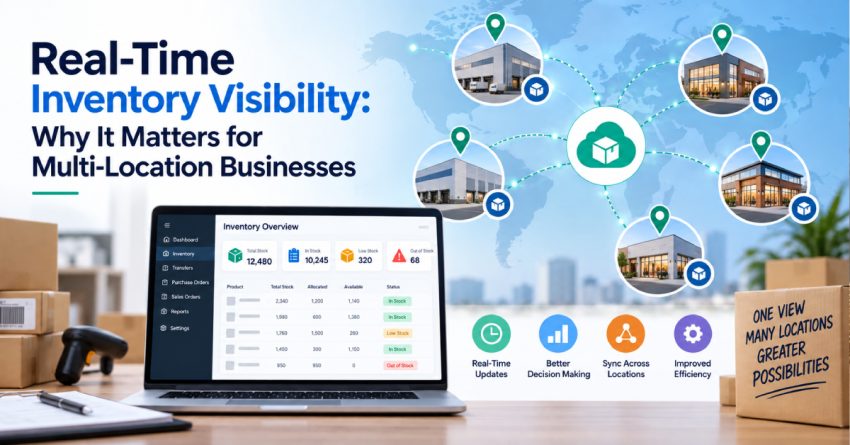
Inventory management becomes much more complicated when a company has multiple stores, warehouses, branches or distribution centers. The amount of product, sales volume, reorder policies, and customer buying patterns will vary from site to site. Inaccurate and late information can hinder businesses from avoiding stockouts, overstocking, late orders and poor buying decisions. Real-time visibility in inventory management provides organizations with a better understanding of what is in stock, where it is and how fast it is turning.
What is Real-Time Inventory Visibility?
Real-time inventory visibility is the ability to get accurate data on the inventory and its movements at any business location at any time. Employees and managers can get the up-to-the-minute information on transactions rather than waiting for a periodic spreadsheet or report.
This could contain information on:
- Current stock quantities
- Goods received and delivered
- Sales and returns
- Stock transfers
- Reserved inventory
- Items that have been damaged or are not available.
A centralized view enables businesses to gain insight into the inventory position before it is received by each location.
Stockout and Overstocking Prevention
One of the major challenges for companies operating multiple locations is to maintain an accurate inventory at all locations.
Without visibility, a store might run out of a high-demand item while another store may have excess of that item but cannot utilize it. This leads to missed sales opportunity and blocked capital.
Inventory management through real-time system helps the company to take necessary actions regarding stocking and transferring items.
Making Stock Transfers more efficient
Multi-location companies often transfer goods from one store, warehouse or distribution center to another. It is important that these transfers are carefully monitored to ensure accurate records are kept.
Real-time visibility will allow managers to know where the excess inventory is, and if the excess can be moved to a different location where there is greater demand.
This can decrease fretful procurement and assist companies make better usage of their stock.
Improving Purchasing Decisions
Managers who have access to the current inventory information can benefit from the same as they can make more reliable purchase decisions.
As opposed to relying upon old reports, procurement teams will be able to assess inventory, sales patterns, pending deliveries, and location-specific demand.
This will help to inform accurate purchasing and prevent over purchasing future needs.
Strengthening Customer Service
In addition to the revenue, inventory visibility also impacts the customer experience. It is expected that businesses know if products are available or not before ordering.
When stock records are incorrect, businesses can receive orders that are not backed by inventory, causing order cancellations, delays or customer dissatisfaction.
Managing inventory accurately improves the reliability of any business in terms of information of availability and order fulfillment.
Supporting Better Demand Planning
Customers in various locations may behave in different ways. What’s selling well in one market might be sluggish in another.
These patterns can be detected by using real time data on the inventory along with historical sales data. Management can then fine-tune their purchasing, replenishment, and allocation plans based upon local demand.
This allows the planning of inventories to be more responsive than simply using the company-wide average.
Reducing Inventory-Related Costs
Bad visibility can result in unforeseen costs related to the storage of unnecessary items, emergency buying, additional inventory, product deterioration, and non-productive transportation.
Knowing inventory movement throughout the system allows businesses to determine how to consolidate inventory, optimize inventory replenishment and minimize unnecessary movement.
Therefore, with better inventory management, it can not only help to increase operational efficiency but also utilize working capital better.
It’s essential that integrated technology plays a role. Integrated technology has to be part of it.
In most cases, real-time visibility requires that the systems are connected together such as sales, purchase, warehouse, and inventory. Using an inventory system like integrated ERP, warehouse management, barcode, RFID or other inventory technology can aid in synchronizing information between locations.
But technology is not sufficient. Standardized processes, consistent master data, defined ownership and frequent checks are also essential for business to ensure information is reliable.
Conclusion
For multi-location businesses, it’s not enough to know how much inventory is available, you also need to know where it’s being stored. It is also crucial to know where this inventory is, how fast it moves and if it is available for customers’ orders.
Real-time visibility will enable the companies to respond quickly to demand, cancel stock imbalances, make better buying decisions, and provide better customer service. With appropriate technology and disciplined inventory management processes, companies can achieve more inventory network control and support more efficient and responsive inventory operations.
Frequently Asked Questions
Q: What is real-time inventory visibility for multi-location businesses?
Real-time inventory visibility is the ability to access accurate, up-to-the-minute data regarding stock levels and movements across every business location at any time. It provides a centralized view tracking current stock quantities, sales, returns, transfers, reserved items, and damaged inventory.
Q: How does real-time inventory visibility prevent stockouts and overstocking?
- Stock Rebalancing:It allows managers to identify excess stock at one site and transfer it to a high-demand location running low on inventory.
- Capital Optimization:It prevents overbuying in sluggish markets while securing stock for best-selling locations to avoid missed sales.
- Order Reliability:It provides precise stock availability data, preventing businesses from accepting unfulfillable orders that lead to cancellations.
Q: How does real-time tracking improve purchasing and demand planning?
Access to live stock updates and historical sales data allow procurement teams to make purchasing decisions based on location-specific demand trends. This localized approach avoids relying on company-wide averages and prevents emergency, panic-driven procurement.
Q: What operational costs can businesses reduce with real-time inventory visibility?
- Storage Expenses:Reduces costs related to storing unnecessary, excess inventory.
- Logistics Costs:Minimizes non-productive transportation and expensive emergency buying.
- Product Loss:Lowers financial losses tied to product deterioration and unsellable goods.
Q: What is required to achieve real-time inventory visibility?
- Integrated Software:Connecting ERP systems, warehouse management software (WMS), barcodes, and RFID tags across sales, purchasing, and logistics systems.
- Process Discipline:Maintaining standardized processes, consistent master data, clear data ownership, and frequent inventory checks.
Also Read: How AI and Automation Improve Inventory Management