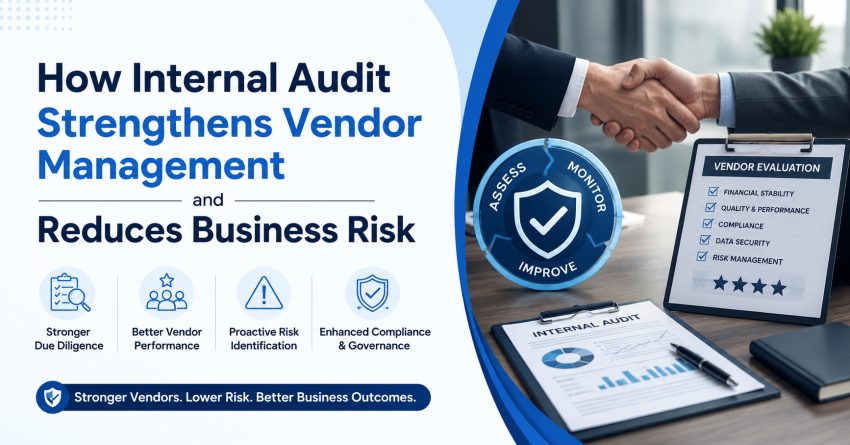
Effective vendor management is crucial for ensuring efficiency, managing expenses, and promoting business continuity. In today’s world, businesses use the services of many third-party vendors to provide them with different kinds of products and services. At the same time, poor vendor management could be detrimental for a company because it may result in compliance problems, financial losses, operational disruption, and other issues that can tarnish the company’s reputation.
This is why Internal Audit plays a significant role in improving vendor management practices within a business.
Evaluating Vendor Selection and Onboarding
The vendor management process starts by identifying suitable vendors that satisfy certain compliance criteria and the needs of the organization. The role of Internal Audit here is to make sure that vendor selection is conducted in accordance with corporate policy and procedures.
During the audit, the processes involved in vendor selection and assessment will be evaluated to ensure that they are fair and based on predetermined criteria. This way, issues such as fraud and favoritism are prevented.
Also, internal auditors are able to identify problems in the vendor onboarding process.
Strengthening Compliance and Risk Management
Companies must ensure their vendors comply with all applicable regulatory requirements for law, finance, cyber-security, and industry regulations. The role of the Internal Audit function in the area of compliance management includes the analysis of vendor contracts, system monitoring, and risk evaluation.
The vendor’s compliance with the requirements for quality service and data security is evaluated as part of the audit process, along with the effectiveness of monitoring systems employed by organizations in vendor performance management and compliance.
Appropriate vendor oversight enables companies to identify high-risk vendors and take necessary actions prior to any problems occurring. Good oversight may also help companies avoid interruptions caused by vendors’ non-compliance, security breaches, and unethical conduct.
Improving Financial Control and Cost Efficiency
The interaction with vendors generally entails large financial transactions, thus financial control becomes one of the primary concerns for organizations. Internal Auditing enables organizations to ensure the correctness of payments, prices under contracts, invoices, and expenditures on procurement.
Through an analysis of financial control systems and transaction history, an auditor is able to detect any duplications, discrepancies, or inefficiencies within procurement operations and improve cost control.
Effective auditing also supports better contract management by ensuring that negotiated terms, pricing agreements, and service-level commitments are being followed consistently.
Enhancing Vendor Performance Monitoring
Vendor performance monitoring is very important for sustaining high levels of services and efficiency. Internal Auditing can be used to assist companies to determine if their vendors are performing up to the expected standards.
This is achieved by analyzing factors such as key performance indicators, time of delivery, quality of service, and process for resolving any issues that arise. Such an analysis assists in improving vendor accountability and partnership.
Supporting Business Continuity and Strategic Growth
Vendor issues may have detrimental effects on business operations as well as customer satisfaction levels. Internal Audit assists companies to recognize potential weaknesses in their vendor relationship network and plan ahead for the creation of contingency plans that will be implemented whenever a disruption occurs.
This process could include evaluating supplier dependency threats, finding alternative suppliers, as well as disaster recovery plans. All these processes play a vital role, especially for companies operating in competitive and/or highly regulated industries.
Effective vendor management processes combined with internal auditing facilitate the strategic growth of companies by ensuring that there are effective and efficient supply chain operations.
Conclusion
Internal Audit plays a critical role in strengthening vendor management processes by improving oversight, enhancing compliance, strengthening financial controls, and ensuring effective vendor performance monitoring. Organizations that integrate strong internal audit practices into vendor management are better positioned to reduce risks, improve operational efficiency, and support long-term business growth.
Frequently Asked Questions
Q: Why is internal audit important in vendor management processes?
A: Internal audit helps organizations evaluate vendor selection, compliance, financial controls, and performance monitoring. It identifies risks, improves oversight, and ensures vendors support business objectives effectively.
Q: What is vendor management and why is it important?
A: Vendor management is the process of selecting, onboarding, monitoring, and evaluating third-party suppliers. Effective vendor management helps control costs, maintain compliance, improve service quality, and support business continuity.
Q: How does internal audit strengthen vendor risk management?
A: Internal audit reviews vendor contracts, compliance practices, cybersecurity controls, and performance metrics to identify potential risks and ensure appropriate risk mitigation measures are in place.
Q: How does internal audit improve vendor performance monitoring?
A: Internal auditors assess key performance indicators (KPIs), service quality, delivery timelines, and issue-resolution processes to ensure vendors meet contractual obligations and organizational expectations. This helps improve vendor accountability and overall operational efficiency.
Q: How does internal audit help control vendor-related costs?
A: By reviewing invoices, payment records, and contract terms, internal auditors identify duplicate payments, pricing discrepancies, and procurement inefficiencies. Addressing these issues helps businesses manage vendor costs more effectively and ensures they receive full value from their contracts.
Also Read: Role of Internal Audit in Achieving Organizational Goals