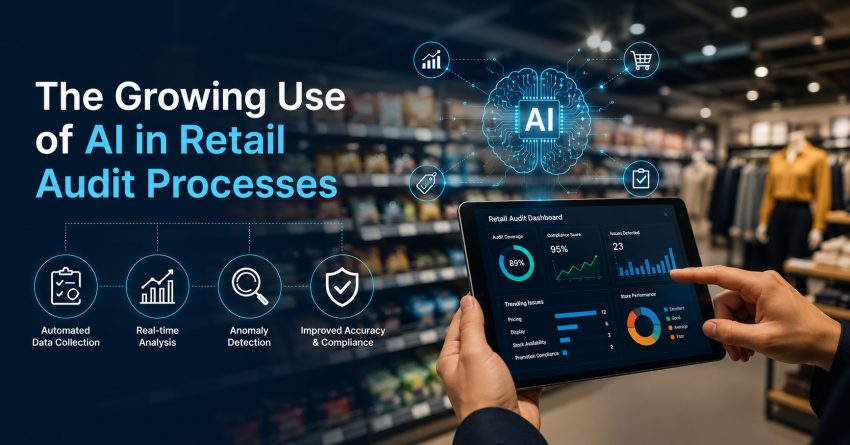
Retail businesses operate in an environment where inventory, sales, customer transactions, supplier relationships, and regulatory requirements are constantly changing. Conducting retail audits through traditional manual methods can be time-consuming and may not always provide real-time insights needed for effective decision-making.
Artificial intelligence (AI) changes how retail audits are planned, executed, and analyzed. By combining intelligent data analysis with automation, AI helps organizations improve audit accuracy, identify operational risks earlier, and make informed business decisions based on continuous monitoring rather than periodic reviews.
As retail operations become increasingly digital, AI is becoming an important component of modern audit strategies.
What Are Retail Audits?
Retail audits are systematic evaluations of retail operations to assess compliance, inventory accuracy, financial controls, operational efficiency, merchandising standards, and customer service performance.
Retail audits help organizations:
- Verify inventory records
- Review of sales transactions
- Monitor pricing accuracy
- Evaluate store compliance
- Detect operational risks
- Improve business performance
Traditionally, these audits relied heavily on manual inspections, spreadsheets, and physical verification. AI enables a more data-driven and continuous approach.
Why AI Is Becoming Important in Retail Audits
Retail businesses generate large volumes of operational data every day through point-of-sale systems, inventory management platforms, customer interactions, and digital commerce channels.
Manually reviewing this information is often resource-intensive and may overlook important patterns.
AI helps auditors process vast amounts of data quickly while identifying anomalies, trends, and potential risks that require further investigation.
This allows organizations to move from reactive audits to proactive risk management.
How AI Is Transforming Retail Audits
Automated Data Analysis
AI can process information from multiple business systems simultaneously, including:
- Sales transactions
- Inventory records
- Supplier invoices
- Purchase orders
- Customer returns
- Pricing information
Automated analysis significantly reduces manual effort while improving consistency and accuracy.
Continuous Audit Monitoring
Traditional audits are often conducted monthly, quarterly, or annually.
AI enables continuous monitoring by reviewing transactions and operational activities in real time.
This allows organizations to identify issues as they occur rather than waiting until the next scheduled audit.
Fraud Detection
Retail organizations handle thousands of financial transactions every day.
AI can identify unusual transaction patterns that may indicate:
- Duplicate payments
- Unauthorized discounts
- Refund irregularities
- Inventory manipulation
- Employee fraud
Early detection helps reduce financial losses and strengthens internal controls.
Inventory Verification
Inventory discrepancies are among the most common audit findings in retail.
AI supports inventory audits by comparing:
- Physical inventory records
- Warehouse data
- Point-of-sale transactions
- Supply chain movements
This improves inventory accuracy while reducing manual stock verification efforts.
Compliance Monitoring
Retail businesses must comply with internal policies and external regulations.
AI can automatically monitor compliance across multiple operational areas, including:
- Pricing consistency
- Promotional offers
- Documentation requirements
- Financial reporting
- Operational procedures
Automated monitoring helps organizations identify compliance gaps before they become larger issues.
Benefits of AI in Retail Audits
Improved Audit Accuracy
AI minimizes manual errors by consistently analyzing large datasets using predefined audit criteria and intelligent algorithms.
This improves the reliability of audit findings and supports better decision-making.
Faster Audit Completion
Manual audits often require significant time for data collection, reconciliation, and reporting.
AI automates many of these activities, allowing audit teams to complete reviews more efficiently.
Better Risk Identification
AI continuously evaluates operational data to identify potential risks before they affect business performance.
This proactive approach supports stronger governance and operational resilience.
Greater Operational Visibility
AI combines data from multiple business systems to provide a comprehensive view of retail operations.
Decision-makers gain better visibility into inventory, sales performance, compliance, and operational efficiency.
Data-Driven Decision Making
AI-generated insights enable management teams to prioritize corrective actions based on objective data rather than assumptions.
This leads to more informed operational improvements.
Technologies Supporting AI-Based Retail Audits
Machine Learning
Machine learning models analyze historical audit results and operational data to identify patterns, predict potential risks, and improve audit recommendations over time.
Computer Vision
Computer vision enables automated analysis of retail environments using images and video.
Applications include:
- Shelf compliance verification
- Product placement analysis
- Stock availability monitoring
- Store layout assessment
These capabilities reduce the need for extensive manual inspections.
Natural Language Processing (NLP)
NLP allows AI systems to review contracts, audit reports, supplier communications, and policy documents.
This helps auditors identify inconsistencies, missing information, and compliance issues more efficiently.
Predictive Analytics
Predictive analytics estimate future operational risks by analyzing historical trends and current business conditions.
Organizations can address potential issues before they impact operations.
Industry Applications
Store Operations
AI evaluates store performance by analyzing:
- Sales trends
- Inventory movement
- Staff productivity
- Customer service indicators
These insights support operational improvements across multiple locations.
Supply Chain Audits
AI helps review supplier performance, delivery schedules, procurement activities, and inventory flow to identify inefficiencies within the supply chain.
Financial Audits
Retail finance teams use AI to monitor transactions, identify anomalies, reconcile financial records, and improve reporting accuracy.
E-commerce Audits
Digital retail platforms generate large volumes of customer and transaction data.
AI supports audits by reviewing:
- Online sales
- Payment processing
- Return patterns
- Pricing accuracy
- Order fulfilment performance
Challenges in AI-Powered Retail Audits
Data Quality
AI systems depend on accurate and complete business data.
Poor data quality can reduce audit accuracy and produce misleading results.
Integration with Existing Systems
Many retail organizations operate multiple software platforms.
Integrating AI across these systems requires careful planning and standardized data management.
Workforce Skills
Audit professionals increasingly need skills in data analysis, AI tools, and digital technologies alongside traditional auditing knowledge.
Continuous learning supports successful AI adoption.
Responsible AI Governance
Organizations should establish governance frameworks that address:
- Data privacy
- Information security
- Transparency
- Bias reduction
- Regulatory compliance
Responsible AI strengthens confidence in audit outcomes.
Preparing for AI-Driven Retail Audits
Organizations planning to modernize retail audits should focus on several priorities:
- Improve data accuracy and consistency.
- Digitize audit documentation.
- Automate repetitive audit procedures.
- Implement continuous monitoring capabilities.
- Train audit teams in AI-enabled technologies.
- Establish governance for ethical and responsible AI use.
- Regularly evaluate AI performance and audit effectiveness.
A structured implementation strategy allows organizations to integrate AI while maintaining strong audit standards.
Conclusion
AI is reshaping the future of retail audits by enabling organizations to conduct more accurate, efficient, and continuous assessments of their operations. Through intelligent data analysis, automation, predictive insights, and real-time monitoring, AI helps strengthen internal controls, improve compliance, and reduce operational risks.
As retail businesses continue to embrace digital transformation, AI-powered audits will play an increasingly important role in supporting transparency, operational efficiency, and informed decision-making across the retail ecosystem.
FAQs
Q1. How does AI improve retail audits?
Answer: AI analyzes operational and financial data, identifies unusual patterns, automates repetitive audit tasks, and provides real-time insights that improve audit accuracy and efficiency.
Q2. Can AI replace retail auditors?
Answer: No. AI supports auditors by automating routine tasks and analyzing large datasets, while human professionals continue to apply judgment, interpret findings, and make strategic decisions.
Q3. What are the main benefits of AI in retail audits?
Answer: AI improves audit accuracy, reduces manual effort, enables continuous monitoring, strengthens fraud detection, enhances inventory verification, and supports data-driven decision-making.
Q4. Which retail functions benefit from AI-based audits?
Answer: Inventory management, finance, supply chain operations, merchandising, pricing, compliance monitoring, customer transactions, and e-commerce operations all benefit from AI-enabled audits.
Q5. What challenges should organizations consider before adopting AI for retail audits?
Answer: Organizations should focus on improving data quality, integrating AI with existing systems, developing workforce skills, and implementing responsible AI governance to ensure reliable audit outcomes.
Also Read: How Retail Audits Help Businesses Maintain Pricing Accuracy