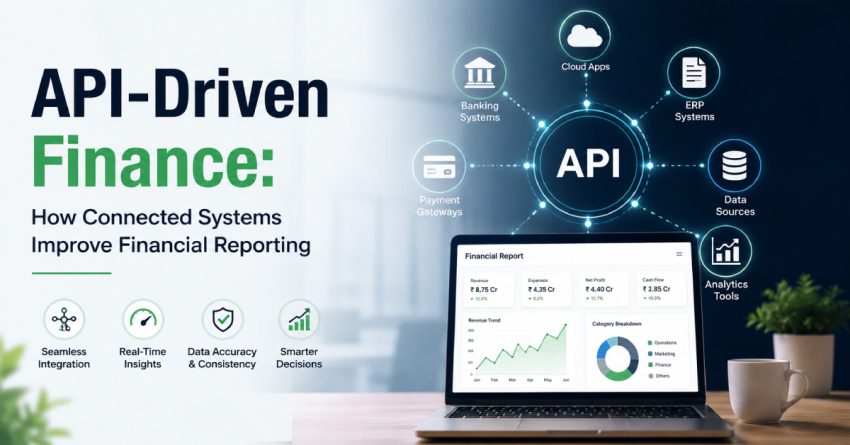
Modern finance no longer operates within a single software application. Financial information is exchanged through enterprise resource planning (ERP), customer relationship management (CRM), payroll software, banking systems, procurement systems and tax software. These systems work independently and finance teams often find it time consuming to use them to manually combine information, causing delays, inconsistencies, and reporting inaccuracies.
APIs have been transforming the way data transfer takes place in the process of creating a smooth channel of communication for business applications. The use of APIs makes the transfer of data related to finances automated, thereby making the process faster and more accurate. When combined with financial accounting advisory services, API-powered finance helps companies establish a financial ecosystem that helps them make decisions.
Key Benefits of API-Driven Financial Reporting
Automated Data Integration
A major benefit of APIs is that they can eliminate manual data entry. The financial data of accounting software, ERP systems, banking systems, invoicing software and payroll systems can be synced automatically without any manual effort.
This eliminates redundant efforts, decreases errors and enables financial experts to focus more on analyzing financial performance and less on report compilation. Those that have taken advantage of financial accounting advisory services can build API integration strategies that mesh with their business processes and data integrity.
Real-Time Financial Visibility
Business leaders need timely and up-to-date financial information to make timely decisions. Reporting at the end of the month may be holding up key business decisions.
The financial dashboard updates instantly where the system uses APIs. Income, expenditure, cash flows, and receivables, as well as payables, update in real time, providing the finance team with an instant view of how the business is performing.
Through the use of financial accounting advisory services, companies can adopt reporting systems that offer them useful insights rather than just historical information.
Ensuring Data Accuracy and Consistency
There is always the possibility of error in terms of duplication, discrepancies and reconciliation when doing data entry manually in different systems. Using APIs, all these problems disappear since APIs help move data from the source system to the reporting system.
This ensures the financial information remains consistent in all the departments and at the time of reporting stakeholders.
| Feature | Traditional Financial Reporting | API-Driven Financial Reporting |
| Data Collection | Manual data collection | Automated data synchronization |
| Reporting Cycles | Delayed reporting cycles | Real-time financial updates |
| System Integration | Multiple data silos | Connected business systems |
| Data Accuracy | Higher risk of manual errors | Improved data accuracy |
| Closing Process | Time-consuming reconciliations | Faster financial close process |
Faster Financial Close and Compliance
Monthly and annual end of period data compilation is another challenge faced by finance professionals, when creating financial reports. The process of API integration will be beneficial here, as it ensures transactions updating in multiple systems.
It is not only a faster way to perform financial reporting; but also provides better compliance through standardization of the process and auditability of the transactions made. For API-driven finance and regulatory requirements, there is an increasing need for financial accounting advisory services to ensure implementation of best practices that provide the maximum possible value.
Supporting Better Strategic Decisions
Making decisions based on facts is the benefit of good financial reporting. Interconnected financial systems allow management getting accurate information on profitability, cost of operations, liquidity and performance of their business without having to manually consolidate everything.
Real-time analytics allow organizations to be proactive, as they can detect trends in real time, monitor metrics and adjust to changes in the markets. Financial accounting advisory services can help to develop financial strategy based on those insights.
Conclusion
The use of API-based finance is going to play an important role as companies undergo digital transformation and attempt to make their finance functions faster, smarter, and more integrated. Automated integrations help to eliminate manual processes, provide precise reporting, and financial performance visibility in real time.
In the modern world, where everything is based on data, businesses have the opportunity to utilize advanced API technologies together with professional financial accounting advisory services in order to develop an efficient finance function.
FAQs
Q: What is real-time financial reporting?
Real-time financial reporting provides continuously updated financial information, allowing businesses to monitor performance without waiting for periodic reports.
Q: How do APIs improve data accuracy?
APIs transfer information directly between systems, reducing manual data entry, duplicate records, and reconciliation errors.
Q: What is ERP integration?
ERP integration connects enterprise resource planning software with other business applications to enable automatic data sharing and streamlined business processes.
Q: Is API integration secure?
Yes. Modern APIs use authentication, encryption, access controls, and secure communication protocols to protect business and financial data.
Q: What industries use API integration?
API integration is widely used in banking, finance, healthcare, retail, manufacturing, logistics, education, insurance, and e-commerce.
Also Read: Financial Accounting: Accuracy, Reliability, and Transparency