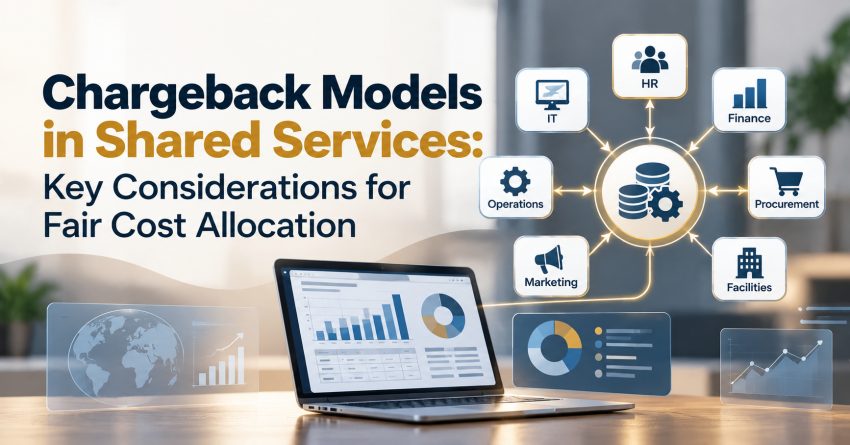
Shared services are used to help organizations streamline and consolidate their functions, like finance, human resources, procurement, information technology and administration. Centralization can facilitate efficiency, but there is a practical question as to how to allocate the cost of these services to other business units, subsidiaries or locations. An effective chargeback model can improve transparency and support consistent and equitable allocation of shared-service costs.
Cost allocation can become more complex for organizations operating global shared service centres because of differences in currencies, tax requirements, service volumes and operating models.
What is a Shared Services Chargeback Model?
A chargeback model is a method of recovering the costs of a centralized service from the departments or entities that use the service. Shared-service costs can be allocated to the relevant departments or entities using defined cost drivers.
For instance, IT expenses can be spread based on the number of users or devices, and payroll can be distributed based on the number of employees. The goal is to make a connection between service use and the price that is paid.
Allocation drivers may differ by service. Common approaches include:
- HR and administrative services may be allocated based on headcount.
- The number of transactions for finance or procurement events.
- Number of users or devices accessing an IT service.
- Actual usage of facilities or infrastructure.
- Established fixed charges for predictable periodic services.
- For more complex service portfolios, use activity-based costing.
A single model may not be effective in all functions. Allocation drivers should be selected based on their relevance to the services being allocated.
The following is a list of questions to consider when determining how to allocate resources fairly.
When drafting a chargeback system, one of the key concepts should be fairness. It must be possible for business units to comprehend the rationale for the charge, and how it is calculated.
There are a number of factors that should be taken into account:
Transparency
The methodology, allocation drivers and pricing assumptions should be documented and communicated to relevant internal stakeholders. Charges that are unexpected or unexplained may cause conflict and diminish trust in the shared-services model.
The accuracy of cost drivers
Allocation drivers should reflect service consumption wherever reasonably measurable. For a service that is mostly transaction-based, an outdated count of the number of transactions may lead to an incorrect allocation of those transactions to services.
Consistency
The treatment of similar services should generally be applied consistently for a given business unit, unless there is a documented reason for different treatment. Consistency checks can be performed periodically to detect inconsistencies due to changes in operations or data.
Administrative Effort
While it may seem more accurate to use a highly detailed model, it may need a great deal of data collection and upkeep. Organizations need to strike a balance between precision and the effort needed to work with the model.
Challenges in Global Shared Services
Shared services are complex projects, particularly when they span multiple countries. The design of internal charges may be influenced by currency fluctuations, local regulations, tax requirements and the differences in the delivery of the services.
Organizations may also need to distinguish between costs that benefit specific entities or business units and costs that benefit the organization as a whole. Where allocations have accounting, tax or regulatory implications, appropriate documentation is important.
Enhancing the Chargeback Process
Technology can help with chargeback management in various ways, including automating data collection, applying allocation rules, and creating reports. However, technology does not address weaknesses in the underlying allocation methodology.
Allocation Drivers, Service Catalogues and Pricing Assumptions should be reviewed regularly by organisations. Clear escalation procedures for business units to raise questions or challenge allocations should also be established.
A well-designed chargeback model can provide management with greater visibility of the cost of internal services and help business units understand their service-related costs. For a global shared service, transparent methodology, reliable data and regular review may help to develop an practical to implement, consistent and manageable cost allocation structure.
FAQs
Q1. What is a shared-services chargeback model?
A chargeback model allocates centralized service costs among departments or entities that use those services.
Q2. What are common chargeback drivers?
Common allocation drivers include headcount, transaction volume, user numbers, devices and actual service usage.
Q3. What makes a chargeback model fair?
A fair chargeback model uses relevant allocation drivers, reliable data and a clearly documented methodology.
Q4. Why are global chargebacks complex?
Global chargebacks involve different currencies, tax requirements, local regulations and service delivery models.
Q5. How often should chargeback models be reviewed?
Chargeback models should be reviewed periodically and whenever costs, services or business structures change.
Also Read: Why Shared Services Are Becoming Digital Innovation Hubs