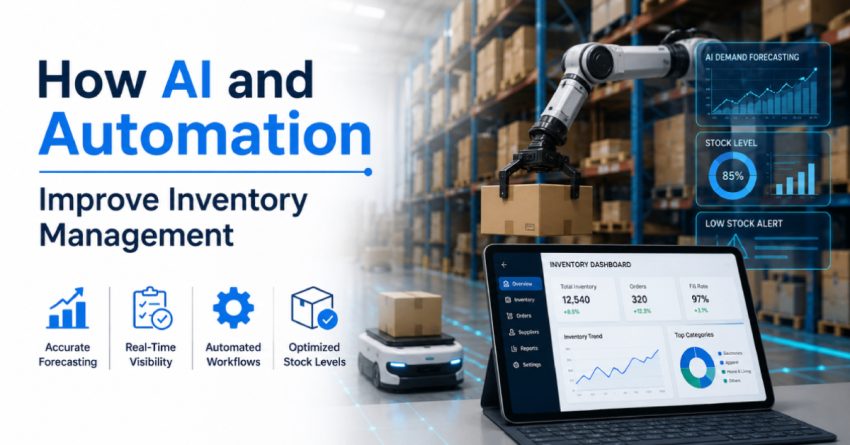
Inventory management has become increasingly complex as businesses deal with changing customer demand, expanding product portfolios, and global supply chains. Traditional inventory systems that rely on manual processes or historical estimates often struggle to maintain the right balance between stock availability and operational costs.
Artificial intelligence (AI) and automation are changing how organizations manage inventory by enabling real-time visibility, predictive decision-making, and intelligent process automation. Rather than reacting to inventory issues after they occur, businesses can now anticipate demand, optimize stock levels, and improve supply chain efficiency through data-driven insights.
What Is AI in Inventory Management?
Artificial intelligence in inventory management refers to the use of machine learning, predictive analytics, and intelligent algorithms to monitor, analyze, and optimize inventory operations.
Unlike conventional systems that depend on fixed rules, AI continuously learns from historical data, market trends, customer purchasing behavior, and operational performance to improve inventory decisions over time.
Its primary objective is to ensure the right products are available in the right quantities while minimizing excess inventory and reducing stock shortages.
What Does Automation Mean in Inventory Management?
Automation involves using technology to perform repetitive inventory-related tasks with minimal manual intervention.
Examples include:
- Automatic stock updates
- Barcode and RFID-based inventory tracking
- Purchase order generation
- Warehouse picking and sorting
- Shipment scheduling
- Inventory reconciliation
When combined with AI, automation becomes more intelligent by making recommendations and adapting to changing business conditions instead of simply following predefined rules.
Why Modern Inventory Management Requires AI and Automation
Consumer demand changes rapidly, and supply chain disruptions can occur unexpectedly. Businesses require systems that respond quickly to these changes without relying solely on manual decision-making.
AI and automation help organizations:
- Improve inventory accuracy
- Respond faster to market demand
- Reduce operational costs
- Increase warehouse efficiency
- Enhance supply chain visibility
- Support data-driven decision-making
These capabilities help organizations maintain operational continuity while improving customer satisfaction.
Key Technologies Transforming Inventory Management
Predictive Analytics
Predictive analytics uses historical sales data, seasonal trends, customer behavior, and market information to forecast future inventory requirements.
Accurate forecasting helps businesses avoid both overstocking and stock shortages while improving purchasing decisions.
Machine Learning
Machine learning models continuously improve as they process new information.
These systems identify demand patterns, detect unusual inventory movements, and recommend inventory adjustments based on changing business conditions.
Internet of Things (IoT)
IoT-enabled devices provide real-time visibility into inventory across warehouses and distribution centres.
Connected sensors monitor:
- Stock movement
- Storage conditions
- Equipment performance
- Product location
This improves inventory accuracy while reducing manual tracking efforts.
RFID and Smart Barcode Systems
Radio Frequency Identification (RFID) and advanced barcode technologies automate inventory tracking.
These technologies help businesses:
- Locate products quickly
- Reduce counting errors
- Improve warehouse efficiency
- Monitor inventory movement in real time
Robotic Process Automation (RPA)
RPA automates repetitive administrative tasks such as:
- Inventory reporting
- Order processing
- Supplier communication
- Data entry
- Invoice verification
Employees can then focus on planning, analysis, and operational improvement rather than routine administrative work.
Benefits of AI and Automation in Inventory Management
Better Demand Forecasting
AI analyzes multiple data sources simultaneously to generate more accurate demand predictions.
Improved forecasting allows businesses to purchase inventory based on actual demand patterns instead of assumptions.
Reduced Stock Shortages
Inventory shortages can lead to delayed deliveries, lost sales, and reduced customer satisfaction.
AI continuously monitors inventory levels and identifies replenishment requirements before shortages occur.
Lower Inventory Costs
Maintaining excess inventory increases storage, insurance, and handling expenses.
AI helps optimize inventory levels, reducing unnecessary carrying costs while maintaining product availability.
Improved Warehouse Efficiency
Automation accelerates warehouse operations by reducing manual tasks such as product identification, stock counting, and order processing.
This improves operational speed while reducing human error.
Real-Time Inventory Visibility
AI-enabled inventory systems provide up-to-date information across warehouses, suppliers, and distribution networks.
Decision-makers gain immediate access to inventory data, allowing faster responses to operational changes.
Better Supply Chain Planning
AI analyzes supplier performance, transportation data, and inventory trends to support more effective supply chain planning.
Organizations can identify potential disruptions early and adjust procurement or distribution strategies accordingly.
Applications Across Different Industries
Retail
Retail businesses use AI to:
- Forecast customer demand
- Optimize seasonal inventory
- Manage multiple store locations
- Reduce stock imbalances
Manufacturing
Manufacturers apply AI for:
- Raw material planning
- Production scheduling
- Spare parts management
- Inventory optimization across production facilities
Healthcare
Healthcare organizations use AI to monitor:
- Medical supplies
- Pharmaceuticals
- Surgical equipment
- Laboratory inventory
Accurate inventory management helps reduce waste while ensuring critical supplies remain available.
E-commerce
Online businesses rely on AI to:
- Predict purchasing trends
- Optimize fulfilment operations
- Manage warehouse inventory
- Improve order accuracy
Food and Beverage
Businesses handling perishable goods use AI to monitor inventory freshness, reduce waste, and improve replenishment planning.
Challenges in AI-Based Inventory Management
Data Quality
AI depends on accurate and consistent inventory data.
Incomplete records or incorrect inventory counts reduce forecasting accuracy and limit automation effectiveness.
System Integration
Many organizations operate legacy inventory systems that require modernization before AI can be fully implemented.
Careful planning helps integrate new technologies with existing operational systems.
Workforce Adaptation
Employees require training to work effectively with AI-powered inventory tools.
Organizations should focus on developing digital skills alongside technology implementation.
Cybersecurity
As inventory systems become increasingly connected, protecting operational data becomes more important.
Strong cybersecurity measures help safeguard inventory information and maintain business continuity.
Building an AI-Enabled Inventory Strategy
Organizations planning to modernize inventory management should consider the following priorities:
- Improve inventory data quality.
- Digitize inventory processes.
- Implement real-time inventory tracking.
- Adopt predictive forecasting models.
- Automate repetitive operational tasks.
- Monitor inventory performance continuously.
- Establish governance for AI-driven decision-making.
A phased implementation approach allows organizations to improve operational efficiency while minimizing disruption.
Conclusion
AI and automation are reshaping inventory management by enabling businesses to move from reactive inventory control to intelligent, data-driven operations. With improved forecasting, automated workflows, real-time visibility, and predictive decision-making, organizations can enhance operational efficiency while reducing costs and improving customer satisfaction.
As inventory operations continue to evolve, combining artificial intelligence with automation will play an increasingly important role in creating resilient, efficient, and adaptable supply chain processes.
Frequently Asked Questions
Also Read: How Inventory Management Supports FMCG Businesses