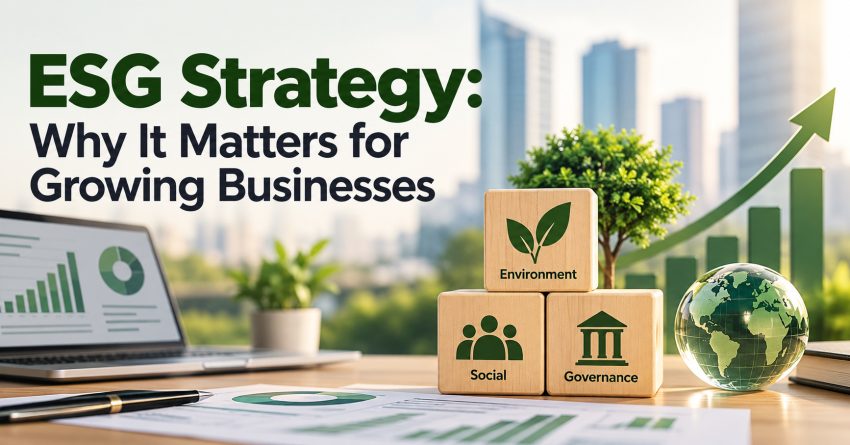
It is important to understand that growth for a business not only means revenue growth and market share expansion. Businesses also have to pay attention to the environment they work in, treatment of employees and corporate governance issues. The concept of ESG provides a framework for assessing such aspects. A proper ESG strategy consulting can help companies integrate their operations in accordance with sustainability goals and stakeholder expectations.
What Does an ESG Strategy Involve?
An ESG strategy provides a framework for identifying, managing and monitoring a company’s environmental, social and governance responsibilities. It integrates sustainability priorities into daily business operations and long-term planning.
The three key elements include:
- Environmental: Energy use, carbon emissions, waste management, water use and resource efficiency.
- Social: Employee treatment, health and safety, diversity, human rights and interaction with local community.
- Governance: Ethics, board accountability, compliance, transparency, and risk management.
These priorities will differ based on the particular company’s industry, size, operations and its risk exposure.
Why Growing Businesses Need an ESG Strategy
Firstly, the ESG strategy should allow the company to detect risks and prevent them from appearing. There are numerous issues and risks that can arise within an organization that fall under the ESG factors umbrella, including environmental risks, supply chain risks, risks related to employees and workplace, governance risks, among others. The use of the ESG strategy will help managers identify the risks and implement the necessary measures to monitor and control them.
Secondly, the ESG strategy will help the company secure financing by demonstrating to investors and lenders that the business has the necessary strategies and systems in place to meet the needs and demands of the market while addressing potential risks and concerns. The ESG strategy would be vital in providing information to investors about the company’s environmental and governance-related concerns and how they intend to address them.
Thirdly, the ESG strategy would promote the business’s core values to customers. Most consumers are now more conscious of the operations of the companies they purchase their products from. As such, it is important for businesses to ensure that they align with the values and expectations of their consumers by addressing issues such as waste management and employee safety. Addressing ESG issues would also help the firm improve its reputation among its stakeholders.
Finally, the ESG strategy would help the firm control costs by helping it identify ways in which it can eliminate weaknesses and reduce emissions and waste levels in its production processes, thus eliminating costs associated with excess emissions and waste disposal.
How ESG Strategy Consulting Supports Implementation
For creating an ESG framework, it is necessary for firms to identify issues, create targets and define responsibilities. Nevertheless, companies may have difficulties due to a lack of competence or systems for assessing performance and setting the priorities.
Strategy consulting in the area of ESG will allow organizations to tackle these tasks in a professional manner. Based on clients’ needs, consultants can provide assistance with the following activities:
- ESG assessment: Analysis of the existing policies, practices, risks and deficiencies in performance.
- Materiality assessment: Identification of environmental, social and governance issues that are most material to the business
- Goal setting: Creation of measurable goals that correspond to the business needs and applicable standards.
- Performance measurement: Selection of the right indicators for tracking performance and improvement.
- Reporting assistance: Organization of reliable ESG data for the purpose of internal assessments, investor communication and reporting.
The goal of the above process is the creation of a feasible framework, not unrealistic goals.
Integrating ESG into Business Planning
Inclusion of ESG factors in the processes of budgeting, procurement, operations planning and risk management is necessary. Management needs to establish duties, assign adequate resources and track the process. Companies need to ensure that their sustainability claims are based on credible data so as to avoid making any misleading disclosures or facing allegations of greenwashing.
A step-by-step approach will assist growing companies to start addressing the biggest risks first and then expand as their capability grows.
Conclusion
An effective ESG strategy helps growing businesses manage risks, improve resource efficiency and respond to stakeholder expectations. By setting measurable goals and monitoring performance, businesses can integrate sustainability into their operations and long-term planning. ESG strategy consulting can support companies in developing and implementing a practical framework suited to their needs.
This content is meant for information only and should not be considered as an advice or legal opinion, or otherwise. AKGVG & Associates does not intend to advertise its services through this.
FAQs
Q: What is an ESG strategy?
An ESG strategy integrates environmental, social and governance priorities into a company’s daily operations and planning.
Q: Why is ESG important for growing businesses?
Growing businesses use ESG strategies to manage risks, improve efficiency and respond to investor, lender and customers’ expectations.
Q: How does ESG help a company manage risks?
An ESG strategy helps managers identify environmental, supply chain, workplace and governance risks before they escalate.