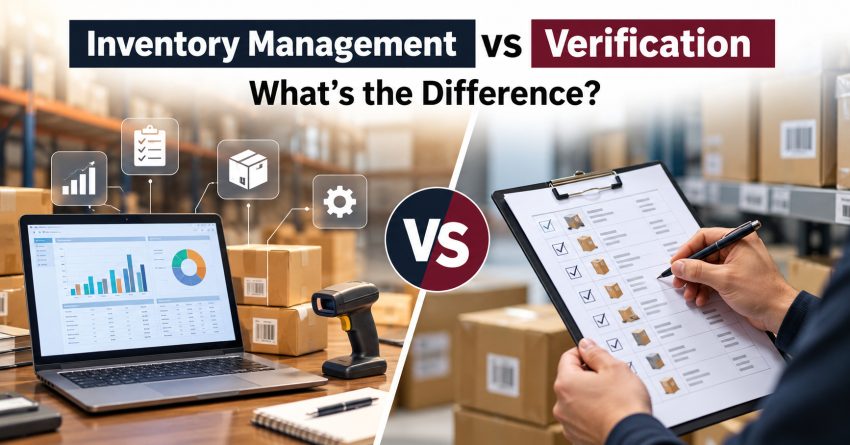
Inventory accuracy is important for businesses involved in manufacturing, retail, warehousing and distribution. Accurate inventory records help businesses control costs, prevent stock-outs and plan purchases effectively. However, inventory management and inventory verification serve different purposes. Understanding the difference helps organisations maintain reliable stock records and improve operational efficiency.
What Is Inventory Management?
The term inventory management can be defined as the process of keeping track of all the stock that is held during its entire life cycle. Inventory management involves recording and control of the goods from purchasing and storing through selling, use, and dispatch. The aim of such an activity is to ensure adequate stock holdings to meet all business needs without having too much capital invested in inventory.
The activities of inventory management include:
- Monitoring the levels of stock and their movements.
- The planning of purchase in relation to forecasting demand.
- Fixation of minimum and maximum stock levels.
- Detection of slow moving and dead stock.
- Recording of all receipts, issue, and transfer of stocks.
What Is Inventory Verification?
Inventory verification is the process of checking the physical stock held at a business location against the quantities recorded in accounting records or an inventory management system. It helps identify discrepancies caused by errors, theft, damage, misplaced items or unrecorded stock movements.
Businesses may conduct inventory verification periodically, during financial audits or whenever discrepancies arise. The process generally involves physically counting items, checking their descriptions and condition, and comparing the results with recorded quantities.
The process usually entails physical counting of items, verifying the description of the items, quantity, etc.
Inventory Management vs Verification: Key Differences
Firstly, inventory management is an operational function. It involves maintenance of adequate stock level as well as tracking of availability of materials whenever required. Inventory verification in India, on the other hand, is a verification process that helps determine whether there is consistency between the recorded stock levels and the actual stock on hand.
Secondly, inventory management depends on the stock records, purchases, sales data, and forecast for decision making. Inventory verification depends on physical observation, counting and comparing with current records to identify any inconsistencies.
Thirdly, inventory management seeks to make the operations efficient and help control costs incurred as a result of inventory management. Inventory verification seeks to improve the reliability of the stock records by helping to identify lost, damaged, misplaced or incorrectly recorded stock.
Fourthly, inventory management is done through continuous processes using software and standard operating practices. Verification of inventory may occur periodically, at the end of the financial year or whenever the need arises. Based on the nature of the business, verification of inventory may be done through cycle counting during the year.
Finally, inventory management influences decisions regarding procurement, manufacturing and distribution whereas inventory verification provides information about the condition and quantity of stock. Both activities contribute to stronger inventory control when used together.
Why Businesses Need Both Processes
Depending on software alone for inventory management will not help in finding any physical differences due to errors in accounting, theft, damage, or stock movements. Likewise, doing physical inventory check without keeping good records of your inventory will not help in identifying recurring problems or improving your stock management.
By combining both, you can keep a reliable record and take measures for any discrepancies found. Companies can create their own schedules for inventory checks depending on the value of the stock, frequency of movement, and the risk involved with each type of inventory.
Professional inventory verification services in India can also help businesses assess stock accuracy across warehouses, factories and retail locations. This way it is easy to investigate and strengthen internal control systems.
Conclusion
Inventory management and inventory verification serve different but complementary purposes. Inventory management focuses on maintaining appropriate stock levels and tracking stock movements, while inventory verification checks whether physical stock matches recorded quantities. Combining both processes helps businesses improve stock accuracy, control costs and strengthen internal controls.
FAQs
Q: Is inventory management different from physical verification?
Management is a continuous operational process, while verification is performed periodically or when discrepancies arise.
Q: Why is physical inventory verification necessary?
Verification identifies missing, damaged, misplaced or incorrectly recorded items that software records may not reveal.
Q: What activities are included in inventory verification?
The process usually includes physical counting, item identification, condition checks and comparison with system records.