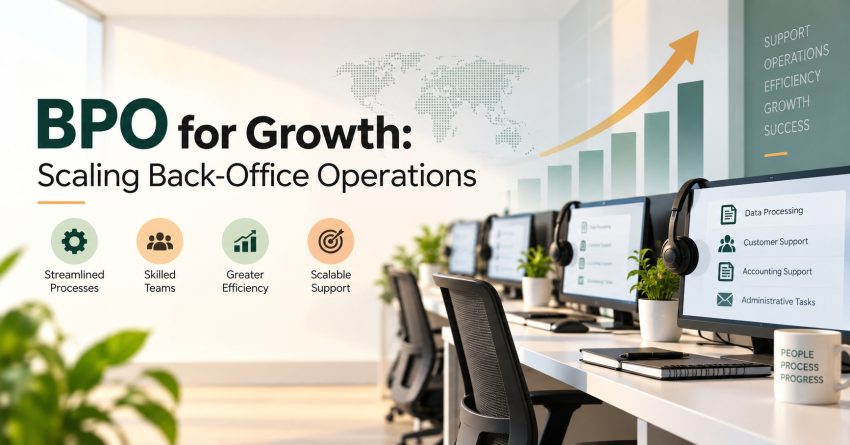
As businesses grow, back-office functions can become increasingly complex. There are a number of activities that take time, people and processes to complete, including accounting, payroll, data management, customer support, procurement, and administrative tasks. When these functions grow faster than internal capability, companies can have increased expenses, flawed processes, and strain on core teams. Business process outsourcing services can help in structuring the management of the selected back-office operations, and also focus on strategic priorities that are left for internal resources.
Evaluating which functions to outsource
Outsourcing isn’t necessarily restricted to giving up the responsibility for an entire department to an external company. Businesses can measure each process according to its complexity, frequency, resources needed, and importance.
Activities in the back office that are commonly outsourced are:
- Accounts payable and receivable
- Payroll processing
- Management and entry of data
- Invoice processing
- Customer support administration
- Procurement support
- Document management
- Routine reporting
The purpose is to seek activities that are repeatable and have a clear process and expectations for services provided.
As operations grow, managing costs becomes an issue
A larger staff of internal personnel for administrative work may lead to higher employee, technology, training and infrastructure expenses. Outsourcing can enable access to specialized teams without the business having to develop all those capabilities within its own walls.
But cost reduction is not the only factor to consider. Companies need to consider the benefits of outsourcing in terms of service quality, technology, cost of transition, data security and scalability over time.
Improving Process Consistency
In the back office, there are certain tasks that are repetitive and follow the same process. Variations in work practice can cause mistakes, delays and inaccurate data logging.
Most of the business process outsourcing services follow a set of well-defined processes, service level agreements, quality control, and reporting functions. With these processes well designed, businesses can achieve better consistency in their day-to-day business.
Supporting Business Growth
It can be difficult to scale up internal operations when transactions grow very fast. It takes time to hire and train staff, and demand for business may change.
An outsourcing model can give the company more capacity without having to expand all the internal functions at once. This applies especially to new businesses entering new markets, businesses with seasonal demand, and businesses with a high transaction rate.
Enhance technology and reporting
Outsourcing these days goes beyond just handling the work; it also entails workflow automation, digital documentation, data analytics and cloud-based systems. These technologies can help minimize the need for manual work and enhance visibility of operational performance.
Businesses should evaluate an outsourcing provider’s data management, ability to integrate with existing infrastructure, data performance reporting, and data access controls. Technology should be used to assist the reliability of the process, not take the place of one manual process with another.
It is important to keep on top of Oversight and Control
Outsourcing is NOT a way to transfer management responsibility. Businesses continue to require adequate oversight and control over processes that are outsourced, including processes that involve financial information, employee records, customer information, or any confidential information relating to the business.
Having clear contracts, defined service levels, performance indicators, escalation procedures, data-security requirements, and periodic reviews can increase accountability. Frequent performance monitoring can also help organizations to detect problems in advance of their impact on other parts of the organization.
The development of a Scalable Back-Office Model
The choice of outsourcing should be based on business needs and not just on the need to decrease the workload within the company. Businesses should define what processes can be effectively transferred, the type of controls needed, and how they will be evaluated.
Business process outsourcing services can support organizations through efficient and effective management of their routine processes, thereby freeing up capacity for future expansion, if proper governance and process design is implemented. This creates a back-office framework that can scale up and down effectively without impacting the main business teams.
FAQs
Q: What is back-office business process outsourcing?
It involves assigning selected administrative and support activities to an external team under defined service standards.
Q: Can outsourcing reduce back-office costs?
It may reduce staffing, infrastructure, training and technology costs, depending on the scope and outsourcing arrangement.
Q: What should businesses consider before outsourcing a process?
They should assess complexity, frequency, internal resources, data sensitivity, service expectations and transition costs.