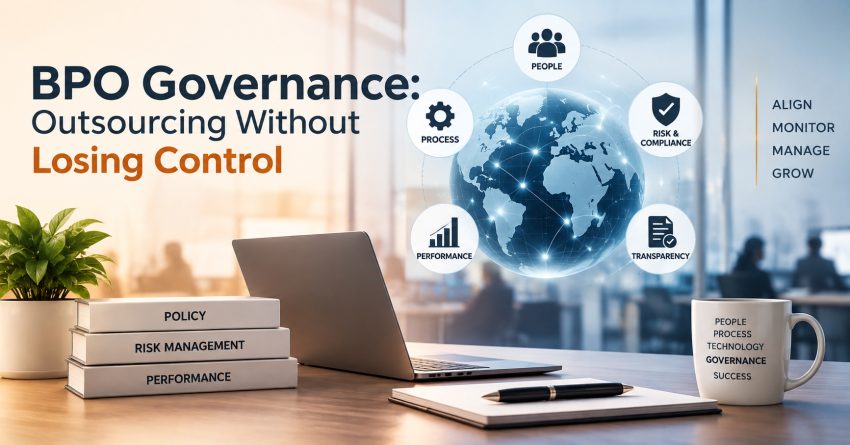
To reduce costs, gain access to specialized skills and resources, and scale operations, organizations can outsource repetitive business tasks. But the outsourcing of a process does not mean the outsourcing of the responsibility to oversee. In the absence of governance, companies can experience multiple issues, such as inconsistent service, data challenges, lack of accountability, or lack of performance visibility. Business process outsourcing services can be utilized by organizations without compromising appropriate control over the operations, in the presence of strong governance.
Assign responsibilities right from the beginning of the project.
Effective governance starts “before” the outsourcing arrangement is in place. Both sides should be aware of who is responsible, what is expected, what needs to be approved, how to escalate, and what the expected results are.
A clear operating structure will communicate who can own what activity, who needs to be responsible for making decisions, what to do if they need to seek client approval, and what to do if there is an exception. This minimizes ambiguity and generates accountability in the outsourcing relationship.
Set up Measurable Service Standards
Service-level agreements offer a practical tool to measure outsourced activities. Rather than depending on expectations, enterprises can set clear metrics around accuracy, turnaround time, response time, productivity, compliance and other metrics that apply.
Such measures must be commensurate with the type of outsourcing process. An invoice processing function may need can be measured by accuracy and turnaround figures, for instance, or customer support operations could be measured by response time, resolution rate, and quality.
Improve Data and Access Controls
Often, processes being outsourced will have financial, customer, employee or confidential business documents involved. Information access, storage, transfer and protection is thus a governance issue.
A business should have the proper access levels, authentication protocols, data management controls, and incident reporting protocols. Permission should be granted based on job requirements, and any unnecessary access should be reviewed and eliminated.
Set up periodic performance evaluations
Governance must be an ongoing process, not a contract. Periodic appraisals can help companies evaluate if the service level targets are being met and if recurring problems need to be addressed.
Service level performance, unresolved exceptions, quality trends, compliance issues and improvement initiatives can be considered for management reviews. A regular review process also provides a platform for consideration of evolving business needs.
Risks and exceptions management
There might be some occurrences of unexpected events, which could happen due to system failures, staffing problems, processing issues, or security problems in an outsourced operation. The governance structure should be responsible for deciding who will be the one that will identify, escalate, investigate, and handle these occurrences.
There are risk registers, escalation matrices, incident procedures, and contingency plans that can be made by the organizations depending on the type and level of importance of the outsourced activities. This makes the uncertainties less likely in the event of operational disruption.
Ensure Auditability and Documentation
Documentation is clearly maintained, ensuring accountability and oversight. Organizations are required to maintain documents concerning important processes, approvals, performance reports, exceptions, and corrective actions.
Furthermore, the audit rights and documentation requirements may be incorporated into contractual agreements for the business process outsourcing of sensitive or regulated processes.
Maintain a balance of outsourcing and business control
Choosing a competent service provider is not the only key to successful outsourcing. There is a need for a governance framework that fosters the alignment of business performance to managing risk, accountability, data protection and strategic goals.
Establishing responsibility, measurable criteria, monitoring performance, managing risk and keeping appropriate controls in place enables organizations to gain greater visibility of outsourced activities. Business process outsourcing services can then help with scalability while strengthening the business governance framework that the business will be relying on.
FAQs
Q: Does outsourcing transfer management responsibility?
No. The client organization remains responsible for oversight, controls, compliance and monitoring outsourced activities.
Q: Which KPIs can be used to monitor BPO performance?
Relevant KPIs may include accuracy, productivity, turnaround time, response time, resolution rate and compliance levels.
Q: What is a service-level agreement in BPO?
A service-level agreement defines measurable standards for accuracy, turnaround time, response, quality and compliance.
Also Read: Tax Outsourcing: Functions That Can Be Safely Outsourced