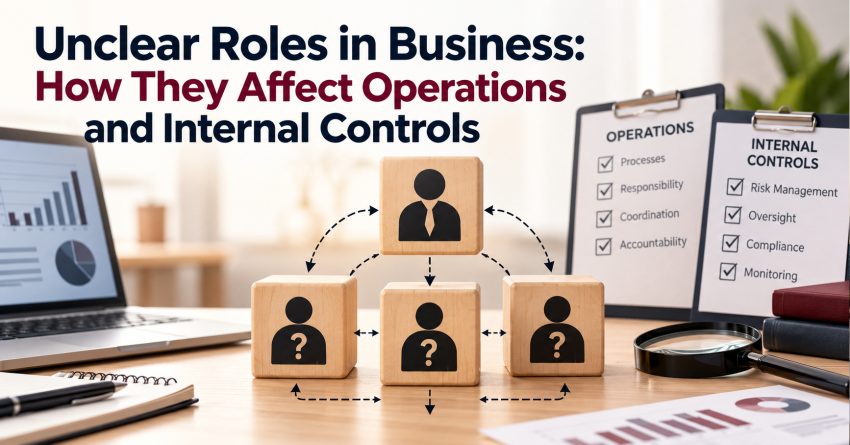
Businesses need to have clear roles and responsibilities to maintain business organisation. Even great processes can be hard to manage when employees don’t know who has responsibility for a task, who decides, or who is accountable for a result. If left unchecked, confusing roles can impact productivity, cause control gaps and add to the potential risk of operational problems over time. management consultancy can map responsibilitie businesses to review responsibilities, enhance organizational structures and strengthen internal controls.
Unclear roles and how they impact business operations
Routine tasks may be more time-consuming when responsibilities are shared or not specified. Staff can repeat tasks, wait for decisions or believe that another member of staff is working on an important task. This can cause delays in workflows between departments.
Some common operational effects include:
- Slow decision-making or approvals process
- Redundant work between employees/directors.
- Difficulty in identifying accountability for missed objectives or targets.
- Inter-team communication issues
- An increase in the reliance on particular people.
- Poor implementation of standard processes
These can be more apparent when an organisation expands. Clarity once established in a structure that is viable at a smaller size of a business may become inadequate as teams, functions and reporting lines increase.
There is a connection between roles and Internal Controls
Clear ownership is a prerequisite for effective internal controls. Staff members don’t know who the control should do, review it or approve the activity associated with it, making it hard to monitor.
For instance, in a financial transaction, there may be different roles for initiating a transaction, approving a transaction, recording a transaction and reviewing a transaction. Having a single individual responsible for these tasks or failing to specify them increases the potential for errors, fraud or unauthorised transactions in the business.
In addition, unclear roles can have a negative impact on the following control measures:
- Approval of hierarchies
- Segregation of duties
- Reconciliation and review procedures are in place.
- Exception reporting
- Compliance monitoring
- Performance accountability
Thus, assigning responsibilities is not just an organizational task. It plays an important role in the establishment of a reliable control environment.
How businesses can help improve role clarity
One of the first steps is to document the key processes and identify who is responsible at each step. A responsibility matrix can be used to clarify who performs, approves, contributes to, and is responsible for an activity, such as a RACI (Responsible, Accountable, Consulted and Informed) matrix.
The reporting lines and authority for decision-making within management teams should also be regularly reviewed. The critical processes should be identified with a clear owner and escalation for issues that need management intervention should be drawn up.
An outside perspective is helpful when there’s a conflict of responsibility among internal teams or weaknesses in control. Process reviews, organisational assessments and role-mapping exercises can be undertaken to help identify any gaps and make practical recommendations for improvement that can be achieved through management consultancy.
Incorporating accountability into operations
Clear responsibilities help employees to know what is expected of them and allow managers to assess their performance. They also enable organisations to have more robust checks and balances without additional levels of approval.
Job roles need to be changed as technology and work organisation change, as do regulations and business strategy. An ongoing review process can help avoid operational or control weaknesses.
In the end, there is a better basis for accountability that comes from role clarity. Having these responsibilities matched with processes and internal controls can help to minimize confusion, facilitate decision-making and enhance consistency across the business.
FAQs
Q1. How do unclear roles affect a business?
Unclear roles can delay decisions, duplicate work, weaken accountability and create communication gaps across teams.
Q2. Can unclear roles weaken internal controls?
Yes, unclear ownership may cause gaps in approvals, reviews, reconciliations and compliance monitoring processes.
Q3. What is a RACI matrix?
A RACI matrix defines who is responsible, accountable, consulted and informed for every important business activity.
Q4. When should business roles be reviewed?
Business roles should be reviewed during expansion, restructuring, technology changes or recurring process delays.
Q5. How can management consultancy improve role clarity?
Management consultancy can map responsibilities, remove overlaps and establish clearer reporting and approval lines.
Also Read: How Management Consulting Helps Businesses Identify Growth Opportunities