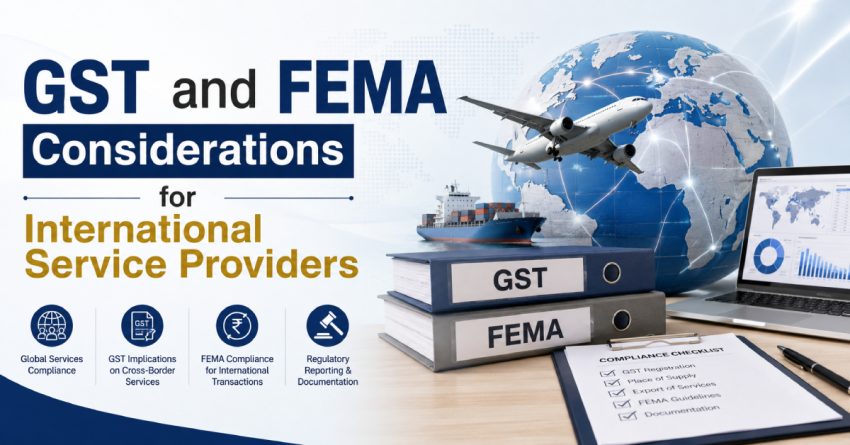
International service providers who provide their services in India and in foreign markets have to deal with several regulatory requirements along with cross-border transactions. Two key focus areas that need to be looked into are Goods and Services Tax (GST) and Foreign Exchange Management Act (FEMA). The foreign exchange regulations are dealt with by FEMA and the payment across the board is regulated by them. The GST primarily regulates the indirect tax treatment of services. Businesses who wish to achieve an effective FEMA compliance and smooth workflows when operating internationally must understand both of these frameworks.
Understanding GST Framework
If the conditions prescribed under the GST are satisfied, then the Indian business might be able to consider the transaction as an export of services to the client from outside India.
In general, companies should consider the following:
- The supplier’s and the recipient’s location
- Place of supply
- Nature of the service
- Receiving payment in currency of the people’s countries which is permitted according to the rules or as may be permitted according to the rules.
- Relationship of the parties
Generally, the services are zero rated supplies for GST purposes, provided they meet the conditions and procedures.
GST Registration and Documentation
International service providers must ensure they have up-to-date GST registrations, invoices, contracts and supporting documents. The export invoice should be appropriately endorsed and contain certain data depending on the selected tax mechanism.
In general, businesses exporting services can supply services under a Letter of Undertaking (LUT) if eligible, without paying integrated GST, subject to certain conditions. The other option available to the eligible exporters is to pay IGST and file a refund application.
It becomes necessary to keep proper documentation in place as GST authorities may demand proof of the export transaction’s nature and eligibility.
Where FEMA Comes In
GST will determine the tax treatment of an international service transaction and FEMA will determine the foreign exchange aspects of an international service transaction. This is especially important if a business receives payments from foreign customers or payments from foreign vendors.
As per FEMA compliance, businesses must secure foreign exchange transactions through authorized channels and document those transactions. The nature of the transaction must also be correctly identified for regulatory reporting purposes, as should the purpose of the transaction.
Managing Foreign Currency Receipts
Documentation of proper records of the invoice raised to overseas customers, foreign currency received, bank realization detail, and related documents should be maintained by the international service providers.
Comparing and reconciling invoices, bank statements and accounting records at an opportune time can assist in identifying discrepancies and create a clear audit trail.
Additionally, businesses need to be aware of the requirements that apply to the realization and repatriation of export proceeds, and any extensions or exceptions to this under the applicable requirements.
FEMA Compliance for Overseas Payments
Service providers can also pay foreign consultants, software vendors, contractors or any other service vendors. These transactions should be analyzed according to the provisions and rules of FEMA on current account transactions.
Businesses need to evaluate the service they will be paying for, what tax obligations may be required, what documentation is expected, where they can bank for the payment to go through and if they will need to report it.
Having a defined strategy for FEMA compliance can minimize the risk of regulatory problems related to the documentation of foreign exchange transactions.
GST and FEMA Must Be Managed Together
Another frequent issue that international service providers face is considering GST and FEMA as two separate procedures. In practice, the transaction records will frequently be required to meet the requirements of both systems.
In some cases, businesses will need to reconcile the GST invoice with the foreign currency receipt and banking records for an export transaction. The variance in invoice values, customer information, date or receipt data can cause an unwanted compliance issue.
A coordinated compliance process can therefore enhance accuracy and minimize the need for repeat reconciliations.
Building Strong Compliance Controls
International service providers should enhance their compliance regime as follows:
- Ensuring full contracts and invoices.
- Incorporating banking activity with GST records.
- Foreign currency receipts are monitored.
- Periodic verification of export documentation.
- Vigilance regarding the changes in regulations of GST and FEMA.
- Having clear records for audits and assessments.
Businesses can also benefit from professional advice to analyze cross-border processes and pinpoint the possible gaps before they turn into regulatory issues.
Conclusion
GST and FEMA are two separate but interrelated areas of compliance for international service providers. The cross-border services tax treatment is governed by the GST, and the foreign exchange aspects of receiving and making cross-border payments are governed by the FEMA.
To conclude, a proper FEMA strategy together with accurate GST accounting and reconciliation would make it possible for companies to conduct themselves effectively in cross-border transactions. With the increased incidence of cross-border services, it is crucial to maintain documentation, financial control, and knowledge of regulatory obligations in order to continue cross-border operations successfully.
Frequently Asked Questions
Q: What is the relationship between GST and FEMA?
GST governs the indirect tax treatment of cross-border services, while FEMA regulates foreign exchange transactions, including foreign currency receipts and outward remittances.
Q: What are the options for exporting services under GST?
Eligible exporters can generally export services either under an LUT without payment of IGST, subject to applicable conditions, or by paying IGST and subsequently claiming a refund.
Q: What FEMA requirements apply to foreign currency receipts?
Businesses should receive foreign currency payments through authorised channels and maintain appropriate invoices, bank records, and other supporting documentation.
Q: Why should GST invoices be reconciled with FEMA banking records?
Reconciliation helps ensure consistency between export invoices, foreign currency receipts, and banking records and can help identify discrepancies.
Q: What are BRC and FIRC?
BRC and FIRC are bank-related documents used as evidence of foreign exchange realisation for export transactions, subject to the applicable banking and regulatory requirements.
Also Read: RBI Reporting Compliance: Key Areas for Businesses to Monitor