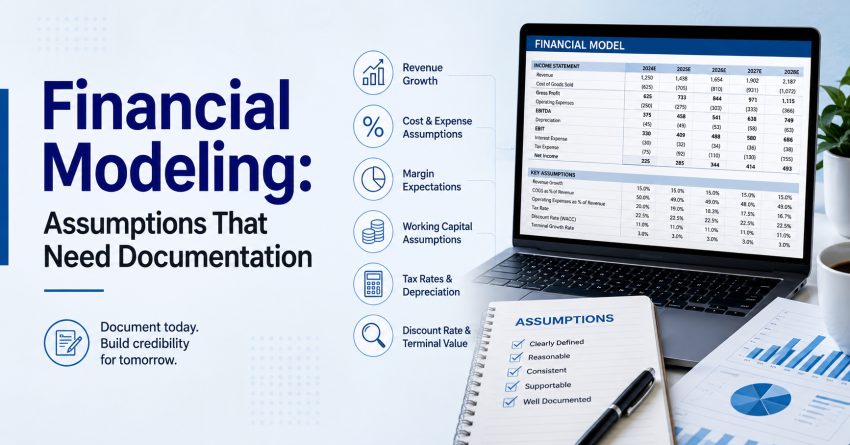
Financial models can be used to assist in budgeting, forecasting, fundraising, mergers and acquisitions, and strategic planning. But a financial model can only so much as be trusted, and the reliability of the model depends on the reliability of its assumptions. Inaccurate forecasts, inconsistent decision-making and loss of stakeholder confidence are possible when poorly documented assumptions. Businesses that want to practice sound corporate finance are advised to record financial modeling assumptions not only as a best practice, but a necessity.
What is the importance of Assumption Documentation?
All financial models are built on assumptions related to business performance, market conditions and operations. The inputs to these projections can affect the projected revenues, costs, cash flows, and profitability, so it is important that the stakeholders know how these inputs were developed.
There are several advantages to using well-documented assumptions:
- Improve model transparency.
- Facilitate easier reviews and audits.
- Support informed decision-making.
- Make further model changes easier.
- Minimize the possibility of mistakes and discrepancies.
Clear assumptions add to the trustworthiness of financial models in corporate finance, as they are used by investment, lending, and management teams.
| Assumption Category | What Should Be Documented |
| Revenue Growth | Revenue growth assumptions, pricing assumptions, customer acquisition assumptions, and demand assumptions. |
| Cost Estimates | Expenses, inflation assumption, salaries of employees, and prices of raw material or input assumptions. |
| Capital Expenditure | Planned capital expenditure, capital asset replacement assumption, project timeline assumption, and capital outlay assumption. |
| Working Capital | Assumptions in relation to the collection period, payment period, inventory turnover assumption, and cash conversion cycle assumption. |
| Financing | Assumptions relating to interest rates, financing, cost of financing, and debt servicing. |
Use Reliable Data Sources
Financial assumptions have to be founded on reliable data, not just guesswork.
These include:
- Historical performance of the company.
- Industry analysis reports.
- Market research.
- Economic forecasts.
- Regulatory news.
Data related to customer and sales
Using data sources increases the reliability of the financial model and makes corporate finance decisions more informed.
Clearly State Assumption Logic
Just typing a percentage or growth percentage into a spreadsheet is not enough. Each of the key assumptions should be justified for their choice.
For instance, where a growth rate in revenues is assumed to be 12% per year, the model must clearly indicate whether this assumption is founded on past performance, market expansion strategies, new product introductions, or other factors that contribute to the success of the company.
This will make the model more comprehensible and easier to discuss in management meetings and with investors.
Perform Sensitivity Analysis
It is very rare for business situations not to change. Variations in interest rates, variations in consumer demands, changes in inflation, and operating costs may result in significant consequences for the bottom line.
Sensitivity analysis is useful for understanding how variations in the assumptions will affect the results of the contingency plans.
It is a common method for corporate finance for strategic planning and investment appraisal.
Review and Update Assumptions Regularly
Financial models should not be “set and forgotten”! Business environments change, and assumptions need to be reviewed and adapted in response to the environment.
These are updated regularly to keep forecasts current and relevant, and to continue to aid effective decision making. It is also important for organisations to keep version control to understand how assumptions may change over time.
Conclusion
A financial model is more than a set of formulas; it is a blueprint of the future for a business, founded on solid assumptions. Keeping a record of these assumptions enhances transparency, increases the precision of forecasting and increases investor, lender and management confidence.
For companies that are particularly interested in sound corporate finance, it is a fundamental practice to keep well documented financial models. Clearly documenting assumptions, validating data sources, performing sensitivity analysis, and regularly revisiting models allow businesses to make better financial decisions, minimise uncertainty and foster long-term growth.
Frequently Asked Questions
Q: What are financial modeling assumptions, and why must they be documented?
Financial modeling assumptions are the foundational inputs—such as projected growth rates, cost structures, and market conditions—used to build financial forecasts. Documenting these assumptions is critical because it enhances model transparency, allows easier audits, supports executive decision-making, and builds trust with investors and lenders. Undocumented or poorly documented assumptions can lead to inaccurate forecasts and loss of stakeholder confidence.
Q: What are the main components of a reliable financial model?
A reliable financial model consists of well-structured formulas, validated historical data, clear logical drivers, and thoroughly documented assumptions. It bridges past performance with future operational expectations to support strategic planning, forecasting, and decision-making.
Q: What risks do organizations face when relying on poorly documented financial models?
Operating with undocumented or poorly structured models introduces significant risks, including:
- Inaccurate financial forecasts and flawed strategic planning
- Inconsistent executive decision-making
- Decreased trust and confidence from lenders, investors, and auditors
- Difficulty in troubleshooting, updating, or auditing formulas
Q: What is the difference between static inputs and dynamic variables in financial modeling?
Static inputs are fixed assumptions (e.g., a specific loan interest rate or fixed lease payment), whereas dynamic variables fluctuate based on model logic or external drivers (e.g., sales volume changing relative to marketing spend). Documenting how these variables interact ensures that anyone reviewing the model understands its underlying logic.
Q: How does debt financing impact financial model projections?
Debt financing assumptions—such as interest rates, repayment schedules, and debt servicing terms—directly affect net income and cash flow projections. Accurately modeling these obligations ensures that an organization projects adequate liquidity to meet principal and interest commitments without disrupting operations.
Also Read: Financial Modelling and Valuation Strategies for Cross-Border Investments