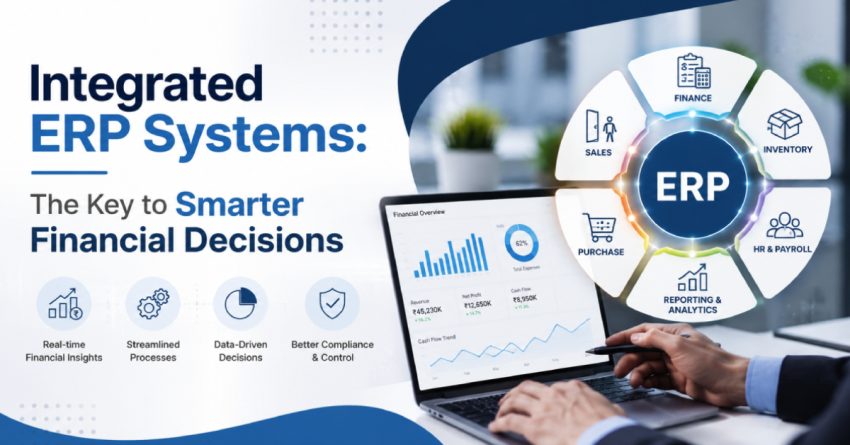
In today’s rapidly changing business environment, financial decisions need to be timely, accurate, and based on reliable information. A lack of information sharing between departments with separate systems can result in inaccurate information, duplicate data entry and slow reporting. This is where enterprise resource planning (ERP) systems can make a significant difference.
Business functions such as finance, sales, procurement, inventory, human resources and more are integrated on a single platform – this is an integrated ERP system. Having all critical information in a single place will help to streamline business operations, enhance financial management, and enable better decision-making.
Centralized Financial Data
Centralizing information on finances is one of the greatest benefits of enterprise resource planning. In contrast to gathering information from multiple spreadsheets or software programs, companies can get their updated information from a single secure system.
Centralized means that the data is more accurate and that management has a clear view of the organization’s financial situation. It also minimises the likelihood of inconsistencies that can have an impact on reporting and decision-making.
Faster and More Accurate Reporting
Manual preparation of financial reports may be time consuming and error-prone. With integrated ERP systems, data collection and report generation is automated, which simplifies the production of accurate balance sheets, profit and loss statements, cash flow reports and financial documents.
Real-time reporting is the ability to track business performance as it happens, without having to wait for the month-end or quarter-end reports. This allows faster reaction to the financial problems and opportunities that come up.
Enhanced Budgeting and Forecasting
It takes accurate historical information and up-to-date financial data to do a good job of budgeting. ERP systems give businesses a complete view of revenue, spending patterns, product buying habits, and operational expenses.
Through having reliable information, firms are able to come up with realistic budgets and foresee future situations where it will be possible for them to cut costs. Better forecasting helps in better planning and sustainable growth.
Effective Cash Flow Management
Cash flow plays an important role in determining whether the firm succeeds or fails. ERP system makes cash flow management simpler by making it easy to track payment receipts, outstanding bills, suppliers, and recurring charges. In addition, financial information provided in a timely fashion will facilitate payment planning and customer collections.
Improved Compliance and Audit preparedness
Companies are required to follow financial standards and financial controls as well as tax regulations and accounting standards. The financial transactions and detailed audit trails for all activities are automatically recorded in an integrated ERP system.
This enhances transparency, audit ease, and compliance with regulatory standards with increased confidence. Automated recordkeeping also minimizes manual errors and reduces compliance risks.
Better inter-departmental working
Many decisions regarding finances involve information from many departments. Financial planning is affected by sales forecasts, the level of stock, the cost of the products to be bought and the payment bills.
Within an enterprise resource planning system, departments are able to operate on the same data, in real time. This enhances communication, prevents duplicate work and enables management to make informed decisions using accurate business information.
Conclusion
Businesses that want to be more efficient and in control of their business are turning to integrated ERP systems as a vital resource. They simplify the process of managing data, automate the process of reporting, facilitate budgeting, cash flow management, and help with compliance, helping organizations make the right financial decisions.
Implementing the right ERP system can improve day-to-day financial management while providing insights that support informed business decisions and long-term growth. In a world where more and more businesses are embracing digital transformation, it makes sense to consider ERP as one way of improving financial performance and decision-making.
Frequently Asked Questions
What is an ERP system?
An ERP (Enterprise Resource Planning) system is software that integrates core business functions such as finance, inventory, sales, procurement, and human resources into a single platform.
How does an ERP system work?
An ERP system collects data from different business departments and stores it in a centralized database, allowing information to be shared and updated in real time.
How does ERP improve business efficiency?
ERP automates repetitive tasks, reduces manual data entry, improves communication between departments, and streamlines daily business operations.
What industries use ERP systems?
ERP systems are used in manufacturing, retail, healthcare, education, logistics, construction, finance, hospitality, and many other industries.
What are the benefits of an ERP system?
ERP systems improve productivity, enhance data accuracy, simplify reporting, strengthen collaboration, support compliance, and provide real-time business insights.
Also Read: How ERP Simplifies Multi-Location Business Management