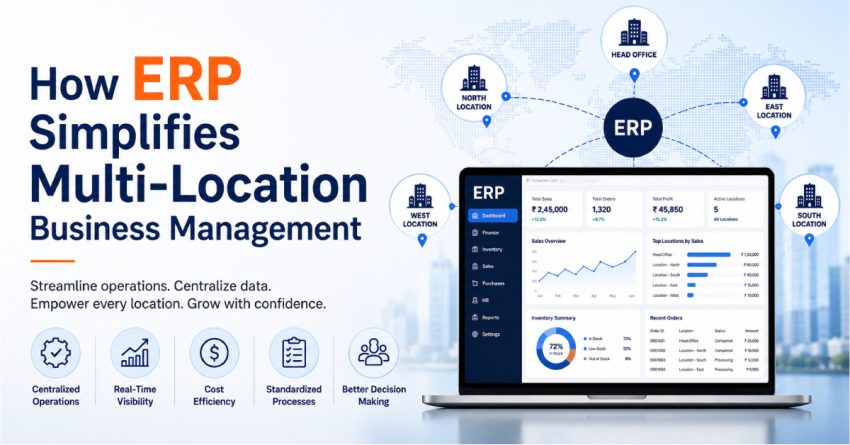
Managing a business with multiple branches, offices, warehouses, or production units can become increasingly complex as operations expand. Companies often struggle with maintaining consistency, monitoring performance, and coordinating activities across different locations. This is where Enterprise Resource Planning plays a significant role in simplifying business management and improving operational visibility.
Centralized Data Management
One of the key benefits of Enterprise Resource Planning is centralized data management, where all the necessary data from any business unit is compiled in one place. Thus, companies do not have to use several pieces of software or conduct manual data collection at each branch separately; instead, they can rely on one unified tool to get instant access to relevant information from any branch or department.
Centralized data allows the management to control the stock level, sales, employees’ productivity, and financial statements immediately, minimizing risks of double data entries and inconsistencies in data. With such timely feedback, managers will be able to react to emerging problems instantly.
Improved Coordination Between Locations
Companies operating in many business units might experience some difficulties coordinating their activities since their processes and means of communication might differ. The Enterprise Resource Planning system unifies business processes within an enterprise, which simplifies coordination between departments located in other branches.
For example, staff members from various business units will be able to conduct procurement, bookkeeping, warehouse management, and customer service following the same algorithm.
Better Inventory and Supply Chain Control
Inventory management becomes more difficult when products are stored and distributed from multiple warehouses or outlets. Enterprise Resource Planning provides businesses with real-time visibility into stock levels across all locations. This helps prevent overstocking, shortages, and unnecessary transfers between branches.
ERP also offers improved supply chain management since it improves communication between businesses and their suppliers. In addition, ERP tracks product deliveries and distribution to different locations, thus making it easy to control inventory distribution in a way that meets demands at various locations.
Enhanced Financial Management
When businesses use different software for accounting in different locations, they may run into accounting problems. Enterprise resource planning simplifies the process of managing business finances since the system offers one accounting platform through which businesses can conduct their financial activities in all locations.
In addition, it enables businesses to track all transactions in each location easily. This helps them in generating financial statements for all their locations as well as keeping track of expenses and profits from individual locations.
Scalability for Business Growth
As organizations grow in terms of market expansion or opening up more branches, their operations become more complex. Enterprise Resource Planning helps businesses scale because they will be able to include additional branches, departments, and personnel without interfering with existing operations.
The flexibility of ERP systems allows businesses to adjust according to their needs without disrupting current operations. This is beneficial for growing companies who require efficient systems for future expansion.
Conclusion
Synchronizing multiple locations of an organization requires coordination and proper control of operations. By using enterprise resource planning, organizations will find it easy to deal with challenges associated with business operations in different locations. This is due to the ability of the ERP software to address issues related to inventory, accounting, and other processes.
Frequently Asked Questions
Q: What is Enterprise Resource Planning and how does it help multi-location businesses?
A: Enterprise Resource Planning (ERP) is a unified software system that centralizes data and streamline operations across multiple branches, warehouses, or offices. It simplifies business management by providing real-time visibility into all locations from a single platform.
Q: How does ERP improve data management for businesses with multiple locations?
A: ERP compiles data from all business units into one centralized system, eliminating the need for multiple software tools or manual data collection at each branch. This reduces data duplication, inconsistencies, and gives management instant access to stock levels, sales, employee productivity, and financial statements.
Q: How does ERP improve coordination between different business locations?
A: ERP unifies business processes across all locations, ensuring that departments like procurement, accounting, warehouse management, and customer service follow the same standardized workflows — regardless of which branch they operate from.
Q: How does Enterprise Resource Planning help with inventory and supply chain management?
A: ERP provides real-time visibility at stock levels across all warehouses and outlets, helping prevent overstocking, shortages, and unnecessary inter-branch transfers. It also improves communication with suppliers and tracks product deliveries to ensure inventory is distributed efficiently across locations.
Q: What operational challenges do ERP solve for multi-location companies?
A: ERP addresses key challenges including inconsistent processes across locations, inventory management difficulties, fragmented financial data, poor inter-branch coordination, and lack of real-time operational visibility — all of which become more complex as a business grows.
Also Read: Importance of Enterprise and Risk Management in Today’s Business Environment