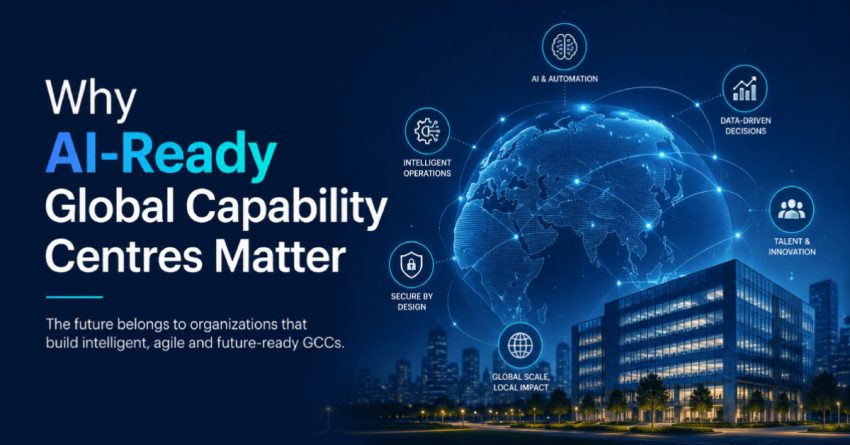
Artificial intelligence (AI) transforms how organizations manage operations, make decisions, and deliver value. As businesses expand across markets, they are increasingly looking for operational models that combine efficiency with intelligence. This shift has brought new attention to AI-ready Global Capability Centres (GCCs), which are evolving from traditional support functions into strategic centres for innovation, analytics, and digital transformation.
An AI-ready Global Capability Centre is designed to integrate artificial intelligence into business processes, technology infrastructure, and workforce capabilities. Rather than treating AI as an isolated technology initiative, these centres create an environment where automation, data, and human expertise work together to improve business performance.
What Is an AI-Ready Global Capability Centre?
A Global Capability Centre is an operational hub established by an organization to manage functions such as finance, human resources, information technology, customer support, analytics, engineering, procurement, and research.
An AI-ready GCC goes a step further by embedding artificial intelligence into everyday operations. This involves:
- Modern digital infrastructure
- High-quality and accessible data
- AI-enabled business processes
- Skilled professionals who can work with AI tools
- Strong governance for responsible AI adoption
The objective is not to replace employees but to enhance decision-making, improve productivity, and create scalable business operations.
Why AI Readiness Has Become Important
Organizations generate massive amounts of operational and customer data every day. Without AI, much of this information remains underutilized. AI helps convert data into actionable insights, allowing businesses to respond faster to changing market conditions.
AI-ready GCCs provide an environment where data, technology, and expertise come together to support:
- Faster operational decisions
- Process optimization
- Predictive business insights
- Improved customer experience
- Continuous innovation
Instead of functioning solely as execution centres, GCCs become knowledge-driven hubs that contribute to long-term business strategy.
Key Characteristics of an AI-Ready GCC
Strong Data Foundation
Artificial intelligence depends on accurate, structured, and secure data. Organizations must establish data governance frameworks that ensure consistency, quality, accessibility, and compliance.
A strong data foundation enables AI systems to produce reliable insights while reducing operational risks.
Intelligent Automation
Traditional automation follows predefined rules. AI introduces intelligent automation by enabling systems to analyze information, recognize patterns, and make recommendations based on historical data.
Examples include:
- Automated invoice processing
- Intelligent document management
- Financial reconciliations
- Customer support assistance
- Risk monitoring
These capabilities reduce repetitive work while allowing employees to focus on higher-value responsibilities.
Cloud-Based Technology Infrastructure
Modern AI solutions require scalable computing power and flexible infrastructure.
Cloud-enabled GCCs can:
- Process large datasets
- Deploy AI models efficiently
- Scale operations quickly
- Improve collaboration across global teams
Cloud platforms also support continuous updates, helping organizations adapt to evolving AI technologies.
Skilled Workforce
Technology alone cannot create an AI-ready organization.
Employees need skills in areas such as:
- Data analysis
- AI tools
- Business intelligence
- Digital collaboration
- Critical thinking
- Problem-solving
Continuous learning ensures that employees can effectively work alongside AI rather than viewing it as a replacement.
Responsible AI Governance
AI adoption must be supported by governance policies that address:
- Data privacy
- Security
- Transparency
- Bias mitigation
- Regulatory compliance
- Ethical decision-making
Responsible AI builds trust among employees, customers, and business stakeholders while reducing operational and legal risks.
Business Benefits of AI-Ready Global Capability Centres
Faster Decision-Making
AI analyzes large volumes of business data significantly faster than manual processes. Leaders receive timely insights that support quicker and more informed decisions.
This enables organizations to respond rapidly to changing customer expectations, operational issues, and market opportunities.
Improved Operational Efficiency
Routine activities consume considerable organizational resources.
AI helps automate repetitive processes such as:
- Data validation
- Report generation
- Transaction processing
- Document classification
- Workflow management
As a result, employees spend more time on analytical and strategic work.
Better Risk Management
AI continuously monitors transactions and operational activities to identify unusual patterns that may indicate errors, fraud, or compliance issues.
Early detection enables organizations to address risks before they become larger business challenges.
Enhanced Customer Experience
AI helps organizations understand customer behavior, predict service requirements, and provide faster support.
AI-ready GCCs enable businesses to deliver more consistent and personalized customer experiences while improving service quality.
Greater Innovation Capacity
By reducing manual workloads, organizations create more opportunities for innovation.
Employees can dedicate time to:
- Process improvement
- Product development
- Business analysis
- Digital transformation initiatives
Innovation becomes an ongoing capability rather than an occasional project.
Industries Benefiting from AI-Ready GCCs
Many industries are expanding AI adoption within their Global Capability Centres, including:
Financial Services
AI supports:
- Fraud detection
- Financial forecasting
- Regulatory reporting
- Credit risk analysis
- Intelligent document processing
Healthcare
Healthcare organizations use AI for:
- Clinical data analysis
- Administrative automation
- Patient scheduling
- Revenue cycle management
- Predictive analytics
Manufacturing
Manufacturers apply AI to:
- Predictive maintenance
- Supply chain optimization
- Production planning
- Inventory forecasting
- Quality control
Retail and Consumer Goods
Retail organizations leverage AI for:
- Demand forecasting
- Customer analytics
- Pricing optimization
- Inventory management
- Personalized shopping experiences
Technology and Software
Technology organizations integrate AI into software development, cybersecurity monitoring, technical support, infrastructure management, and data engineering.
Common Challenges During AI Adoption
Although AI offers significant opportunities, organizations often face several implementation challenges.
Data Quality Issues
Incomplete or inconsistent data can reduce AI accuracy.
Organizations should establish clear data management practices before implementing AI solutions.
Skills Gap
Many organizations experience shortages of professionals with AI and data expertise.
Continuous training and cross-functional collaboration help bridge this gap.
Change Management
Employees may hesitate to adopt new technologies due to uncertainty about changing roles.
Clear communication, practical training, and employee involvement improve adoption and confidence.
Integration with Existing Systems
Legacy systems may not support modern AI applications.
A phased modernization approach allows organizations to introduce AI while maintaining operational continuity.
Building an AI-Ready GCC
Organizations preparing for AI adoption should focus on several strategic priorities:
- Define clear business objectives for AI initiatives.
- Strengthen data governance and quality management.
- Invest in scalable cloud infrastructure.
- Build AI literacy across business functions.
- Implement responsible AI governance frameworks.
- Measure outcomes using performance indicators.
- Continuously refining AI models based on business feedback.
AI readiness is an ongoing capability that develops through continuous improvement rather than a one-time technology deployment.
Conclusion
AI-ready Global Capability Centres represent the next stage in the evolution of global business operations. By combining artificial intelligence, reliable data, digital infrastructure, and skilled talent, these centres enable organizations to improve efficiency, strengthen decision-making, manage risks more effectively, and support continuous innovation.
As AI continues to reshape industries, organizations that invest in AI readiness will be better positioned to adapt to changing business environments while creating more resilient, intelligent, and future-focused operations.
Frequently Asked Questions
Also Read: How Employee-Centric Workplaces Strengthen Global Shared Services Organizations