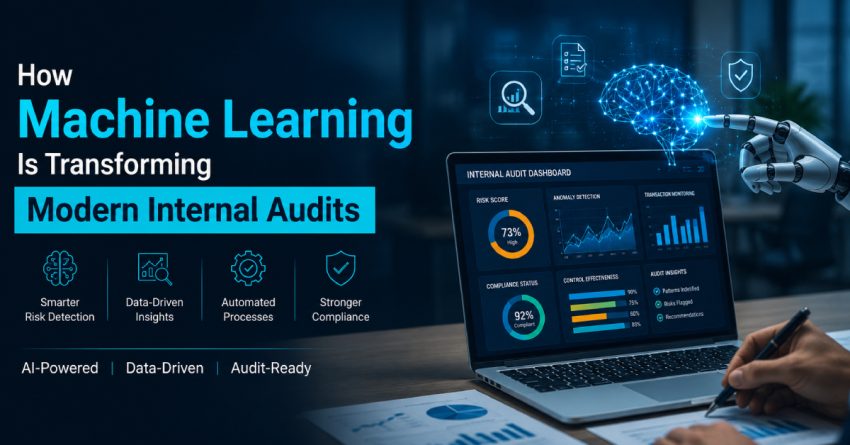
The concept of internal audit has evolved substantially over the last few years. Organizations have stopped being constrained by having to rely on manual auditing, sampling, and periodic assessments in order to discover any risks. Machine learning is becoming increasingly popular as a tool to improve the audit process by increasing its quality, speed, and accuracy due to the large volume of data companies create in regard to their financial operations. It helps analyze large volumes of data, prioritize transactions based on risk, and support better decision-making.
Machine learning does not replace professionals; however, it is something which is added to them to handle certain functions for them and allows them to do more analysis and provide recommendations. Therefore, internal audit teams become even more valuable and increase organizational efficiency.
Detecting Risks Before They Escalate
The major advantage of using machine learning in auditing is in the possibility to find abnormalities which would not be found with standard approaches to audits. Machine learning algorithms can look through millions of transactions simultaneously, unlike standard auditing which focuses on only a part of the transaction volume.
These systems monitor financial transactions, procurement history, payroll information, vendor payments, and workflow activity for any unusual activities. This allows internal audit teams investigate potential risks to avoid escalating the risks into major compliance or financial concerns.
Early detection also helps improve internal controls within an organization and limiting financial losses and disruption to their operations.
Moving Beyond Periodic Audits
Traditional auditing may yield information that is based on past information gathered at certain time intervals. Machine learning can assist continuous auditing by processing data on ongoing basis all along the year.
Benefits of Continuous Auditing:
- Be aware of and recognize exceptions as they arise.
- Increase the ability to monitor infraction of policies more effectively.
- Monitor changing business risks
- Improve compliance oversight
- Improve ability to react to new threats quickly
This proactive approach puts internal audit functions from being reactive in reporting to active risk management.
Improving Audit Accuracy
Manual reviews tend to be repetitive about the risk of human error. Machine learning algorithms use the same criteria for every transaction, which helps to minimize inconsistencies when analyzing the data.
Auditors can focus on finding and confirming payments that are suspicious, duplicate payments, or unauthorized approvals, all of which are highlighted in the application automatically.
As a result, a more objective and data-driven internal audit process can be conducted, which in turn yields a more reliable result.
Better Risk Prioritization
Not all exceptions require immediate investigation. A major strength of machine learning is that it can rank the risks based on probability and potential impact.
Instead of investigating every anomaly, audit teams receive prioritized alerts that focus on areas with the highest risk of fraud, policy violations, or operational failures.
The intelligent prioritization lets organizations allocate their audit resources more effectively and ensures that any major issues are acted upon in real time.
Accelerated Data Analysis on Multiple Systems
Today’s companies run on top of ERP, CRM, HR, procurement, and cloud-based business applications. Data from these various systems needs to be manually reviewed, which is time consuming and resource intensive.
Machine learning can integrate data from several business applications and determine relationships between business departments much faster than classic methods.
This provides internal audit teams with a holistic view of organizational risk while significantly reducing the time required for data collection and analysis.
Supporting Stronger Fraud Detection
Fraud schemes keep getting more creative, and it becomes increasingly difficult to detect them with time.
Machine learning can identify unusual transaction patterns, hidden relationships, and anomalies that may indicate fraudulent activity. With the availability of more new data, the algorithm continues to grow and improves its detection capabilities.
The adaptive approach is key to strengthening fraud prevention efforts and increases the efficiency of auditing high-risk activities.
Enhancing Decision-Making with Predictive Insights
Besides detecting problems, machine learning can also predict potential risks by analyzing historical patterns and current business conditions.
Using predictive analytics, auditors can:
- Stay on course in relation to control failures
- Identify which departments require increased monitoring
- Predict compliance risks
- Detect operational bottlenecks
- Suggest preventive measures before issues occur
These insights enable the internal audit function to add more strategic value to management through sound decision making.
Empowering Auditors Instead of Replacing Them
Despite all the advances and integration of technology in internal auditing activities, successful audits are still based on professional judgment. While machine learning has been great at handling data, finding the trends and anomalies, there still needs to be human intervention when it comes to interpreting results, understanding the nuances of the business, and suggesting corrective measures.
The best organizations use cutting-edge technology and expert staff to build data-driven, strategic audit processes.
Conclusion
Machine learning is revolutionizing risk management, compliance, and assurance for enterprises. It helps internal audit teams provide more business value and accuracy than ever before because it enables them to monitor, analyze, prioritize intelligently and predict risks, continuously.
The use of machine learning in the audit function is poised to become more significant as organizations accelerate their digital transformation journey and seek to enhance governance, operational resilience and make informed business decisions with greater confidence. Companies that invest in these technologies will be better prepared to handle tomorrow’s risks and have increased control over their operations.
Frequently Asked Question
Q: How does machine learning improve internal audits?
Machine learning analyzes large volumes of data, detects unusual patterns, prioritizes risks, and supports continuous monitoring, making internal audits faster and more effective.
Q: What is continuous auditing?
Continuous auditing is an approach where audit activities are performed continuously using automated technologies to monitor transactions and identify risks in real time.
Q: What are the benefits of machine learning in internal audits?
AI improves audit efficiency, analyzes large datasets quickly, detects anomalies, automates repetitive tasks, and provides valuable insights for decision-making.
Q: What is data analytics in auditing?
Data analytics in auditing involves examining financial and operational data to identify trends, risks, irregularities, and opportunities for process improvement.
Q: What industries use machine learning in auditing?
Machine learning is widely used in banking, finance, insurance, healthcare, manufacturing, retail, telecommunications, and government organizations.
Also Read: Data-Driven Internal Audits: Why Analytics Is Becoming Essential