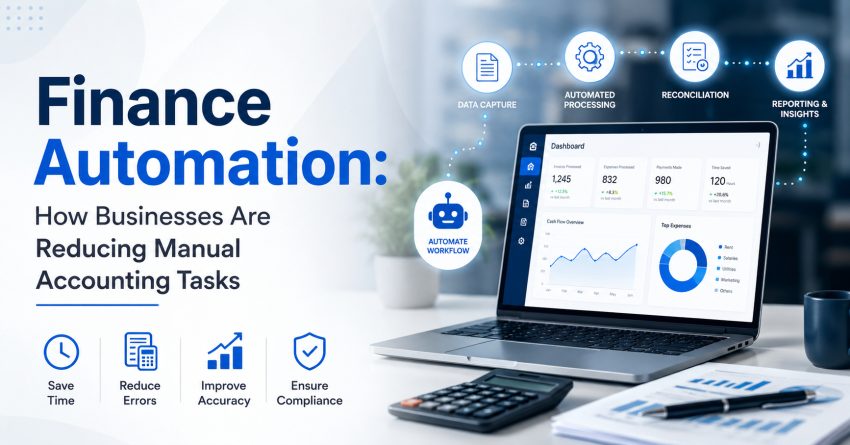
Digitization of accounting has become a popular trend in businesses as it simplifies the accounting procedures and cuts down time required for monotonous tasks. The introduction of automation has helped organizations operate in an efficient manner and get timely financial data without making any mistakes. These technologies do not render finance employees redundant, but rather help them focus on analysis, decision-making and planning. In this dynamic environment of technology, businesses are now undergoing digitization and realize that finance automation is an important element in building accurate, efficient and future-ready digital accounting systems. As businesses continue their digital transformation journey, finance automation is becoming an important part of building accurate, efficient, and future-ready accounting systems.
What is Digital Accounting?
The accounting records of businesses are managed digitally using the software and automation tools used for accounting. Unlike the conventional system of manual entry of data and the use of spreadsheets, the integrated systems handle transactions, create reports and give instant insights into the finances of the businesses.
Not only does this approach make the organization more efficient but also helps them understand their financial status. They will always have reliable financial data whenever they require it and thus be better able to cope with changing market trends.
Why businesses are moving towards automation
Manual accounting methods can be time consuming and prone to human mistakes. The larger the amount of transactions (particularly in businesses) is growing, the harder it is to manage them by hand.
For tackling these challenges, finance automation can be effective since it is a capable tool to streamline tedious tasks. By and large, some of the tasks that benefit the most from finance automation are invoice processing, bank reconciliation, expense management, and report generation. As a result, the financial team of an organization can finish tasks faster, all while maintaining consistency and accuracy.
Some of the areas where automation can make a positive impact on efficiency and streamlining are:
Handling invoices receipts, and expenses
Automation automatically extracts and records invoice information, approves expenses and routes them digitally. This helps to minimize paperwork, quickens processing and avoids manual data entry related errors.
Bank Reconciliation
An automated system can instantly compare bank statements, and flag any discrepancies for review, rather than having to do it manually. This helps to greatly shorten month end closing time.
Financial Reporting
Today’s digital accounting software creates reports based on current financial information. Current reports are available to Management whenever required, which helps facilitate quicker and well-informed decisions.
Benefits of Digital Accounting
Businesses can gain a number of benefits from digital accounting.
- Eliminates repetitive and manual data entry.
- Develop accuracy of financial records.
- Instant access to financial reports.
- Facilitates compliance with regulations.
- Allow finance staff to take up strategic functions.
These enhancements not only boost productivity but also promote better financial management.
Changing role of Accountants
Automation is transforming the job of an accountant and not replacing them. With the growing automation of routine tasks, accountants have more opportunities to add value in areas such as financial planning, risk assessment, business advisory and regulatory compliance.
The use of judgment is still critical in the interpretation of financial information, application of accounting standards and support of strategic business decisions. Despite technology’s integration, good financial management continues to be a human effort and not automation.
Conclusion
Finance automation has brought about revolutionary changes in the field of accounting because of its ability to speed up the process of accounting, which is fast, accurate, and efficient. Through digital accounting, the business organization can cut down manual processes and achieve instant financial information. However, the expertise of the accountant is required in order to comply, advise strategically, and understand complex financial information. By combining finance automation with professional expertise, businesses can improve operational efficiency while maintaining accuracy, compliance, and informed financial decision-making.
FAQs
What is finance automation?
Finance automation is the use of digital technologies and accounting software to automate repetitive financial tasks such as invoice processing, bank reconciliation, expense management, and financial reporting. It helps businesses improve efficiency, accuracy, and access to real-time financial information.
Is finance automation suitable for small and medium-sized businesses?
Yes. Finance automation can benefit businesses of all sizes by reducing administrative workload, improving financial accuracy, streamlining daily accounting operations, and supporting business growth without significantly increasing manual effort.
What are the main benefits of finance automation for businesses?
Finance automation improves operational efficiency, reduces manual errors, provides faster financial reporting, supports regulatory compliance, and enables finance professionals to spend more time on planning, forecasting, and business advisory activities.
How does finance automation work?
Finance automation works by using accounting software, artificial intelligence, and predefined workflows to process financial transactions, generate reports, reconcile accounts, and monitor financial activities automatically.
How does finance automation support compliance?
Finance automation helps maintain accurate records, standardize financial processes, and support timely reporting, while professional oversight remains essential for regulatory compliance.
Also Read: Streamlining Finance With Automation Tools