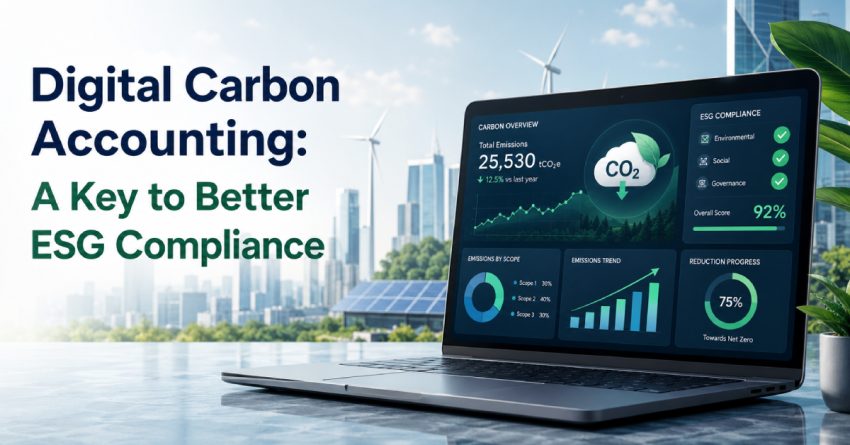
As a result of increasing business concerns regarding reduction of their impact on the environment, carbon accounting has become an integral part of ESG requirements. In this regard, it is necessary for companies to calculate, track and report GHG emissions as well as comply with the existing sustainability regulations. Thanks to technological advancements, digital carbon accounting streamlines the process of collecting, analyzing, and reporting emissions data.
Understanding Digital Carbon Accounting
Digital carbon accounting involves tracking the carbon footprint of an organization’s operations using cloud-based platforms, automation and data analytics. Businesses can record the emissions data from various sources without relying on the spreadsheet or manual calculation.
The digital method of reporting enhances the accuracy of the report and gives useful information that supports decision-making. It also supports organizations to consistently track Scope 1, 2 or 3 Emissions throughout their operations, supply chains and business activities.
Benefits of Digital Carbon Accounting
Improved Data Accuracy
The manual carbon accounting process can be multi-source, resulting in carbon reporting inaccuracies. Validation and consolidation of information is automated in digital systems for more reliable emissions reporting.
Automated Data Verification
Automated verification ensures the detection of discrepancies, duplicates, and gaps in data prior to generating the reports.
Real-Time Emissions Monitoring
The real-time tracking of emissions on digital platforms provides organizations with insights into trends and fast reaction in case of sudden increase of carbon emissions.
Faster Decision Making
Real-time information helps management teams to take fast actions in case of problems.
Simplified Regulatory Compliance
Organizations are increasingly facing a growing number of reporting requirements around ESG, and need efficient systems that meet recognized reporting frameworks. Digital carbon accounting enables accurate and timely carbon disclosure, while making management of Scope 1 2 3 Emissions easier across the organisation.
Benefits of ESG Reporting
Better Transparency
Reliable emissions reporting increases confidence in the sustainability reporting, as it is accurate and standardized. More and more investors, regulators and customers are asking organizations to prove their measurable environmental performance.
Increased Stakeholder Trust
Clear reporting enhances the integrity of the company and fosters sustainable partnerships with investors, customers, and regulators.
Stronger Strategic Planning
By offering data that’s easy to access and use, digital carbon accounting enables organizations to pinpoint emission hotspots, prioritize their sustainability efforts, and distribute resources efficiently. Tracking Scope 1 2 3 Emissions provides complete visibility to help companies set realistic reduction targets and track progress over time.
Challenges in Implementing Digital Carbon Accounting
Data Integration across Operations
Emissions data are commonly gathered by organizations from various systems, suppliers and operational units. A thorough consideration of planning and data governance is needed to achieve integration of all these data sources into a single reporting platform.
Developing reliable reporting processes
Ongoing emission data verification, regular audits and standardized methodologies aim to guarantee accurate, complete and reporting standard emissions data.
Developing Internal Expertise
Finance, sustainability and operational teams need to be familiar with carbon accounting rules and digital carbon reporting solutions to ensure it is done effectively. The development of these skills can enhance the organization’s capacity for Scope 1 2 3 Emissions Management effectiveness.
The future of digital carbon accounting
Carbon accounting is becoming more intelligent and proactive with the emergence of new technologies like AI, machine learning, and predictive analytics. These technologies are becoming more popular, and will be utilized by organizations to predict emissions, assess reduction options, and to automate compliance reporting.
Digital carbon accounting will become a key business capability as expectations for sustainability will keep rising. Organizations that successfully address Scope 1 2 3 Emissions with digital solutions will be able to better comply with regulatory standards, optimize business processes and achieve long-term ESG goals.
Conclusion
Digital carbon accounting is a revolution in the way organizations measure and report environmental performance. Businesses can take advantage of intelligent digital solutions so the accuracy can be enhanced. Add to that, compliance, informed sustainability decisions are also made swiftly, thereby replacing manual processes. As the ongoing development of ESG reporting will continue to gain even more traction, digital carbon accounting for Scope 1 2 3 Emissions will have a bigger and vital role in creating transparency, lowering environmental footprint, and driving sustainable business growth.
Frequently Asked Questions
What is digital carbon accounting?
Digital carbon accounting is the process of using digital tools to measure, track, and report an organization’s greenhouse gas (GHG) emissions accurately and efficiently.
Why is digital carbon accounting important?
It helps businesses monitor their carbon emissions, improve reporting accuracy, meet ESG requirements, and support sustainability goals.
What are the benefits of digital carbon accounting?
It improves data accuracy, simplifies reporting, enhances transparency, supports compliance, and enables better sustainability planning.
What is the difference between carbon accounting and carbon reporting?
Carbon accounting focuses on measuring and calculating greenhouse gas emissions, while carbon reporting involves presenting that information to stakeholders through reports.
How does carbon accounting support sustainability goals?
Carbon accounting helps organizations measure environmental performance, track progress, and develop strategies to reduce emissions over time.