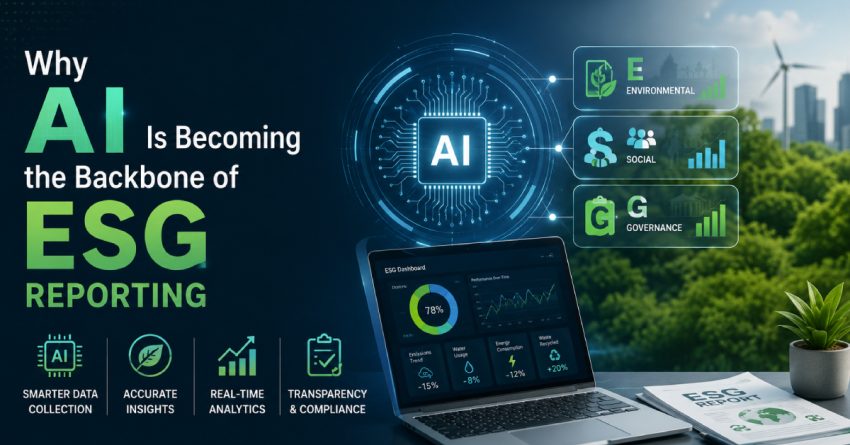
Environmental, Social, and Governance (ESG) reporting has become one of the business strategies of the day. Businesses are increasingly being asked to provide transparent, precise and measurable sustainability reporting for investors, regulators and consumers. Nonetheless, it is difficult to gather, organize and analyze large amounts of ESG data. The emergence of Artificial Intelligence (AI) technology has revolutionized the process by automating the collection of data and thus improving the accuracy and timeliness of reporting. With the continuous evolution of the requirements of reporting, ESG and sustainability reporting are now becoming increasingly data-driven and utilizing the power of AI technology.
The Growing Importance of AI in ESG Reporting
Data for ESG reporting can be collected from different departments within the organization, different suppliers and even from different platforms. Manual collection of data is prone to errors and is time-consuming as well.
AI makes the process easier by collecting data from different sources, authenticating the data and identifying any reporting gaps. This will help organizations improve their ESG reporting process.
How AI Is Revolutionizing ESG Reporting
Automated Data Collection
ESG data can be automatically collected from financial and operational databases, Internet of Things (IoT) and from supply chain management platforms using AI.
Reducing Manual Effort
Automating tasks will help the sustainability team focus on analyzing and making decisions using the data instead of compiling the data.
Advanced Data Analytics
Using AI for analytics helps organizations understand the trends, measure their performance, and areas that require improvement on environment, society, and governance parameters.
Predictive Insights
Instead of analyzing past performance, organizations will be able to look into their future risks and opportunities based on ESG.
Improved Reporting Accuracy
AI constantly checks the data it receives, identifies anomalies, and alerts inconsistencies prior to report closing.
Better Regulatory Compliance
Automated validation ensures organizations are ready to disclose accurate information, which is increasingly required to comply with current ESG reporting mandates and frameworks.
AI-Powered ESG Reporting Offers Several Advantages
| Area | Traditional Reporting | AI-Driven Reporting |
| Data Collection | Manual and fragmented | Automated and integrated |
| Reporting Speed | Periodic reporting | Near real-time reporting |
| Accuracy | Higher risk of errors | Automated validation |
| Strategies to mitigate risk | Reactive | Predictive analytics |
| Data-based strategic insights | Historical insights | Decision Making |
| Risk Identification | Reactive | Predictive analytics |
| Decision Making | Historical insights | Data-driven strategic insights |
AI enhances the transparency and reporting process and creates accurate ESG data which helps companies make informed decisions. Reporting requirements continue to rise and the use of intelligent technologies is becoming more critical to ensure consistency and credibility for Sustainability and ESG programs.
The obstacles to AI adoption for ESG reporting
Ensuring High-Quality Data
Accurate and complete information is the foundation of AI systems. In order to see the best results getting yielded by AI-driven reporting, organizations need to have comprehensive and strong data governance practices in effect.
Designing Resilient Data Infrastructure
A resilient data infrastructure consistently improves in terms of reporting methods, internal controls, and frequent validation processes for ESG data, thereby ensuring consistency.
Balancing Technology with Human Oversight
By and large, AI can handle much of the work in reporting; yet human input is essential for analyzing results, assessing risks, and making strategic decisions. Technology and experienced professionals are the crucial elements in boosting Sustainability and ESG governance.
The Future of AI in ESG Reporting
With the continuous evolution of AI capabilities, the reporting on ESG will become increasingly predictive, automated and transparent. Machine learning, natural language processing and intelligent dashboards will enable organizations to track sustainability performance in real time, instead of through periodic assessments.
AI-powered reporting will help businesses adapt to regulatory shifts, meet stakeholder demands, and fortify long-term business resilience. It is therefore expected that Sustainability and ESG reporting will no longer be a compliance matter but will become a powerful instrument for innovation, efficiency and sustainable development.
Conclusion
The application of AI technology is transforming ESG reporting, with its advantages of enhanced data quality, efficiency in repetitive tasks, and improved decision-making. With the help of AI, companies can achieve transparency, avoid compliance issues, and have better understanding of their sustainable performances. With the changes in reporting trends, the application of AI-based Sustainability and ESG practices will enable companies to maintain stakeholder engagement and increase accountability.
Frequently Asked Questions
What is AI in ESG reporting?
AI in ESG reporting refers to the use of artificial intelligence to automate data collection, validate information, analyze sustainability performance, and generate accurate ESG reports for businesses.
Can small and medium-sized businesses use AI for ESG reporting?
Yes. Many AI-powered ESG reporting tools are scalable and can help SMEs automate data collection, improve reporting accuracy, and meet sustainability requirements without large teams.
Can AI detect missing or incomplete ESG data?
Yes. AI can identify data gaps, missing values, and inconsistencies before reports are finalized, helping improve reporting quality.
What is the biggest advantage of AI over manual ESG reporting?
The biggest advantage is the ability to process large volumes of data quickly while improving accuracy, consistency, and reporting efficiency.
What is the difference between ESG reporting and sustainability reporting?
Sustainability reporting focuses on an organization’s overall environmental and social impact, while ESG reporting specifically measures Environmental, Social, and Governance performance for investors and stakeholders.
Also Read: How ESG Factors Influence Valuation in Private Equity & Venture Capital