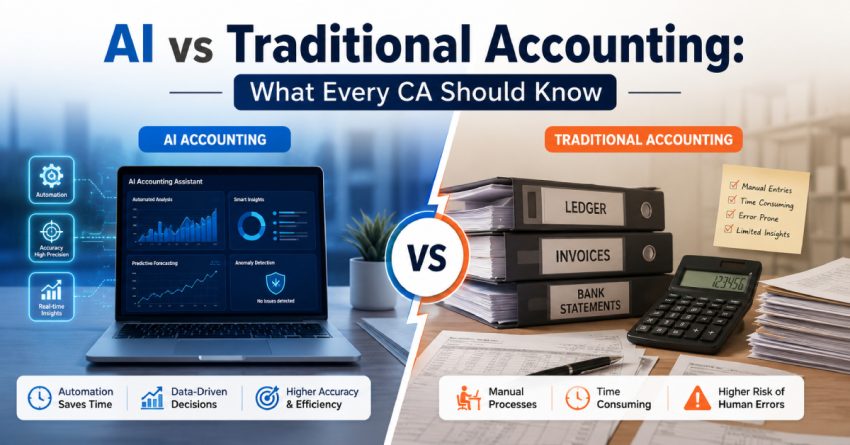
The accounting profession is evolving as businesses increasingly adopt digital technologies to improve efficiency and decision-making. Artificial intelligence (AI) is transforming accounting by automating repetitive tasks, improving data accuracy, and providing timely financial insights. However, traditional accounting continues to play a vital role through professional judgment, ethical decision-making, regulatory compliance, and strategic advisory. Understanding how AI and traditional accounting complement each other is essential for Chartered Accountants (CAs) navigating today’s digital business environment.
Understanding Traditional Accounting
Traditional accounting is a process whereby recording, organizing and reporting of financial information is done on the basis of accounting principles. Chartered Accountants handle the bookkeeping, financial statements, tax compliance, audits and much more, all using their professional judgment for each engagement.
The following are some of the major aspects of conventional accounting:
- An examination of financial records by hand.
- In compliance with accounting standards
- Financial reporting and reconciliations
- Tax planning and statutory filing
- Human interpretation of financial information
Although many processes are being made easier by accounting software, there is still a lot that relies on the experienced professionals for making decisions.
So, what is AI Accounting?
AI accounting utilizes AI technology which acts in a steadfast manner to automate mundane accounting processes and conduct accurate analysis of financial data. AI can handle extensive data volumes in minutes, rather than hours as is the case with man-driven processing.
Common applications include:
- Invoice processing
- Transaction categorization
- Account reconciliation
- Fraud detection
- Financial reporting
- Cash flow forecasting
AI is not meant to replace accountants but to enable them to give more value-added advice.
AI vs Traditional Accounting
| Parameter | Traditional Accounting | AI-Powered Accounting |
| Efficiency & Speed | Daily accounting tasks are largely manual, making them time-consuming and often cumbersome. | Automates repetitive tasks, significantly reducing processing time and improving overall productivity. |
| Accuracy | Manual data entry and processing increase the likelihood of human errors. | Minimizes errors through automation and programmed rules, though expert review is still essential for validation and oversight. |
| Data Analysis | Primarily presents historical financial data through reports and statements. | Analyzes trends, patterns, and financial data to generate insights that support faster and more informed business decisions. |
| Regulatory Compliance | Compliance depends on accountants staying updated with changing tax laws and accounting standards. | Can assist by automating compliance-related tasks and flagging potential issues, but Chartered Accountants are essential for interpreting regulations, ensuring compliance, and handling complex legal requirements. |
Advisory Services
Accountants provide businesses with strategic advice such as:
- Tax planning
- Risk management
- Financial planning
- Business restructuring
- Investment decisions
These services require communication, experience, and critical thinking, which are beyond the capability of an AI.
Ethical Responsibility
The core responsibilities of Chartered Accountants remain unchanged: professional ethics, confidentiality and independent judgment. These are areas where man cannot be dispensed with.
Benefits of AI Accounting
AI accounting has numerous benefits for accountants:
- Automates repetitive tasks and saves time.
- Increases the precision of transaction processing.
- Offers current financial information.
- Detects unusual financial activities more quickly.
- Provides accountants with time to focus on advisory and client relationships.
The advantages provide companies with greater value for clients while aiding to boost operational efficiency.
Challenges in the Adoption of AI
While AI offers great opportunities, there are also some challenges.
There are several common concerns, such as:
- Cost of implementation.
- Employee training.
- Data security and privacy.
- Seamless connection with existing accounting systems.
- Continuous supervision of products created by AI.
To be successful, adoption needs to be planned and monitored on an ongoing basis by qualified staff.
Planning for the Future
The future of accounting is all about the integration of technology and professional skills. Chartered Accountants who are equipped with the skills and knowledge of digital technology, as well as accounting, will be better placed to meet changing client expectations.
Skilled people should concentrate on:
- Learning accounting software with AI capabilities.
- Building their analytical skills.
- Staying current with changes to regulations.
- Expanding advisory capabilities.
As technology continues to change the role of what an Accountant does, these skills will help make them useful.
Conclusion
AI and traditional accounting are not competing approaches but complementary components of modern financial management. While AI helps automate routine processes, improve efficiency, and support data-driven decision-making, Chartered Accountants continue to provide professional judgment, ethical oversight, regulatory interpretation, and strategic guidance. As digital technologies continue to evolve, combining AI with strong accounting expertise will help businesses build more accurate, compliant, and future-ready financial processes
Frequently Asked Questions
What is the difference between AI accounting and traditional accounting?
Traditional accounting relies on Chartered Accountants to record, review, and interpret financial data using professional expertise. AI accounting uses artificial intelligence to automate repetitive tasks, analyze large datasets, and generate financial insights. Together, they improve efficiency while maintaining professional oversight.
What accounting tasks can AI automate?
AI can automate several repetitive accounting tasks, including invoice processing, transaction categorization, bank reconciliations, expense management, fraud detection, financial reporting, and cash flow forecasting. This allows accountants to spend more time on advisory and strategic services.
Can AI replace Chartered Accountants?
No. AI can automate routine accounting activities such as data entry, invoice processing, and reconciliations, but it cannot replace the professional judgment, ethical responsibility, strategic advice, and regulatory interpretation provided by Chartered Accountants.
What are the benefits of AI in accounting?
AI improves accounting by reducing manual work, increasing accuracy, processing financial data faster, identifying unusual transactions, and providing real-time financial insights. These advantages help businesses make informed decisions while improving operational efficiency.
How does AI improve financial reporting?
AI can quickly process large volumes of financial data, identify trends, generate reports automatically, and provide real-time financial insights. This enables businesses to monitor performance more efficiently and make faster, data-driven decisions.
Also Read: How AI Accounting Differs from Traditional Accounting