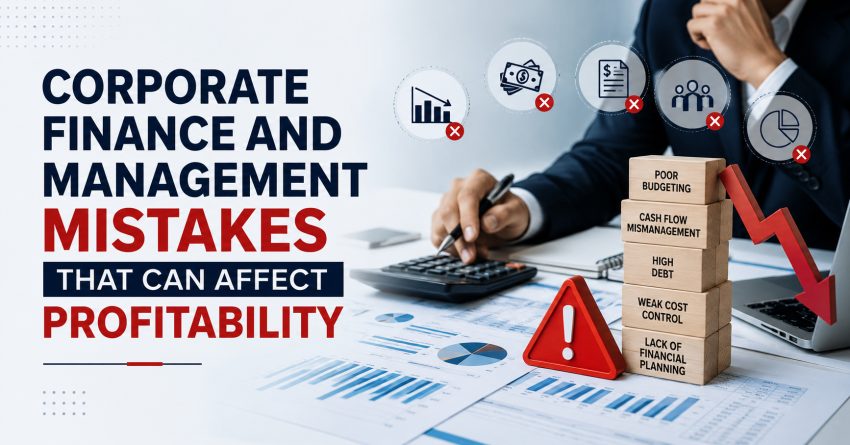
Profits are important to all businesses and in general every business strives for profit & its steady growth. However, even the best businesses with the best practices and customer support can be affected by low profitability.
Effective financial planning & good management of business operations help the organization to optimize expenditure, rationalization of assets utilized & sound decision making. Most companies make errors in their financial and management systems (often without realizing it) that directly impact profitability.
Such errors appear insignificant initially, but they can eventually stack up and lead to cash flow difficulties, greater operating problems and a decline in market competitiveness. Recognizing these mistakes can help companies to restore their stability and profitability. One of the frequently occurring mistakes in the areas of corporate and finance management is inaccurate cash flow planning.
Poor Cash Flow Management
Several companies pay attention only to sales and the generated income, but do not sufficiently track the cash flow. A business may be profitable ‘on paper’ but is unable to pay salaries, vendors, or operating costs. This may be due to late payments received from customers or unforeseen unmanaged expenditure.
Business cash flow forecasting is essential to avoid excess borrowing or late payments damaging profitability. Update their income streams on a regular basis, so that you know how much money is coming in and how much is going out, (to keep an eye on tax and liability). Pay close attention to when receivables are due and ensure there are enough reserves to cover seasonal slumps in cash flow.
Ignoring Financial Data During Decision-Making
A few companies base major decisions on other guesswork rather than financial analysis. Growth, introducing a new product or heavy recruitment without reviewing the financial outlook can cause long term financial stress.
For effective corporate finance and management, a business needs to examine budget comparisons, other market factors, forecasts and expected returns during critical decision stages.
This financial information indicates profitability, efficiency and risk. Overlooking these aspects might result in investments that either yield poor profits or incur additional costs.
Overdependence on Debt
Loans and the reliance on external sources of funding can enable a business to expand, but too much borrowing can cause unsustainable levels of debt. Extra interest payments can hit the bottom line and put strain on cash flow when sales are slack.
Most organizations do not balance the debt and operating income properly. When organizations become equipment-heavy there may no longer be sufficient operating income to provide the necessary flexibility.
Effective corporate finance and management require a balanced funding strategy that combines internal resources and external financing, supported by prudent borrowing and a structured repayment plan.
Lack of Budget Control
The company should do budgetary control. It is actually comparing actual performance with budgets and taking the necessary actions.
The analysis information can be used to control costs. Most companies are exposed to the risk of change in the market, slowdown in the economy, regulation or interruption to their supply chain.
Those that do not hedge against the risks may suffer financial losses. Risk should be properly assessed in corporate finance and management.
Weak Risk Management Practices
Every business faces risks such as market changes, economic slowdowns, regulatory issues, or supply chain disruptions. Companies that are incapable of preparing for these uncertainties in a timely manner face financial losses.
Corporate finance and management must have a structured risk assessment and contingency planning. Businesses that identify risks early can create backup strategies to reduce financial damage.
Ignoring risk management may result in sudden operational disruptions and declining profitability.
Inefficient Resource Allocation
Companies more often than not put too many resources to non-value-adding activities, sometimes at the expense of the value-adding units. For instance, too much investment in non-value adding infrastructure combined with low investment in technology or HR will probably affect long term performance.
Good corporate finance and management allow financial resources to be allocated based on business priorities and expected results. Without direct collaboration, the financial teams and operational management in most companies often work independently from each other.
Poor Communication Between Finance and Management Teams
Lack of communication results in lack of high-quality data with both realism of budgets and forecast inaccuracy and delays in decision time.
Good corporate finance and management are characterized by strong communication between the two divisions, ensuring that financial vision coincides with business goals.
Conclusion
Profitability depends not only on sales but also on how effectively a business manages its finances and operations. Errors in relation to poor cash flow planning, weak budgeting, excessive debt, and inefficient resource allocation can dent long-term growth.
Hence, potent corporate finance and management aid the businesses in making informed decisions, bringing down financial risks, and improve operational efficiency. Companies that make it a regulation to review their financial strategies and management practices are better positioned to maintain profitability and achieve sustainable success.
Frequently Asked Questions
Q: What are the most common corporate finance and management mistakes that affect profitability?
A: The most common mistakes include poor cash flow management, ignoring financial data during decision-making, overdependence on debt, lack of budget control, weak risk management practices, inefficient resource allocation, and poor communication between finance and management teams.
Q: How can businesses improve cash flow management in corporate finance?
A: Businesses can improve cash flow by regularly updating income and expense tracking, monitoring receivables closely, maintaining financial reserves for seasonal slowdowns, and using cash flow forecasting tools to anticipate and plan for future liquidity needs.
Q: When does debt become a financial risk for a business?
A: Debt becomes a risk when interest payments consume a significant portion of operating income, when the business lacks sufficient cash flow to service loans during slow periods, or when borrowing is used to fund non-essential activities rather than growth.
Q: What are the warning signs of poor corporate finance management?
A: Common signs include cash shortages, rising debt, delayed vendor payments, inaccurate budgets, and declining operational efficiency.
Q: Why is financial data important in corporate decision-making?
A: Decisions made without financial analysis — such as launching new products or aggressive hiring — can lead to long-term financial stress. Financial data reveals profitability, efficiency, and risk, helping businesses make informed choices that support sustainable growth.
Also Read: How Statutory Audit Strengthens Corporate Governance?