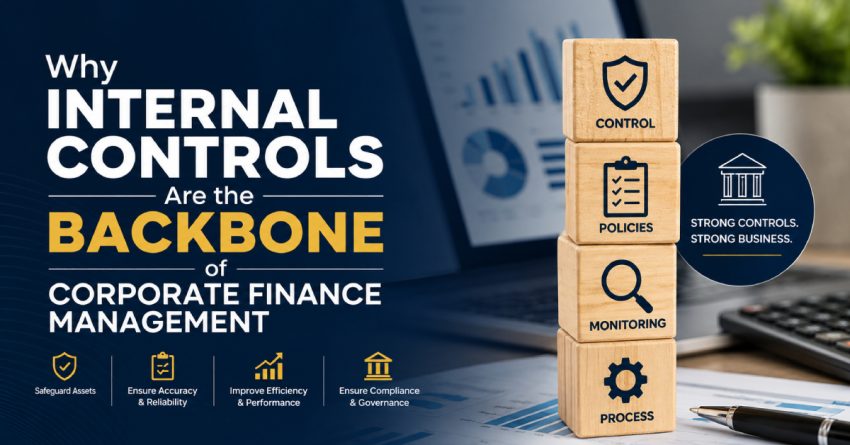
Financial discipline in the contemporary business world is not only about making profits but also about protecting them. Internal controls are designed procedures and policies that help ensure the accuracy of financial reporting, reduce the risk of fraud, and improve operational efficiency. They are an important tool in corporate finance management when properly applied.
Knowledge of Internal Controls in corporate finance Management
The management of corporate finance is concerned with planning, organizing and controlling financial resources. Yet, the optimal financial strategies may be unsuccessful without the right checks and balances. Internal controls offer a system that holds financial undertakings in tune with the corporate objectives and legal stipulations. They serve as a control mechanism that controls all financial dealings by making sure that they are checked, documented and traced accordingly.
Avoiding Fraud in Accounting
One of the major functions of internal controls in corporate finance management is to ascertain the accuracy of financial data. Financial statements are used by businesses in decision-making, communicating to investors, and complying with them. When the information is faulty, then it influences the whole decision-making process. Data integrity can be maintained through internal controls like regular reconciliations, approval systems and audit trails. This will enable the management to make sound decisions using credible information.
Avoiding Frauds and Financial Abnormalities
Fraud prevention is another important aspect. Financial fraud may take place at different levels in an organization; through minor misappropriations to great embezzlement. Internal controls mitigate these risks by bringing about segregation of duties whereby the same person does not have full control of a financial transaction. As an example, the individual who is to approve a payment should not be the one who is to process the payment. These measures enhance corporate finance management through reducing vulnerabilities.
Supporting Regulatory Compliance
Regulatory compliance is also dependent on internal controls. There are several financial laws and standards that businesses in India must comply with. Failure to comply may attract penalties, legal and reputational loss. Internal controls are achieved through effective documentation, reporting, and reliance on accounting standards to keep companies in check.
Improving Operational Efficiency
One more advantage derived from internal controls is efficiency in their operations. Normalizing financial operations will help businesses to minimize errors and duplication of work. As an example, automated approval procedures and well-documented workflows facilitate financial activities. This saves time as well as improves productivity. This efficiency in terms of corporate finance management translates into increased resource use and enhanced profitability.
Strengthening Risk Management
The internal controls are closely associated with risk management. All financial decisions involve some amount of risk, be this in terms of investments, credit or liquidity. These risks can be reduced, analyzed, and identified through effective use of internal controls. To make sure that possible problems are identified at an early stage, internal audits are conducted regularly. This is basically a proactive strategy that enhances corporate finance management and bolsters the businesses further to stay strong in the evolving market.
The Requirement of Continuous Control
One must realize that internal controls do not constitute a one-time arrangement. They should be constantly monitored and enhanced. The more complex the businesses are, the more their financial processes are complex, and the controls should also change. Periodic reviews and changes can make sure that the internal controls remain applicable and efficient in the wider perspective of the corporate finance management.
Conclusion
Finally, internal controls are not only a compliance need but a strategic need as well. They are accurate, reduce fraud, enhance efficiency, and aid in risk management. Internal controls improve the management of corporate finance by fortifying these areas. Investment in good internal controls is a viable and necessary measure for any business that seeks to be stable and grow.
This content is meant for information only and should not be considered as an advice or legal opinion, or otherwise. AKGVG & Associates does not intend to advertise its services through this.
Also Read: Understanding Internal Controls Over Financial Reporting