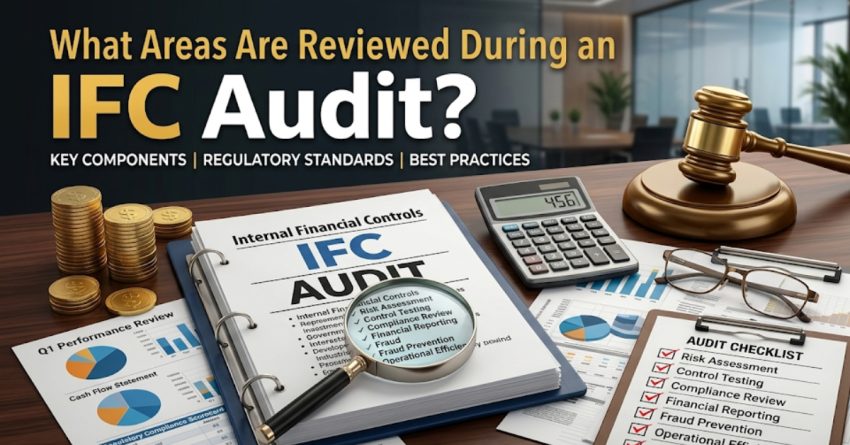
An organization that desires to have proper reporting, regulatory compliance, and financial transparency must have high internal financial controls. No one today can operate businesses in environments that are complex and in which financial processes include various departments, systems and approvals. To make sure that these processes operate correctly and minimize threats of financial errors or fraud, companies use IFC audit.
An IFC audit is performed to determine the efficiency of internal financial control systems of a company. It determines whether financial processes are designed and carried out in a proper manner to protect assets, maintain proper reporting, and keep in line with regulations. In the process, the auditors would scrutinize some of the key areas in the organization to ascertain whether the internal control system is operating effectively.
Financial Reporting Controls
Financial reporting is one of the areas that has been considered as being of the utmost importance when an IFC audit is conducted. Correct financial statements play a critical role in decision making by the management, investors, and the regulators. Auditors examine the activities involved in recording the financial transactions and preparing the financial reports.
This involves checking the correct authorization of accounting entries, proper recording of the entries and appropriate supporting documentation. When financial reporting process has weaknesses, chances of inaccurate financial statements are high. Auditors can evaluate the nature of the reporting system in terms of accuracy, reliability and consistency through an IFC audit.
Revenue Recognition and Sales Process
A major financial indicator to any business is revenue, and that is why sales and revenue recognition process is given special focus when an IFC audit is taking place. Auditors examine whether the revenue is being recorded based on the right accounting policies and whether the sales transactions are well documented.
They also check on the approval procedures of discounts, returns, and credit sales are well controlled. The consideration of these points assists an IFC audit to ensure that the revenues are accurately recorded and that there are no anomalies in the sales procedure.
Procurement and Supplier Payments
Procurement activities are also characterized by high financial transactions, and this makes them one of the key areas of focus during an IFC audit. Auditors consider the vendor selection process, process of issuing purchase orders and the process of granting approvals.
In this, adequate segregation of duties is critical. As an instance, the person who approves purchases is not to be the same competent who makes payments. The compliance of IFC audit is that there are control measures regarding this, as this will prevent unlawful purchases or fraudulent payments.
Inventory Management
Inventory management is another important area that is evaluated during an IFC audit into businesses where there are goods or materials involved. Ineffective inventory management may cause losses of money, lost records of stock, as well as breakdown in the functioning.
Auditors examine the existence of proper records of inventory and the routine verification of stocks. They also examine the existence of controls that prevent any theft, damage or misreporting of the stock levels. An IFC audit can be used to make sure inventory data is reliable by examining these procedures.
Cash and Bank Transactions
Bank and cash transactions are very sensitive subjects that need close supervision. In the process of IFC auditors pay critical attention to cash receipt, cash payments, and bank reconciliations.
They look into the appropriateness of cash transactions being well-documented, as well as the bank reconciliation being done on a regular basis. With these checks, anomalies, irregularities in transactions, and financial records, mistakes can be detected. Properly conducted IFC audit will make business remain transparent in cash management practices.
IT Systems and Financial Controls
In the current organizations, accounting systems are heavily dependent on digital accounting systems and hence, information technology is a key area of concern when conducting an IFC audit. Auditors evaluate whether financial systems are properly checked in terms of access control, data protection and backup processes.
They also consider the capability of the financial systems to allow only authorized personnel access and the aspects of monitoring the changes of financial data. Through the evaluation of IT controls, an audit of IFC will ensure that financial information is secure and reliable.
Adherence to Policies and Regulations
The other major area that an IFC audit will look into is the adherence of internal policies and regulations. Organizations usually put financial policies which direct the employees on how transactions are supposed to be carried out.
Auditors also look at compliance with these policies on a uniform basis throughout the organization. When employees work around laid down procedures, there is a risk of financial risks. An IFC audit is able to reveal such gaps and promote greater compliance with company policies.
This content is meant for information only and should not be considered as an advice or legal opinion, or otherwise. AKGVG & Associates does not intend to advertise its services through this.