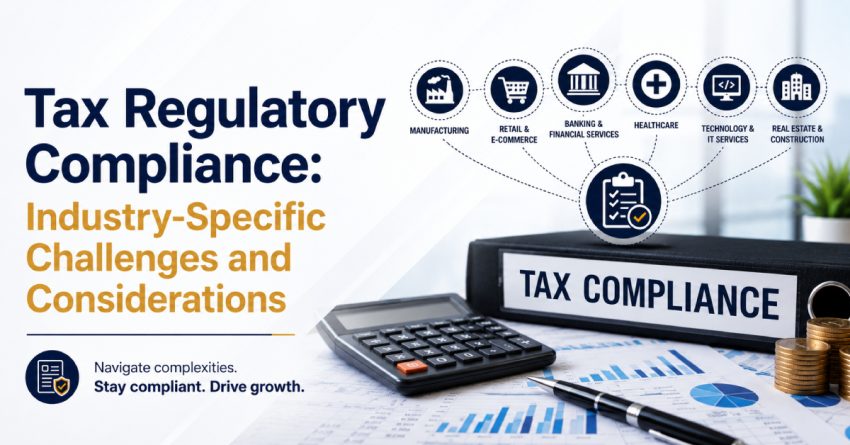
A very important task of businesses in all sectors is tax regulatory compliance. Although the fundamental premises of taxation could be similar, the reality is very different and can be highly varied in different industries. The industries have their own challenges based on operational models, revenue structure, and regulatory expectation. These differences are crucial in ensuring proper and effective tax regulatory compliance.
Understanding the Nature of Industry Variations
Each industry works in a different way and that directly influences the application of tax laws in the industry. As an illustration, manufacturing companies have to value inventory and input credits whereas service-based companies are more concerned with billing cycles and revenue collection. Such differences complicate tax regulatory compliance because a one-size-fits-all approach does not lead to success.
Companies need to fit their compliance plans to the needs of their industry. In the absence of this alignment, companies are at risk of making mistakes in reporting and risking penalties.
Difficulties in the Manufacturing Industry
The issue of tax credit is usually a challenge to manufacturing companies, particularly when it involves more than one supplier and raw materials. It can be a challenging task to track the flow of goods, keep proper records and ensure their correlation to tax filings.
Stock valuation is another area that presents a challenge in tax regulatory compliance in manufacturing. The variation in valuation techniques can affect taxable income, causing differences in case they are not handled with caution. Also, the payment of indirect tax involves extensive paperwork at each production and distribution point.
Complexities in the Service Industry
When dealing with service-based businesses, tax regulatory compliance is faced with various problems. The location of the supply is one of the key issues, particularly when a service is offered in one state or a country and supplied in another one or country. This is even more complex with digital and online services.
Another aspect that needs to be addressed is the revenue recognition. Services can be charged in stages or via long contracts and it can be hard to know when to charge tax. Even the slightest miscalculations may influence the tax regulatory compliance and cause controversies with tax institutions.
Financial Sector Regulatory Burden
The financial services sector is also highly regulated and thus tax regulatory compliance is more challenging. Banks and other investment companies are forced to contend with numerous levels of taxation, including taxes on transactions and taxes on income.
The complexity is increased by the frequent changes in financial regulations. Business organizations are forced to continuously upgrade their systems and processes so as to remain in compliance. High number of transactions also means that there is a risk of error, and good internal controls are important in ensuring good tax regulatory compliance.
E-business and Digital Business Pains
The digital nature of e-commerce and digital platforms has distinct challenges because of their borderless nature. One of the largest concerns in tax regulatory compliance is determining the tax liability in various jurisdictions. Companies may need to abide by more than one system of taxation at a time.
The other problem is dealing with a lot of transactions. It could be too much to keep proper records on every transaction and to be able to make proper tax calculations. Moreover, the development of tax legislation on digital services needs constant monitoring and adjustment.
Requirement of Special Instruction
Since industry issues are diverse, professional knowledge is of great importance. Tax consultants and financial advisors know the needs of the sector and can offer custom solutions. Their advice assists enterprises to stay out of the usual traps and keep proper tax regulatory records.
The collaboration with specialists also guarantees that businesses remain informed about regulatory changes, and it is particularly crucial in the fields where the policy is regularly revised.
Conclusion
Tax compliance in the regulation is not a standardized procedure but rather a very diverse one among industries. In manufacturing and services, finance and e-commerce, every sector has its own challenges. The first step to the creation of an effective compliance framework is to identify these differences.
Businesses can overcome these challenges by implementing industry-specific strategies, capitalizing on technology, and obtaining expert assistance. Good tax regulatory compliance is a way of not only avoiding penalties but also enhances credibility and long-term growth.
This content is meant for information only and should not be considered as an advice or legal opinion, or otherwise. AKGVG & Associates does not intend to advertise its services through this.
Also Read: Cross-Border Transactions: Navigating Tax and Regulatory Compliance