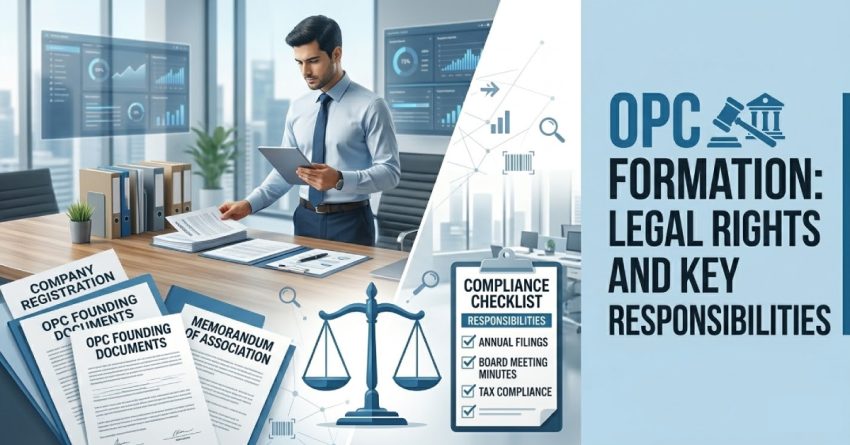
One Person Company has taken over as a business model for individual entrepreneurs. It enables one person to have the luxury of a company but have full control of running the business. Although OPC formation seems to be easy and appealing, not all the owner’s pay attention to registration advantages and ignore significant legal rights and obligations which accompany this type of structure. These aspects are very important in compliance and stability of the business in the long term.
Understanding Legal Identity after OPC Formation
Once OPC formation has been established, the owner of the business is no longer a part of the business. This implies that the business will be allowed to bear assets, sign contracts and undertake legal actions in the name of the business. Most owners do not take this separation seriously and instead proceed to use the assets of the company as personal assets, which leads to legal hurdles during audit or even controversy.
Such distinct identity also implies that the OPC must act in accordance with the corporate laws, but it does not matter that the only owner is the company.
Limited Liability Comes with Conditions
Limited liability is among the greatest benefits of OPC formation. The personal assets of the owner are usually not subject to business. This is not total protection, however. In case the owner commits fraud, offers misleading information or misuses company funds, the police may simply lift the corporate veil and make the owner personally liable.
This is one of the responsibilities that many OPC owners do not take seriously, believing that they will be immune in every circumstance, and this may turn out to be an expensive misconception.
Rights Related to Decision-Making and Control
A major legal right following formation of OPC is full decision making. The owner can decide on business strategies, finances and operations as there are no shareholders or partners. This will enable quicker decision-making devoid of internal approvals.
This is however, this also means full accountability. Bad decisions will not be transferred to partners or directors. Under the law, the sole member is supposed to always act in the best interest of the company.
Compliance Responsibilities Often Ignored
An OPC is governed by the Companies Act although it has a single owner. The company should have statutory registers after posting OPC formation, annual filing of returns and submission of financial statements to regulatory bodies.
The widespread misconception that is in place amongst many owners is that compliance requirements are less strict because of single ownership. Although there are certain exemptions, failure to comply may invite punishment and legal warnings. Early filing and correct record keeping are legal processes that one cannot ignore.
Nominee-Related Legal Obligations
One of the peculiarities of the OPC formation is that it has a nominee. This nominee would become a member of the company in case the owner dies or becomes incapacitated. They consider this a formality by the owners, but it has legal implications.
Prior consent should be presented by the nominees, and any amendment of details of nominees should be duly recorded and submitted. When managing nominees-related obligations are not addressed, one may face administrative problems and inconveniences in unexpected circumstances.
Restrictions and Conversion Responsibilities
There are some restrictions on which OPCs work. Once OPC has been formed, the company might have to transform into a private limited company, in case it passes through specified financial limits or wishes to increase business.
This is one of the responsibilities that are ignored by many owners, and they operate without keeping a check on turnover or paid-up capital limits. Disregarding conversion rules will lead to regulatory proceedings and penalties.
This content is meant for information only and should not be considered as an advice or legal opinion, or otherwise. AKGVG & Associates does not intend to advertise its services through this.