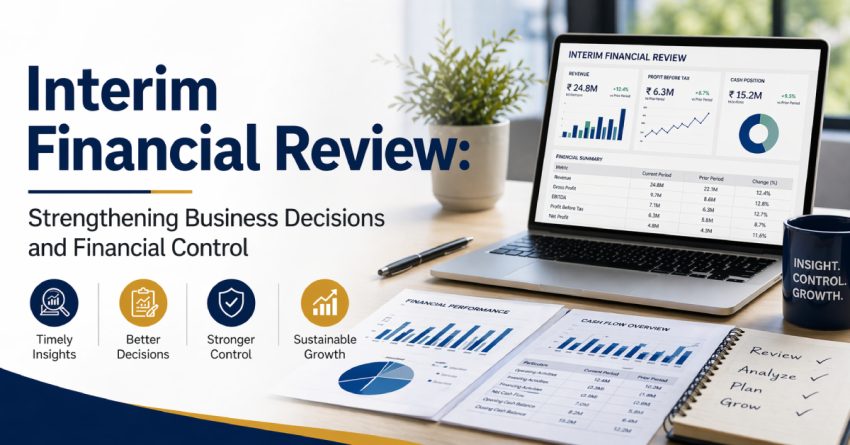
In today’s fast-paced business environment, staying updated on financial performance is essential for sustainable growth. Companies can no longer afford to wait until the end of the fiscal year to assess their financial health. This is where an interim financial review becomes highly valuable. It provides a timely evaluation of a company’s financial status, helping businesses make informed decisions throughout the year.
Understanding an Interim Financial Review
An interim financial review is a limited assessment of a company’s financial statements conducted for a period shorter than a full financial year, such as quarterly or half-yearly. Unlike a full audit, it does not involve extensive testing or verification. Instead, it focuses on analytical procedures, inquiries, and a general review of financial data.
An interim financial review is intended to determine any abnormality themes, inconsistencies, or risks in advance. It enables the management to have an idea on financial performance without taking time and cost as it would be in a complete audit. This renders it an effective tool of tracking business progress on a regular basis.
Why It Matters for Businesses
This is one of the main reasons why businesses are depending on interim financial review so as to make better decisions. Periodical analysis of financial data allows companies to change their strategies, manage costs, and use resources in a more efficient way. This pro-active approach has the benefit of preventing significant financial problems in the future.
Risk management is another key factor. Any difference or miscalculations in finances may happen at any point and when it is identified early it can save one a lot. An interim financial analysis assists companies in recognizing such problems before they get out of hand hence easier operations and adherence to financial laws.
Building Investor and Stakeholder Confidence
Transparency is essential for businesses that need to invest or retain relationships with investors and other stakeholders. The interim financial review that is conducted on a regular basis exhibits accountability and reliability. Access to updated financial information makes investors and other stakeholders feel confident as opposed to waiting until they receive annual reports.
The practice is vital mostly for those companies or organizations that are publicly listed, or those with expansion plans. It indicates that the company is paying attention to its performance and is determined to keep financial discipline.
Improving Financial Planning and Forecasting
Clearly, financial planning requires current information. A real-time financial analysis would offer insights into the business that would enable it to optimize its budgets and projections. With knowledge of current trends, companies will be able to make forecasts regarding their future performance and be ready for all the challenges.
It also helps organizations to assess the actual performance against projected performances. This assists in detecting lapses and undertakes the required changes to keep pace.
Conclusion
Financial insights should be timely to make a difference in a competitive business environment. Interim financial review provides business with a viable means of tracking performance, risk management and decision-making within the year. It improves transparency besides increasing financial planning and trust by the stakeholders. Through the financial strategy that includes periodical reviews, businesses can remain agile, responsive, and more capable of long-term success.
This content is meant for information only and should not be considered as an advice or legal opinion, or otherwise. AKGVG & Associates does not intend to advertise its services through this.