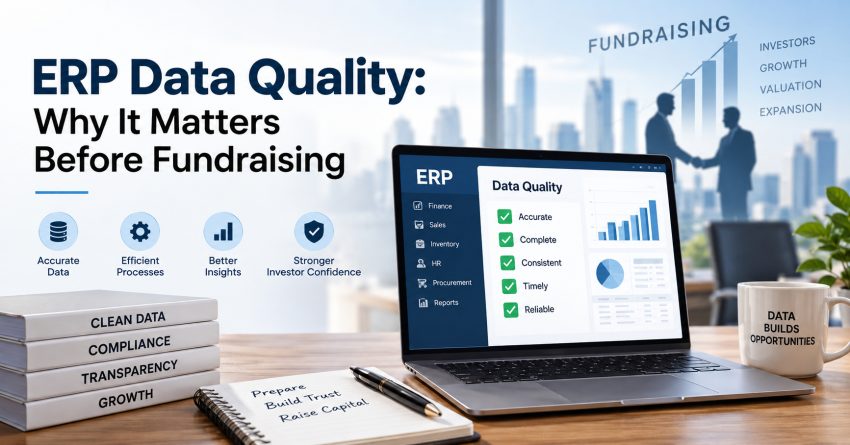
Fundraising is an essential part of a company’s development process. Investors analyze a business not just with its revenue or market opportunity but also the quality, consistency and reliability of the information it provides to investors. The precision of that base information can have a significant impact on investor confidence and valuation for businesses that are utilizing an Enterprise Resource Planning (ERP) system. Data quality is an important prerequisite before getting ready to meet investors or go on a transaction path, therefore good ERP data quality becomes a crucial factor. This makes it important to assess whether the financial data accurately reflects the business’s financial position and performance.
What Does ERP Data Quality Mean?
ERP data quality is the accuracy, completeness, consistency and reliability of data stored in an organization’s business systems.
ERP systems can include information on:
- Revenue and sales
- Purchases and expenses
- Inventory
- Financial assets and liabilities relating to trade, such as accounts receivable and payable.
- Fixed assets
- Payroll
- Records of customers and vendors
If these records are not completed or accurate, financial reports produced from this system may not give an accurate assessment of the performance of the business.
Why Investors Care About Data Quality
Due Diligence is done before investors invest. In the course of doing this, they can look at management reports, financial statements, bank records, tax filings, customer data and other information about the business.
Investors might suspect that the company isn’t reporting accurately if these sources report on the same event differently.
For instance, if there are discrepancies in the Revenue figures between ERP and audited Financials, it may cause further investigation. Management may need to invest a lot of time in determining the facts behind the difference even if there is a valid reason for the difference.
A due diligence process becomes more efficient, and more confidence is added to the financial reporting of management with clean and reconciled ERP data.
ERP Data and Business Valuation
Good financial information is crucial in business valuations. The value of a business may be affected by revenue, operating costs, working capital, assets, liabilities and cash flow.
Poor ERP data can result in errors in the assumptions made in valuation models.
A valuation exercise may require certain financial information to be normalised or further investigated before conducting the valuation. This is especially important for companies that have grown quickly, have multiple revenue streams, have been acquired or had major changes in their accounting systems.
Common ERP Data Issues Before Fundraising
There are a number of issues with data that can occur in the preparation for fundraising.
Duplicate or Incomplete Records
Having duplicate customers, vendors or transaction data can skew reporting and make it challenging to find out what is really happening in the business.
Accounts that are not Reconciled
The differences in ERP balance, bank statements and invoices from accounting records can create queries during due diligence.
Incorrect Revenue Classification
Revenue should be recognized in a uniform manner for all products and services, customer types, and reportable periods. Incorrect classification may impact on profitability analysis and valuation.
Outdated Master Data
Old customer, vendor and pricing or inventory data can lead to reporting inconsistencies and impact management analysis.
Essential ERP Data for Investor Due Diligence
Before engaging investors, businesses should get into the process of preparing data well in advance. A structured review may involve reconciling important accounts, the elimination of duplicate records, validation of master data, examination of revenue recognition policies, and unusual financial transaction investigations.
Management should also ensure that the historic information is consistent for reporting periods. A clear history of substantial changes facilitates and simplifies understandability in financial statements during due diligence.
Supporting a Stronger Valuation
Good ERP data does not necessarily increase a company’s value. It can however, offer a more solid basis for value determination and less risk associated with the financial data used to perform the value determination.
A structured valuation exercise can provide an objective assessment of the financial position, identify information gaps, and support investor discussions.
Conclusion
You shouldn’t just prepare an appealing pitch deck for your fundraising. An investor must have confidence that information about the financial aspects of the growth story is accurate, consistent, and defensible. Data quality is a critical factor for gaining that confidence in ERP.
The efficiency of the process can be made possible through organizing financial statements, reconciling important accounts, standardization of data, and elimination of inconsistencies in financial reporting before conducting due diligence process. A properly supported valuation process can provide a stronger basis for assessing the integrity of financial data and determining business value.
Frequently Asked Questions
Q: What does ERP data quality mean in the context of business valuation and fundraising?
ERP data quality means the accuracy, completeness, consistency, and reliability of financial and operational data stored in an ERP system. It helps ensure that financial information is reliable for valuation and fundraising.
Q: Why do investors focus on ERP data quality during due diligence?
Investors review ERP data to identify inconsistencies between financial statements, bank records, and management reports. Clean and reconciled data can make the due diligence process clearer and more efficient.
Q: How do business valuation services in India assist companies preparing for fundraising?
Valuation exercises can help review financial information, identify data gaps, assess unusual transactions, and support the preparation of financial information for valuation.
Q: How does proper ERP data preparation strengthen a company’s valuation?
Proper ERP data preparation provides a reliable basis for valuation models by reducing inconsistencies and improving the quality of historical financial information.
Q: What is financial due diligence, and why does it depend on clean system data?
Financial due diligence involves reviewing financial statements, tax records, bank records, and management reports before a transaction. Clean system data helps reduce discrepancies and supports a more reliable review.
Also Read: Enterprise Operations in 2027: Preparing for What’s Next