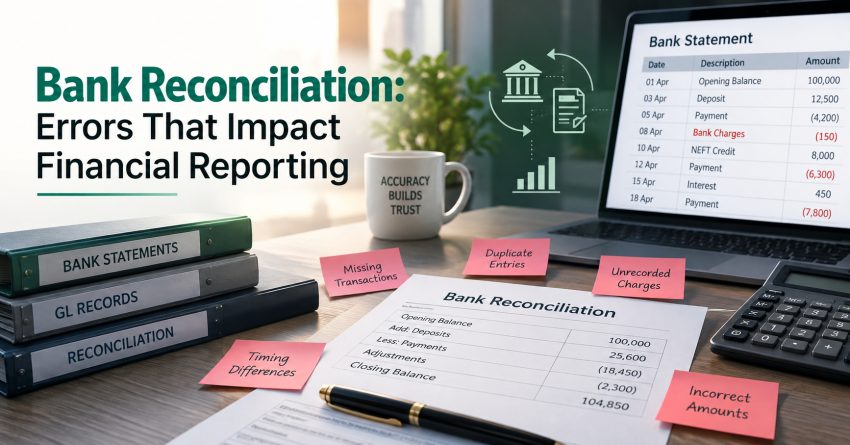
Bank reconciliation is a significant accounting control that enables businesses to compare cash records with the bank transactions reported. If it is done on a regular basis, it can help to detect discrepancies, provide cash visibility, and help to create more accurate financial statements. Errors, however, in the reconciliation process may not be detected and can ultimately impact financial reporting.
It can become a much more complex process for organizations that have multiple accounts, locations, transactions and payment channels. Resource planning services are designed to engage businesses to develop more organized financial processes, data consistency and enhanced reconciliation controls.
Why Bank Reconciliation Matters?
Bank reconciliation is the process of matching up the bank’s statement to the records of the bank in a company’s books. Variances may occur for legitimate reasons, for example, outstanding cheques and deposits in transit. But discrepancies that don’t make sense can mean that there are accounting mistakes, duplicate transactions, missing ones, or even any unauthorized transactions.
By performing a regular reconciliation, businesses can detect such issues early enough to avoid adverse impact on financial reporting at a monthly, quarterly or annual level.
There are common errors that can have an impact on reconciliation:
1. Unprocessed Bank Entries
Another problem that businesses may face is a case where some transactions present in the bank statements are not processed in the accounting system. This can involve bank expenses, interest income or direct debit/electronic payments.
Failure to process such transactions may result in inaccurate representation of the cash balance within the accounting system.
2. Duplication
Duplication involves double booking of one transaction or receipt in the accounting system. This may happen when transactions are automatically loaded into the accounting system and then manually entered.
Duplication may lead to overstatement or understatement of account balances and may affect financial reporting.
3. Errors in Transaction Amounts
An inconsistency in the accounting system may be a result of inputting the wrong amount. It becomes increasingly difficult to trace errors made during data input when the business processes many transactions.
Review is thus critical for businesses in order to deal with unusual amounts.
4. Bank charges and interest not recorded
The bank can levy service fees, transaction charges, or any other costs not shown in the company’s books. Likewise, some accounts might not be captured promptly for the interest earned.
If these items are not taken into consideration, it will impact cash balances and/or income and/or expense numbers.
5. Outstanding Payments and Deposits.
Cheques or electronic payments that have been entered into by the business might not show up on the bank statement for some time. Deposits can also be in transit.
These timing discrepancies do not necessarily indicate an accounting mistake but should be documented and tracked. In the event, the valid reconciling items could be confused with unexplained differences.
6. Incorrect Account Mapping
If a company has several bank accounts or is doing their accounting on more than one system, they might end up making a transaction in the wrong account. This can lead to reconciliation problems, and it can also impact the validity of financial data among business units.
These errors can be minimized by using standardized account structures and review controls.
There are steps that businesses can take to improve the resource planning services.
A regular reconciliation process should comprise:
- Regularly reconciling bank statements; and
- Maintaining supporting documentation for adjustments
- Reviewing items that are unusual or old reconciling items.
- Creating a separation of preparation/review duties when applicable
- Early investigation of unexplainable differences
- Ensuring Accurate Record of Corrections and Approvals
- Appropriate accounting and financial management systems used
Organizations can also review other financial operations to see if there are opportunities to automate, standardize, or improve data management to minimize potential manual mistakes. Resource planning services can facilitate this by assisting organizations to plan financial flow and enhancing coordination among accounting, operations, and other departments.
The Importance of Timely Reconciliation in Financial Reporting
Bank reconciliation is not just a simple accounting activity. It helps provide control over cash information and can assist in detecting inaccuracies before financial statements are finalized.
Lapses in reconciling may cause errors to build up over time, making detection more challenging. Regular audits provide finance departments with the opportunity to deal with discrepancies before they become too time-consuming.
Develop a more reliable finance process
The quality of financial information is the basis of accurate financial reporting. Bank reconciliation is a practical method to ensure that cash transactions you have recorded in the accounting books match what is shown on the bank statement.
By recognizing and fixing some of the most prevalent mistakes, establishing a proper review procedure and optimizing the finance process, companies may improve financial controls and the accuracy of their reporting. The resource planning services may also be useful in improving financial procedures for businesses which want to make them more consistent.
FAQs
Q: What is bank reconciliation?
Bank reconciliation compares a company’s accounting records with its bank statement to identify and resolve differences.
Q: Why is bank reconciliation important for financial reporting?
It helps detect missing, duplicate or incorrect transactions before monthly, quarterly or annual reports are finalized.
Q: What are the most common bank reconciliation errors?
Common errors include missing entries, duplicate transactions, incorrect amounts, unrecorded charges and account mapping issues.
Also Read: How Build Operate Transfer Outsourcing Supports Long-Term Strategic Planning