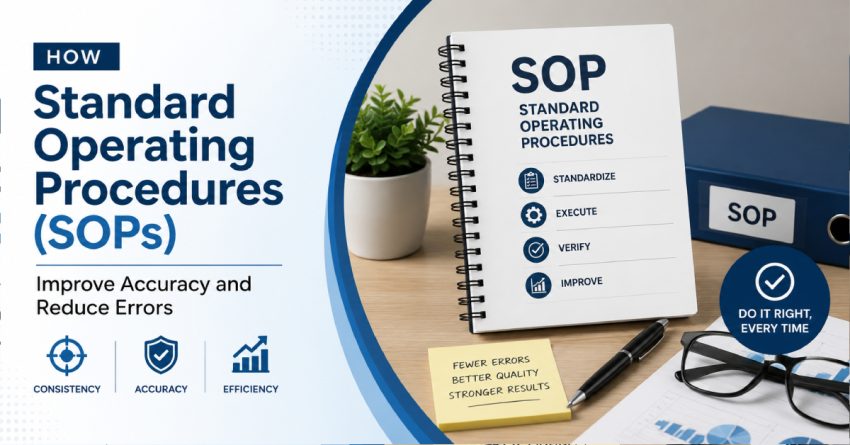
In today’s fast-paced business environment, maintaining consistency and minimizing errors are critical for operational success. Organizations across industries rely on clearly defined processes to ensure tasks are completed accurately and efficiently. This is where SOP (Standard Operating Procedure) plays a vital role. By providing structured guidelines, businesses can reduce variability and improve the quality of their outcomes.
Establishing Clear Guidelines
One of the primary ways SOP (Standard Operating Procedure) reduces errors is by offering clear, step-by-step instructions for completing tasks. When employees know exactly what is expected of them, the chances of confusion and mistakes decrease significantly. Instead of relying on memory or assumptions, team members can follow documented procedures that outline each stage of a process.
Clear guidelines are particularly important in complex operations where even a small error can lead to significant consequences. By standardizing tasks, organizations ensure that every employee performs them in a consistent manner, thereby enhancing accuracy.
Minimizing Human Error
Human mistakes are hard to avoid since some jobs can be tedious or require great concentration. SOP (Standard Operating Procedure) can help minimize the possibility of such events through various validation, checks, and standardization measures. Such built-in protection mechanisms become an additional safety feature.
For instance, adding the verification step to the procedure prevents mistakes at the output stage. It will help reduce the number of errors and teach employees to take responsibility for their actions.
Enhancing Training and Onboarding
It is often difficult to train new employees without having necessary documents at hand. SOP (Standard Operating Procedure) comes in handy in this respect because it acts as a reference guide. In addition, new employees will be able to acquire processes quickly without having to depend on verbal communication that could differ depending on the person giving the training.
Using the same training documents will ensure that all employees get the same amount of training as everyone will use the same guide. Thus, the risk of misunderstandings will be reduced; hence, fewer errors will occur.
Improving Process Consistency
Process consistency is important when it comes to increasing the accuracy of tasks. SOP (Standard Operating Procedure) will help create consistency because processes will be performed the same way all the time, irrespective of the person involved in executing the processes.
Process consistency will be especially useful in fields such as medicine, manufacturing, finance, among others where standardization of processes and consistency will ensure high quality of products and services offered.
Facilitating Continuous Improvement
One more benefit of SOP (Standard Operating Procedure) is that it facilitates continuous improvement. Process documentation enables managers to assess and update procedures on a regular basis to spot any possible errors or inefficiencies. Such a process will contribute to making adjustments to the current workflow and improving the level of precision.
In addition, soliciting employees’ suggestions about existing procedures can lead to improvements and innovations. Better procedures will help cut down the number of mistakes and improve the overall efficiency of workers.
Conclusion
Improving accuracy and cutting down errors are two of the most important tasks that any company should be able to perform in order to become successful. SOP (Standard Operating Procedure) can prove to be an indispensable resource when tackling these challenges because of its effectiveness and versatility.
Also Read: Ethics & Transparency in Management Consulting: Building Trust and Accountability