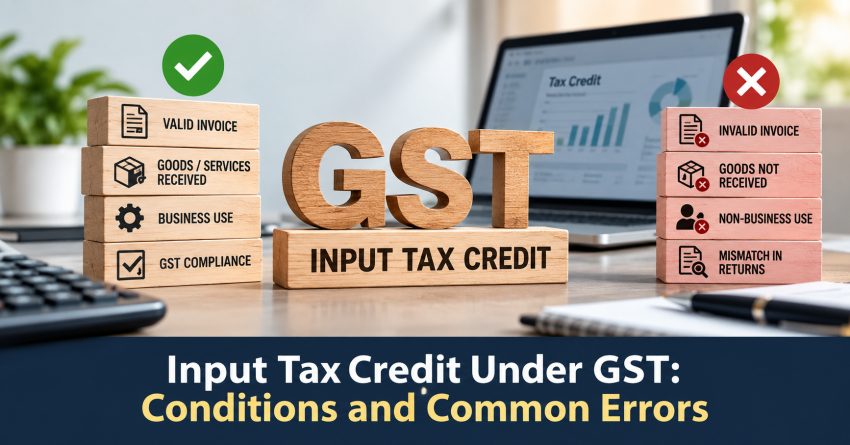
Input Tax Credit (ITC) is among the most significant aspects of Goods and Services Tax (GST) regime. It lets businesses with a valid GST registration save on their output tax bill for eligible purchases and business expenses by claiming credit for GST paid on their eligible purchases. However, ITC will have certain conditions, documentation requirements, compliance rules to be followed. Knowing what these requirements are can help businesses ensure they do not make incorrect claims, notices and the unnecessary tax exposures.
What is Input Tax Credit?
The concept of Input Tax Credit (ITC) enables the taxpayer who is registered for the Goods and Services Tax (GST) to credit the tax levied on the inputs used in the taxable supply of goods/services made to the recipient and debits the tax levied on the taxable supply of goods/services made by the registered supplier to the taxable recipient. For instance, where a business does pay GST on business-related purchases then also collects GST from customers, the eligible input credit can generally be adjusted when the output liability is calculated.
The mechanism enables us to minimize the so-called cascade effect of taxes, by which the tax burden would be effective only on the value added at each stage of the production process.
The following are key conditions for claiming Input Tax Credit:
The conditions that businesses must meet to claim ITC under GST are outlined below. The following are some of the crucial requirements:
- Have a valid tax invoice or prescribed tax paying document.
- Getting the appropriate items or services.
- Ensuring that any supplier where applicable reports the transaction appropriately.
- Making the appropriate GST returns on time.
- Use of goods/services for qualifying business activities.
- Keeping necessary documentation to back up the credit awarded.
To satisfy these requirements, businesses can help to create a foundation for ITC claims that are legitimate and well documented.
Common mistakes that businesses should avoid making.
The mistakes that may happen leading to making an incorrect claim for the ITC or ITC reconciliation are:
- ITC eligibility: Certain goods and services may not be eligible for blocked ITC or any type of ITC.
- Error in the invoice: It could arise from an error in the details such as GSTIN, invoice number, taxable value, or tax value.
- Double ITC claims: Double invoicing may occur.
- Incorrect ITC reconciliation: Businesses may not check whether their purchases match GST information.
- Absence of invoices/ supporting documents: Without them, it would be hard to prove your case.
Properly checking returns prior to submission will help to prevent these errors.
Timely Reconciliation Matters:
The compliance of GST is all about the flow of information between the buyer, seller and the tax system. A business can book a purchase internally, and discrepancies can occur when the supplier books the purchase differently or doesn’t book it as expected.
Performing reconciliation on a consistent basis can allow companies to identify:
- Missing invoices
- Reconciliations
- Wrong tax amounts
- Discrepancies relating to suppliers
The difference between the two sets of information (purchases and GST) might be caused by several factors:
This can reduce the risk of possible problems in future compliance reviews.
Good GST compliance is essential
Invoicing, reconciling and processing invoices alone are not sufficient measures when it comes to ITC management. It is important for companies to establish clear procedures for recording purchases, checking invoice details, assessing eligibility and reconciling tax.
All these processes can be facilitated with software solutions for accounting and compliance. But there should be regular monitoring and expert guidance as required for the automated systems.
Conclusion
The impact of Input Tax Credit on GST liability and tax efficiency of a business can be significant. But false or unsupported statements can cause problems for compliance. Knowing the applicable conditions, keeping accurate records and regularly reconciling records and avoiding common pitfalls will help businesses manage ITC more effectively.
GST provisions and compliance requirements may change from time to time, so businesses should keep themselves up to date with the latest rules that apply to their business and should also seek professional advice in the case of complex transactions.
Frequently Asked Questions
Q: What is Input Tax Credit (ITC) under GST?
Input Tax Credit (ITC) allows GST-registered businesses to reduce their output tax liability by claiming credit for the GST paid on business-related purchases and input. It acts as a value-added mechanism that prevents the cascading effect of taxes.
Q: Why is regular ITC reconciliation important for GST compliance?
Regular reconciliation allows businesses to cross-check their internal purchase records against the sales reported by their suppliers. It identifies missing invoices, wrong tax amounts, and supplier reporting discrepancies early, preventing tax notices and penalties during compliance reviews.
Q: What is the deadline or time limit for claiming Input Tax Credit under GST?
A taxpayer can claim Input Tax Credit for a financial year up to the due date of filing the GST return for September of the following financial year, or the date of filing the annual return, whichever is earlier.
Also Read: GST and FEMA Considerations for International Service Providers