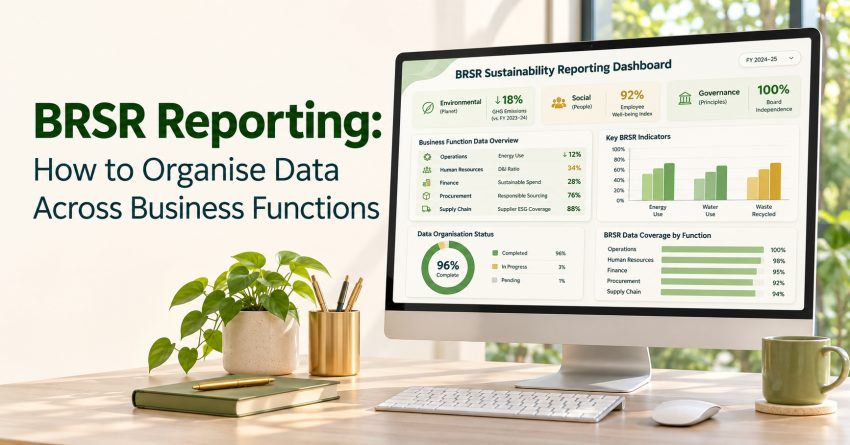
Preparing a Business Responsibility and Sustainability Report (BRSR) requires businesses to collect and organise sustainability-related data from different departments. Without a structured process for capturing and verifying this information, businesses may face gaps, inconsistencies and accuracy issues. Establishing a clear reporting process can help improve the quality and reliability of BRSR disclosures.
Know what data you need
Understanding the requirements of Business Responsibility and Sustainability Reporting (BRSR) set by SEBI will help you know what data you need to capture. Ensure you know what data you need to capture and which department it applies to.
This will give you clarity over who owns the data, reducing the risk of any missing data. It will also give insight into what data you already have.
Allocate roles
As sustainability data is captured from various areas within the business, having clear roles will help.
Roles could be:
- Finance – Energy consumption, investments and costs.
- Human Resources – Diversity, Training, Safety and Wellbeing.
- Procurement – Supplier evaluations and responsible sourcing.
- Operations – Energy, Water, Waste and Emissions.
- Compliance – Regulatory, Governance and Conduct.
A dedicated reporting team can coordinate the information and ensure a standard process is being used.
Create standard templates
You may have different departments capturing data in different formats. This can cause issues with the data.
Creating templates will ensure you have a standard format in place. Templates should specify the data to be captured, units of measurement and reporting periods. This will make it easier to collate data from across the business and identify any discrepancies.
Having a single digital platform will help to streamline this.
Have a verification process
To ensure your disclosures are accurate you need to ensure your source data is accurate. Create a process to verify the data being submitted is complete and has supporting evidence.
For example, ensure the energy data matches the billing from the utilities. For employee-related data ensure it matches the data held by the HR department. Maintain supporting evidence for all reported data.
This will increase the reliability of your BRSR Reporting and help to answer any questions during an internal review, audit or from stakeholders.
Improve collaboration
Do not treat this as just an annual task. Maintaining regular communication with departments will help to identify any gaps in your reporting.
Ensure you have regular review meetings, department contacts and submission deadlines. Senior management should also be kept up to date. This will help to improve accountability.
Use technology
If you have multiple locations or business units, using spreadsheets could become complicated. Reporting platforms can help consolidate data, maintain records, track submissions and generate reports.
The right technology can improve data visibility, reduce duplication and help maintain consistency across BRSR disclosures. It can also make it easier to track departmental submissions and identify missing information.
Conclusion
Organising sustainability data for BRSR reporting requires collaboration, clearly defined responsibilities and reliable documentation. Standardised processes for collecting, reviewing and verifying information can help reduce reporting gaps and improve the quality of disclosures. A structured approach also helps management assess sustainability performance across different business functions. Treating BRSR data collection as an ongoing process can support more consistent and reliable reporting.
FAQs
Q: How can businesses organise data for BRSR reporting?
Map disclosure requirements to departments, assign data owners and use standard templates with evidence and submission deadlines.
Q: Which departments should contribute to BRSR data collection?
Finance, HR, operations, procurement and compliance should contribute data relevant to their activities and reporting responsibilities.
Q: Why are standard templates important for BRSR reporting?
Standard templates align definitions, measurement units and reporting periods, making departmental data easier to consolidate.