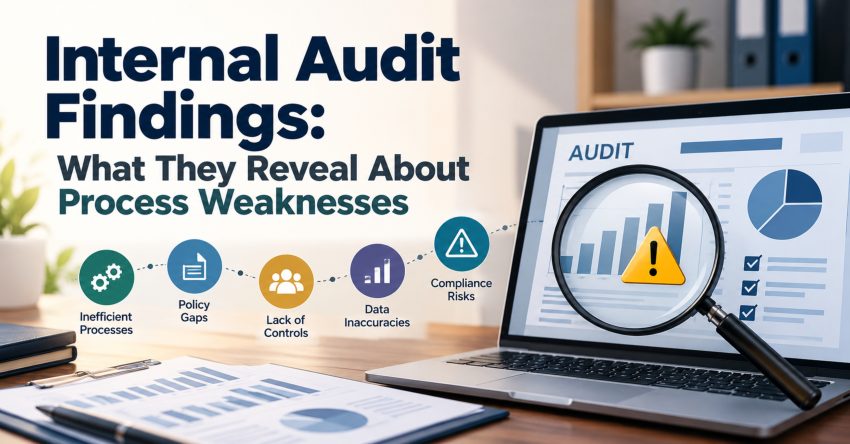
Businesses may examine individual errors when reviewing operational issues; however, repeated observations can indicate underlying weaknesses in business processes. An internal audit can assess controls, procedures, documentation, approvals and responsibilities to identify process weaknesses. Analysing observations collectively can provide insights into operational efficiency, compliance, financial accuracy and risk management across different functions.
Looking Beyond Individual Findings
A single control failure may appear insignificant. However, when similar issues recur, they may indicate weaknesses in the underlying process. For example, repeated approval delays may suggest unclear authority levels, inadequate procedures or insufficient employee training.
An internal audit can enable organisations to change from spotting individual exceptions to finding out why there are areas of weakness that keep recurring.
Common audit observations may indicate weaknesses across various business activities, including:
Audit observations may point out areas of weakness in multiple business activities. These may include:
- Failure to properly separate duties.
- Inconsistent approval procedures.
- Poor record maintenance.
- Delayed reconciliations.
- Lack of documented processes.
- Excessive dependence on manual activities
- Weak monitoring of exceptions
- Inadequate control over key activities in the organisation
These problems can be either separate, or they can be a part of a broader process problem. It is important to understand their relationship when deciding on corrective actions that are appropriate.
Identifying Root Causes
Correcting an individual observation does not necessarily prevent the same issue from recurring. Organisations should identify the underlying causes of the weakness.
RCAs can investigate if the problems are due to obsolete procedures, system limitations, lack of control, unclear responsibilities, lack of training or lack of supervision. It is more sustainable to deal with the root of the problem than to deal with the individual issues repeatedly.
Identifying Cross-Departmental Issues
Some process deficiencies affect multiple departments. For example, procurement issues may affect accounts payable, inventory management and financial reporting.
An internal audit should be able to give a wider picture by analysing the interactions between various functions. Drawing these relationships can provide management with insight into whether there are risks in the organisation that may stem from a control weakness in one process.
Prioritizing Corrective Actions
All audit observations don’t need the same level of response. Considerations in determining priorities include financial impact, frequency, regulatory implications, operational disruption, and likelihood of recurrence.
Responsible owners, expected completion dates, resources needed, and ways to determine if the issue has been resolved should be identified, as this should be ideally included in corrective action plans.
Receiving an audit observation doesn’t necessarily mean the underlying weakness has been solved. Follow-up reviews may be useful in assessing if corrective measures are being effectively carried out and if similar issues are occurring.
Also, if observations are repeated across audit cycles, this can be helpful to determine if internal controls and processes are improving.
Transforming Audit Observations into Process Improvement
Internal audits can provide value beyond identifying individual control deficiencies. Reviewing observations collectively can reveal broader weaknesses in work processes, monitoring, record-keeping and internal controls.
These findings can be leveraged by businesses to restructure processes, define clear roles, enhance control measures, and fine-tune monitoring systems. Organisations can develop more consistent and sustainable operations by viewing audit findings as indicators of broader process weaknesses and performance issues.
FAQs
Q: What are internal audit observations?
Internal audit observations identify weaknesses in business controls, procedures, documentation and processes that may affect operational efficiency.
Q: How can internal audits identify process weaknesses?
Internal audits review recurring errors, control failures, approval delays and documentation gaps to identify underlying process weaknesses.
Q: What is root cause analysis in internal auditing?
Root cause analysis identifies the underlying reasons for audit findings, such as outdated procedures, system limitations or inadequate supervision.
Q: What is a corrective action plan in internal auditing?
A corrective action plan defines the steps, responsible persons, deadlines and resources needed to resolve identified control weaknesses.
Q: Why are follow-up reviews important in internal auditing?
Follow-up reviews help assess whether corrective actions are effective and determine if previously identified weaknesses continue to occur.