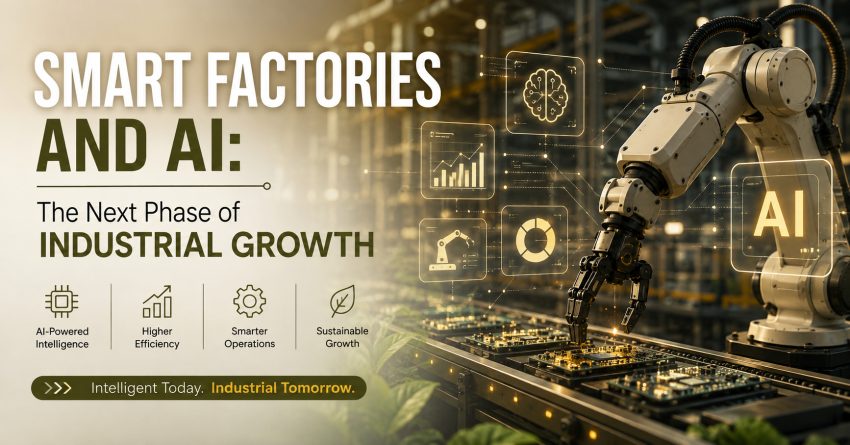
Artificial Intelligence (AI) has already brought about a revolution in the manufacturing industry through its transition from experimentation to mainstream use. Such is the impact of Artificial Intelligence (AI) that it has become a transformative force for the manufacturing industry through its transition from experimentation to mainstream use. The same is getting reflected as the manufacturers from all parts of the world are constantly adopting the smart factory concept, where AI, industrial automation, connected machines, and data analytics work together for enhanced efficiency and resiliency. Adopting this trend has been largely attributed to increasing production cost, shortage of manpower, uncertainty in supply chain, and the need for quick and flexible manufacturing processes.
The same is happening in India. Government programmes like Make in India, Production Linked Incentive (PLI) and policy push towards advanced manufacturing are driving industries to use digital technologies to make them more competitive. Therefore, smart factories are becoming an important part of the country’s strategy to grow its industries.
AI Is Redefining Manufacturing Operations
In the traditional automation approach, the aim was to accomplish repetitive operations without any interaction from humans. In today’s smart factories, machines have become capable of analyzing data, recognizing patterns, and taking intelligent decisions based on the findings in the data. Through AI-driven production systems in industry, machines can optimize their own performance, schedule production, and find out inefficiencies in the production process.
Predictive Maintenance Is Reducing Downtime.
One of the biggest challenges for manufacturers is unexpected equipment failure. AI-powered predictive maintenance addresses this by continuously monitoring machines through sensors. By analyzing parameters such as vibration, temperature, pressure, and operating conditions, AI can detect early signs of equipment deterioration and alert maintenance teams before failures occur.
Smarter Decision-Making Through Real-Time Data
Today, large amounts of production data are created per second in modern factories. By analyzing this data, AI can generate insights that help businesses make informed decisions on their operations, predict customer demand, streamline inventory management, and enhance production planning.
Business leaders can take swifter decisions as they have real-time visibility across manufacturing operations. Thus, there is a significant reduction in waste resources that are better utilized as well. Rather than waiting for historical data, the manufacturers can react to the changing situation of the operations.
Supply Chains Are Becoming More Intelligent
In recent decades, the global supply chain has proven itself to be flexible and resilient, especially in the face of recent disruptions. To enhance procurement, inventory management, logistics, and supplier planning and make the process more resilient, manufacturers are increasingly incorporating AI capabilities.
With Intelligent forecasting, businesses can easily pre-tell the fluctuations in demand, identify supply risks, and improve inventory management. This enables manufacturers to keep their production lines running without excess inventory and costs.
Workforce Transformation will accompany Technology Adoption
The advent of smart factories does not mean that human professionalism is no longer needed, but it does alter how humans add value to factory processes. The role of workers is becoming more related to the supervision of intelligent systems, analysis of production data and management of automatic processes.
This transition is driving manufacturers to commit to digital upskilling, robotics training and AI literacy initiatives. Creating teams that can work well with smart tech is the bottom line for future industrial success.
Sustainability Is Becoming Part of Smart Manufacturing
One must note that AI is also helping manufacturers to reduce their negative impact on the environment. The usage of AI for intelligent energy management will assist in optimizing power consumption while predictive production planning will lead to minimization of waste.
In today’s world, when the focus of industries lies on the sustainability of processes, smart factories are assisting businesses to reduce greenhouse gas emissions and increase operational efficiency. Productivity and sustainability form the core elements of modern manufacturing industry.
Conclusion
AI-driven smart factories are shaping the future of industrial manufacturing. Through intelligent automation, predictive maintenance, real-time analytics, and connected supply chains, manufacturers can become more efficient, resilient, and competitive.
The application of artificial intelligence to smart factories is predicted to be crucial for the development of the manufacturing sector in India into a powerful industrial player in the future. With the help of intelligent manufacturing, the companies that will invest in this today will be able to cope with market challenges tomorrow.
Frequently Asked Questions
Q: How is AI transforming smart factories?
AI enables smart factories to analyze production data, automate decision-making, predict equipment failures, improve quality control, and optimize manufacturing processes.
Q: What is a smart factory?
A smart factory is a manufacturing facility that uses technologies such as AI, IoT, automation, robotics, and real-time data analytics to optimize production, improve efficiency, and support intelligent decision-making.
Q: Can AI reduce manufacturing costs?
Yes. AI reduces labor-intensive tasks, minimizes production errors, optimizes resource utilization, lowers maintenance expenses, and improves overall operational efficiency.
Q: Will AI replace workers in manufacturing?
No. AI changes job roles by automating repetitive tasks while creating demand for skilled professionals in robotics, automation, AI management, and data analysis.
Q: Which industries benefit from smart factories?
Industries such as automotive, electronics, pharmaceuticals, food processing, aerospace, heavy engineering, chemicals, textiles, and consumer goods benefit significantly from smart factories.