In India, corporate debt gains much attention during the changing dynamics of the business world. Presently, businesses across sectors and various scales are facing financial pressures due to rising borrowing rates, ever-changing demand, disruptions in the supply chain, and sector-specific issues. Many companies can restructure their finances successfully, but others are left in a long-term financial situation which can impact employees, lenders, suppliers and investors.
Over the past few years, the insolvency ecosystem in India has come a long way since the enactment of the Insolvency and Bankruptcy Code (IBC). These days, there is a defined legal procedure in place to facilitate businesses in going through the process of financial distress and a clearer way for the creditors to recover dues from the businesses. The subject of what occurs if a company is unable to pay its debt payments is becoming more and more pertinent for the business leaders, investors and stakeholders.
Financial Distress Is Often a Gradual Process
Early Warning Signs Usually Appear First
Rarely, if ever, do companies get insolvent overnight. Financial stress tends to escalate over time, as cash flow is lost, vendors are late, working capital needs rise, profitability decreases and/or interest obligations grow.
A business that recognizes these signs early is better able to talk with its lender, modify their loan arrangements or make changes to the way the business operates before it gets worse.
Cash Flow Becomes the Primary Challenge
Even if it is a profitable business, it can still be in financial trouble if it doesn’t have enough funds available to cover its obligations. Suppliers, taxes or loan payments are not made on time, which makes the continuity of operations more difficult.
This is why financial resilience and liquidity management is emerging as a strategic focus for businesses today, across all industries.
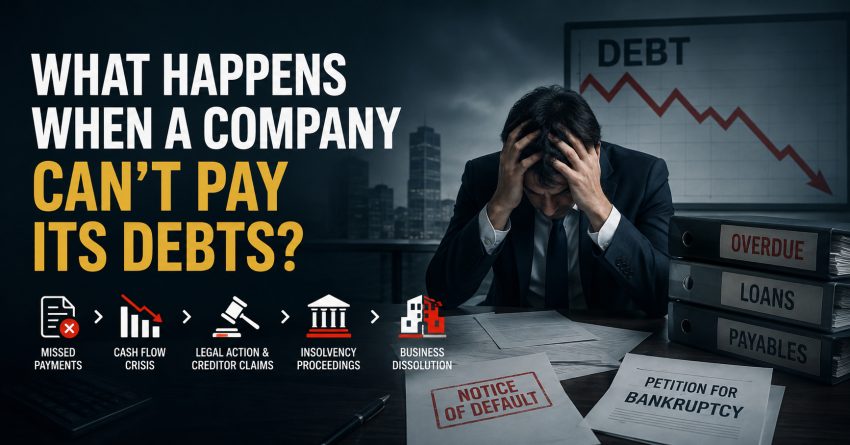
Key Stages When a Company Can’t Pay its Debts
- The financial pressures start affecting cash flows and business activities.
- The company attempts to negotiate banks and financial institutions for their debt settlements.
- In case the restructuring has failed, creditors or the company can initiate the insolvency proceedings under the Insolvency and Bankruptcy Code (IBC).
- The National Company Law Tribunal (NCLT) recognizes the case and appoints an insolvency professional to manage the whole resolution process.
- The creditors evaluate the proposal made by the firm for revival while all the legal recovery proceedings are on hold.
Alternatively, if there is nothing that can help resolve the problem and revive the firm, then the firm is liquidated to pay off the creditors.
The Wider Business Impact
Creditors and Suppliers Face Increased Risk
If a company is experiencing financial difficulties and cannot pay its debts, its suppliers, lenders and service providers can also find themselves in a liquidity crunch. The impact is felt throughout the business community, especially for small and medium-sized businesses who rely heavily on prompt customer payments.
Consequently, companies are also focusing greater attention than ever on the financial well-being of their customers and have enhanced their credit risk assessments.
Investors Are Focusing on Financial Discipline
Stress in companies in different sectors in recent times has led to the importance of being prudent in financial management. Investors are increasingly considering how profitable a business is as well as the leverage, stability of cash flow, ability to serve debt and corporate governance.
In general, firms with strong balance sheets and well-managed capital allocation are perceived as better prepared to deal with economic uncertainty.
Building Financial Resilience
Strengthening Liquidity Planning
The changing economy has prompted companies to become more rational with their financial plans. Companies are making better forecasts on cash flow, diversifying funds, working better on the working capital and having more liquid buffers to minimize financial vulnerabilities.
Proactively planning helps an organization be more prepared for market disruptions and changing business conditions.
Leveraging Technology for Better Risk Management
The use of digital finance platforms, predictive analytics and real-time financial monitoring tools are enabling businesses to anticipate new threats before they become significant. The technologies provide greater transparency of cash flows, debt loans, and operational performance, thus allowing decision-making leadership teams to make quicker and well-informed decisions.
In times of economic uncertainty, companies with robust financial governance practices and technology-backed insights are better equipped to make it through.
Conclusion
If a business is unable to pay debts, the repercussions are more serious than just failing to pay them back. A long period of financial difficulties can have a negative impact on employees, lenders, suppliers, investors and customers. The Insolvency and Bankruptcy Code, India has established a better framework for dealing with such situations, making it more transparent and faster, highlighting resolution in preference to liquidation.
The changing economic landscape will create challenges that businesses must be ready to manage and overcome, and those that are more financially disciplined, proactive in managing risk, and have a good handle on cash flow will be in a stronger position. Thus, it is apt to state that resilience is a key factor for growth in today’s business climate.
Frequently Asked Questions
Q: What happens when a company cannot pay its debts?
When a company cannot meet its financial obligations, it may face financial distress, negotiate with creditors, restructure its debts, or enter insolvency proceedings under applicable laws.
Q: What is the difference between insolvency and bankruptcy?
Insolvency is the financial state of being unable to pay debts, while bankruptcy is a legal process used in some jurisdictions to resolve insolvency. In India, corporate insolvency is primarily governed by the Insolvency and Bankruptcy Code (IBC).
Q: What is debt restructuring?
Debt restructuring is the process of modifying loan repayment terms, interest rates, or payment schedules to help financially distressed businesses regain stability.
Q: What is liquidation?
Liquidation is the legal process of selling a company’s assets to repay creditors when business revival is no longer possible.
Q: What are the common causes of corporate financial distress?
Financial distress can result from declining sales, excessive borrowing, poor cash flow management, economic downturns, rising operating costs, supply chain disruptions, and changing market conditions.
Also Read: The power of Corporate Debt Syndication in building better businesses