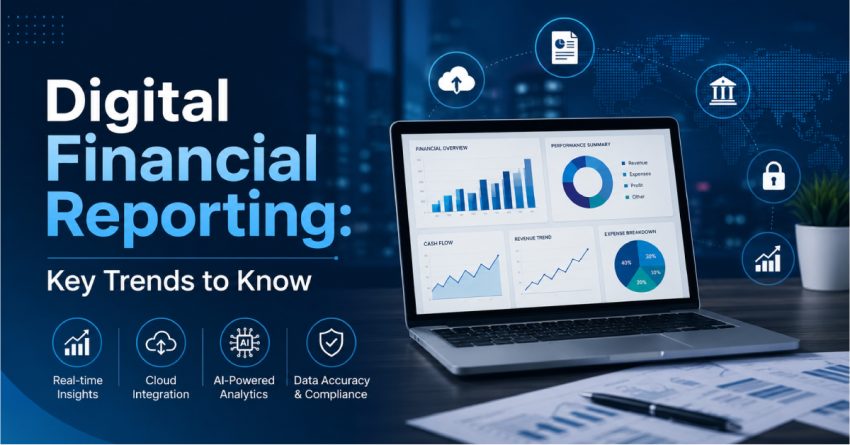
For businesses today, the amount of financial data created is greater than ever before. Whatever it is, dealing with daily transactions, payroll accounting, tax filing, or compliance with financial regulations, working with financial data could be a challenge. Organizations need speed, accuracy and transparency in their reporting and traditional spreadsheet and manual data entry methods are no longer the answer.
Digital financial reporting is revolutionizing business financial information recording, analysis and presentation. With the application of modern technologies, businesses will be able to take well-thought-out decisions, reduce risks and be compliant with regulations. Financial accounting, which is at the heart of this development, will ensure accuracy of financial reporting.
Cloud-based Reporting is the New Trend
One of the biggest trends in digital financial reporting is the growing adoption of cloud-based accounting platforms. Cloud solutions are different from traditional software that is installed on individual computers, in that they enable authorized users to access financial information on demand, anytime, anywhere.
Cloud technology also supports real-time collaboration between the finance team, the business owner and external consultants. The updates are instant to eliminate the chances of outdated information and ensure that the reports are accurate.
Cloud platforms play a crucial role in modern financial accounting practices, enhancing data management and security and ensuring access.
Real-Time Financial Insights
Organizations simply cannot afford to wait until the end of the month to know how their business is performing. Real-time reporting provides real-time information on revenue, expenses, cash flow, and profitability.
Interactive dashboards and automated reports can be used in management to analyze trends and make informed decisions.
Organizations can benefit from getting access to real-time financial data from advanced financial accounting systems that will help them make proactive decisions instead of reactive ones
Automation Improves Accuracy
Reporting problems resulting from manual data entry were common in the past. Now with automation, companies are managing to automate repetitive tasks such as invoices processing, bank reconciliations, expense classifications and reporting.
With automated workflows, consistency in financial data and saving the finance department’s time is possible. Consequently, professionals are able to focus on analysis and strategic decision-making and not administrative work.
Financial accounting continues evolving to increase efficiency and enhance the value and quality of financial reporting through automation.
Improved Compliance controls and Data Security
Compliance issues are a never-ending process for any business entity, especially under current regulations. With digital reporting systems, businesses are able to maintain good record keeping, monitor money flows and generate efficient reports for audit.
Today, sophisticated accounting software also comes with advanced security measures, including encrypted data storage, restricted access by users and automated backups, which aid businesses in securing delicate financial information.
Compliance is much easier and risk is minimized with reliable financial accounting processes, and secure digital systems.
Use of data analytics is shaping improved decision-making
Financial reporting goes far and beyond. In today’s business, analysis is widely executed in order to determine how an organization will perform in the future, the ways in which cost-cutting can be done and risks to financial performance.
Big financial data can be processed to generate useful insights that help in budgeting, investments and business growth.
With analytics in their financial accounting, organizations can have a better understanding of their financial standing and decision-making capabilities.
Conclusion
The rise of digital financial reporting is revolutionizing the financial practices of many organizations. Using cloud computing, automation, real-time reporting, security and data analysis, businesses are heading toward efficiency and compliance under growing requirements.
These trends will evolve further, and it will be critical for businesses to enhance their financial accounting systems for accuracy and decision-making.
Frequently Asked Questions
What is digital financial reporting?
Digital financial reporting is the process of preparing, managing, and sharing financial reports using digital tools, accounting software, and cloud-based technologies instead of manual methods.
Why is digital financial reporting important?
Digital financial reporting helps businesses improve accuracy, reduce manual work, generate reports faster, and make informed financial decisions using real-time data.
Why is data security important in digital financial reporting?
Financial reports contain sensitive business information. Digital financial reporting systems use encryption, user access controls, and automatic backups to protect financial data from unauthorized access and cyber threats.
What is real-time financial reporting?
Real-time financial reporting provides instant access to updated financial information such as revenue, expenses, cash flow, and profitability. It enables businesses to monitor performance continuously instead of waiting for monthly reports.
How does data analytics improve financial decision-making?
Data analytics help businesses identify financial trends, forecast future performance, control costs, and manage risks. These insights support better budgeting, investment planning, and overall business growth.
Also Read: Financial Accounting: Accuracy, Reliability, and Transparency