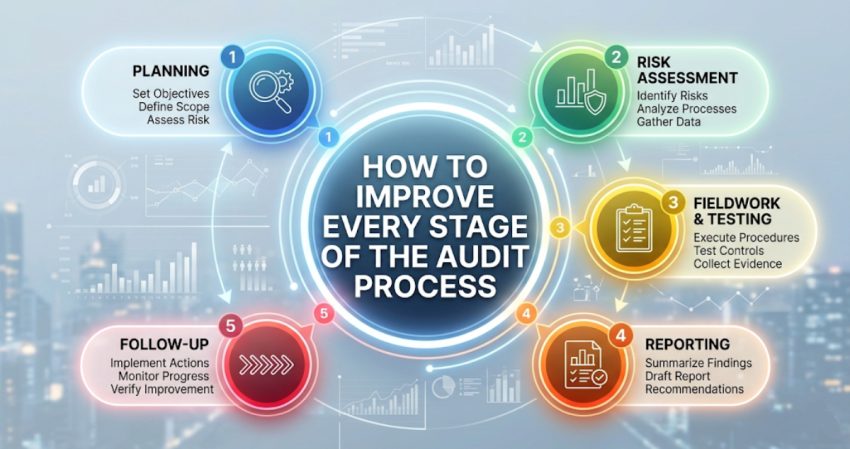
Making sure there is trust, compliance, and that internal controls are enhanced, an effective audit is not merely a review of numbers. Companies which adhere to the phases of audit process are more apt to identify the risks in the initial stage and remain financially accurate. Nonetheless, it is not sufficient to follow the steps. The appropriate practices, tools and supervision are required to support every phase and provide valuable outcomes.
In the contemporary competitive business world, the organizations which streamline the stages of audit process can gain more understanding and prevent expensive surprises. We shall examine the best practices, which can be used to improve all the steps of the audit journey.
Phase of planning: beginning with Objectives
The planning phase is what forms the basis of the whole audit. Poor planning is a likely cause of delays, coverage gaps, and poor findings. Defining clear audit objectives based on business risks and regulatory requirements is one of the most significant best practices.
In the phases of audit process planning, the auditors are supposed to carry out preliminary risk assessments and familiarize themselves with the operations of the organization. Developing an extensive audit plan, timeline and allocation of resources is a way of making sure that the audit process is not affected easily. Preliminary communication with the most important stakeholders prevents the information gaps in the last minute also.
Risk Evaluation: Pay Attention to Things that Matter
A quality audit is made up of risk assessment. Rather than focusing on all the areas, the auditors are supposed to focus on high-risk areas where the possibility of error or fraud is high. This is a risk-based method which enhances efficiency and audit impact.
To enhance this step in the stages of audit process, the organizations are expected to keep the risk registers and internal control documentation up to date. With the help of data analytics tools, it is also possible to see unusual patterns that should be investigated more closely. Risk assumption review on a regular basis helps to make sure that the audit focus is pertinent.
The Fieldwork and Evidence Collection: Be Accurate
Throughout the fieldwork, control testing, document review and audit evidence are carried out. Audit conclusions may be undermined by poor documentation or lack of sufficient sampling. Thus, it is important to be consistent and comprehensive.
The best practice in the steps of audit process involves the utilization of standard working papers, maintenance of effective audit trail, and the use of the correct sampling technique. Whenever possible, auditors should also check the information obtained through several sources. This step can be made more accurate and have fewer manual errors by using audit software to help.
Review and Analysis: Be Skeptical in a Profession
After collecting evidence, it ought to be analyzed properly in order to come up with meaningful conclusions. This step requires professional discretion and detailing. It is important that auditors should not take things at face value and should ask questions about anything that did not make sense.
The best way to enhance this phase of auditing process is through the adoption of multi-layered review systems by organizations. Findings can be validated by senior reviewers, and consistency is ensured, as well as the verification that audit procedures were followed. Conclusions may also be reinforced by use of analytical review techniques and variance analysis.
Reporting Phase: Report effectively
A report prepared after an audit is useless in case the parties are not familiar with it. Most audits have lost their relevance due to presentation of findings in over technical language or not giving any recommendations to be implemented.
One of the good practices in the stages of audit process is the ability to prepare clear, concise, and structured reports. The results must be in terms of risks, underlying causes, and practical redress measures. Reporting on time is also of essence to act swiftly by the management. It is important to hold closing meetings with the management to balance and clarity.
Follow-Up and Monitoring: Close the Loop
The audit process is not completed with the report. Even the best audit results might not be transformed into better without effective follow-up. Self-observation of the corrective measures will make sure that the gaps identified are indeed addressed.
Organizations ought to establish a formal follow-up mechanism within the stages of audit process. Periodic status reviews, tracking systems, and accountability of the management are some of the measures that can ensure that recommendations are implemented. Constant surveillance will also reinforce the control of the environment with time.
Conclusion
The value of well conducted audit is far more than mere compliance. Audits can be potent in terms of risk management and operational enhancement when every step is planned and reinforced with the best practices. Companies that invest in streamlining the stages of audit process enjoy greater control, transparency and enhanced confidence by stakeholders.
This content is meant for information only and should not be considered as an advice or legal opinion, or otherwise. AKGVG & Associates does not intend to advertise its services through this.
Also Read: How the Audit Process Works in 5 Stages