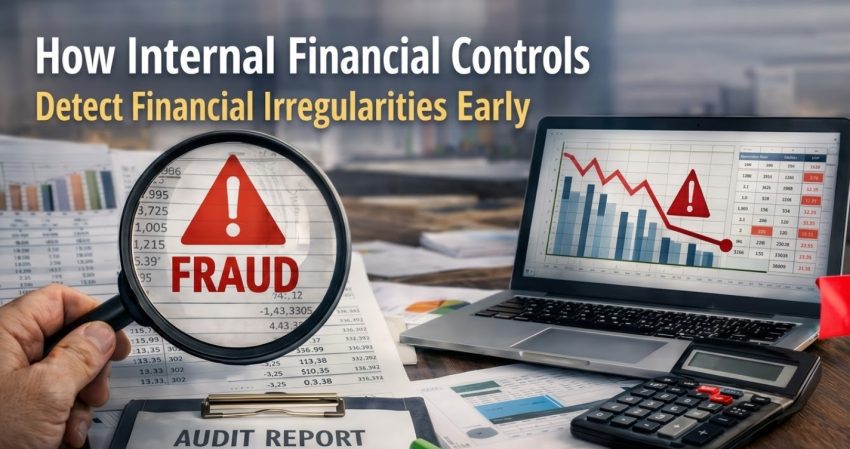
Any successful organization is anchored on financial discipline. The larger and more complex the business is, the more likely it is to make errors, commit fraud, or have gaps in compliance. It is in this respect that a powerful internal financial control (IFC) system is necessary. It allows business organizations to track their transactions, impose accountability, and identify anomalies early in the process before they can cause significant losses in terms of finances.
This blog describes the operation of IFC mechanisms and why they are very vital in proactive risk management.
The knowledge of IFC in Contemporary Organizations
Internal Financial Controls are the policies, procedures, and systems that guarantee reliability and accuracy of financial reporting in addition to protection of company assets. An effective internal financial control system is not just some compliance-oriented model, but it is a reinforcement of financial management.
The modern digital world has seen IFC incorporate checks on processes, automated verifications as well as administration supervision to establish numerous levels of protection. When well implemented it enables the organizations to detect abnormal trends and variances early in the transactional cycle.
Why Early Detection Matters
Financial anomalies tend to start as minor irregularities in the processes such as duplication payment, unauthorized approvals or record manipulation. Unnoticed, these problems may escalate to major cases of fraud or regulatory infraction.
Early detection using strong systems of internal financial control assists organizations:
- Preventing revenue leakage
- Reduce fraud exposure
- Better financial statements.
- Increase stakeholder trust.
- Make sure that laws are adhered to.
The sooner a problem is diagnosed the easier it becomes to repair and the cheaper.
Major Means through which IFC allows early detection
Structured IFC model operates in several levels of control. The most successful mechanisms are listed below.
1. Segregation of Duties
Specifically, making sure that one person has no control over the end-to-end control of a financial transaction is one of the core principles of IFC. Different personnel are assigned with such responsibilities as authorization, recording, and reconciliation.
This internal financial control segregation ensures that mistakes or fraud may not go undetected and that there are inherent checkpoints in the process.
2. Automated System Controls
The need to use ERP and counting systems with in-built validations is becoming more pronounced in modern organizations. Such computerized controls identify uncharacteristic entries, duplicate invoices or transactions exceeding set limits.
Internal financial control is technology-oriented, which cuts off manual reliance and enhances real-time control. The use of automated alerts allows the finance teams to research exceptions on the spot and not at the end of year reviews.
3. Regular Reconciliations
Regular reconciliation, like bank reconciliations, checking the balance of vendors, and inventory matching, is a potent means of identifying discrepancies.
When conducted regularly within a well-organized internal financial control system, reconciliations will soon identify within a few minutes any mismatch, unauthorized records, or timing disparity that can be an indicator of more serious problems.
4. Audit Trails and Approval Workflows
Established approval levels will guarantee that key transactions are reviewed accordingly before implementation. Meanwhile, the digital audit trails track the individual who approved of something and at what time.
These internal financial control controls bring in accountability and facilitate easier investigation of suspicious activities. Audit trails are also used to discourage deliberate manipulation.
5. Constant Supervision and In-house Audits
The use of IFC is best supported by constant monitoring and not periodic checks only. Dashboards and exception reports are now widely used by companies to monitor their financial operations in near real time.
The internal financial control environment is enhanced through constant monitoring of the environment to ensure that emerging risks are addressed in good time.
Popular Red Flags that can be detected IFC
IFC systems can be used in a proper implementation to point out the warning signs, including:
- Payments in duplicates or round numbers.
- Unusual vendor additions
- High number of manual journal entries.
- Delays in reconciliations
- Unauthorized access alterations.
Early identification of these signs enables the management to intervene as soon as the situation goes astray before the financial losses set in.
This content is meant for information only and should not be considered as an advice or legal opinion, or otherwise. AKGVG & Associates does not intend to advertise its services through this.