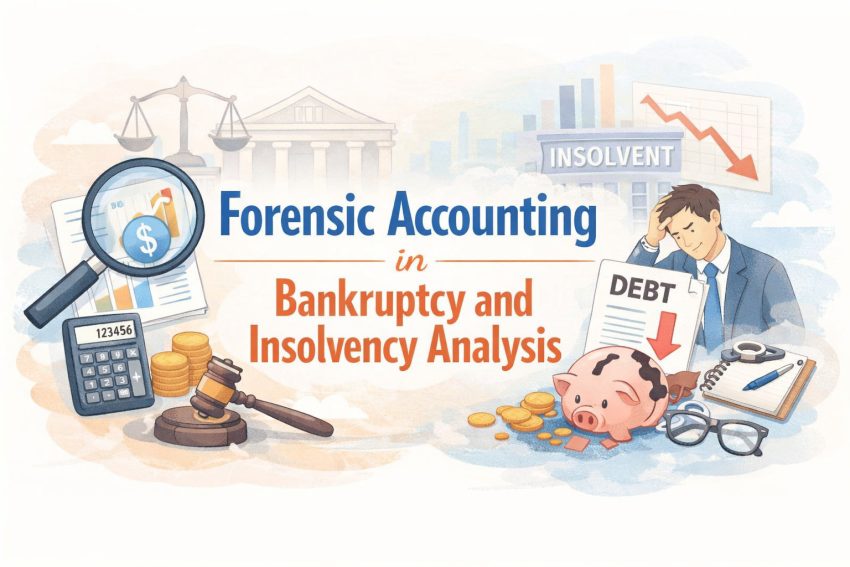
Bankruptcy and insolvency are critical financial situations that can significantly impact businesses, creditors, and stakeholders. In case the organization cannot cover the financial commitments, it is necessary to find out the reasons for the problem, as well as determine the potential violations and the actual financial state of a given structure. Forensic accounting comes in this scenario and serves as an important instrument that can be applied to bring clarity and accountability through the use of a combination of accounting skills and investigative methods.
Understanding Bankruptcy and Insolvency
Bankruptcy and insolvency occur when a business cannot pay its debts as they become due or when liabilities exceed assets. These situations may arise due to poor financial management, economic downturns, operational inefficiencies, or fraudulent activities. Standard financial statements often fail to reveal the complete picture, especially if records have been manipulated. A detailed investigation is therefore required to uncover the reality behind the numbers.
Role of Forensic Accounting in Financial Distress
Forensic accounting is a methodical audit of financial documentation to identify anomalies, distortions, and financial malpractices. In the bankruptcy and insolvency, forensic accounting assists the process of identifying whether the business incurred losses in good faith or the financial misconduct was intentional. Forensic accountants can determine red flags by examining transactions, cash flows, and accounting policies that can have led to the collapse.
Identifying Fraud and Mismanagement
Fraud and mismanagement are some of the main goals of forensic analysis during insolvency. This can be the siphoning of assets, splitting of money, fabrication of costs or favoring some creditors. Forensic accounting helps the investigator to detect the financial trails, detect the hidden assets, and assess the suspicious transactions proceeding the time of insolvency. This knowledge is crucial to recovery processes and litigation.
Assessing True Financial Position
During insolvency proceedings, it is essential to assess the true financial health of the entity. Forensic accountants review historical financial data, re-evaluate asset valuations, and examine related-party transactions. Through this detailed assessment, forensic accounting helps determine the actual net worth of the business, ensuring that creditors and stakeholders receive fair treatment during resolution or liquidation.
Supporting Legal and Insolvency Proceedings
Bankruptcy and insolvency proceedings usually contain litigation, regulatory investigation and proceedings on the basis of insolvency laws. Forensic accounting report is a valid testimony in court, tribunal and insolvency resolution proceedings. By these reports, one has a clear documentation of findings, and the complicated financial information can be understood by the legal authorities. The organized practice of forensic accounting enhances assertions, defense and recovery strategies.
Enhancing Transparency and Creditor Confidence
It is important to be transparent when resolving insolvency to ensure the credibility of creditors. Forensic accountants will be able to restore confidence to the stakeholders by revealing the truths and providing objective results. Their work has made the management and directors accountable as well as avoiding the incurring of additional financial harm. Forensic accounting, in most instances, can be a preventive measure as it tends to point out the control flaws that can be rectified in subsequent business processes.
Conclusion
Bankruptcy and insolvency are financial occurrences that require more than just regular accounting examinations. Forensic accounting offers both investigation and thorough analysis that cannot be done without comprehending financial distress. Forensic accounting can aid in achieving fairness, transparency, and informed decision-making in cases of insolvency and bankruptcy, by detecting fraud, estimating actual financial status and assisting in court proceedings.
This content is meant for information only and should not be considered as an advice or legal opinion, or otherwise. AKGVG & Associates does not intend to advertise its services through this.
Also Read: Forensic Accounting: Safeguarding SMEs and Startups from Digital Scams