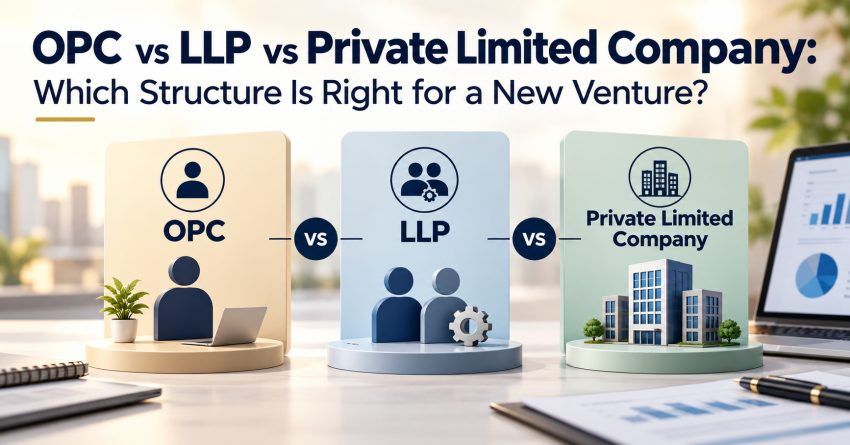
When you start your business, one of the first choices you have to make is on the legal structure of your company. The choice of structure affects ownership, compliance, taxation, fundraising and liability. If you’re operating as an individual entrepreneur, a One Person Company (OPC) may be considered, or if you have multiple entrepreneurs, or are looking for growth, you might want to consider an LLP or Private Limited Company.
Knowing the difference between these structures can assist entrepreneurs in making their choice accordingly.
What is the difference between OPC and LLP and Private Limited Company?
There are advantages and disadvantages for each structure. Here’s a general comparison:
| Factor | OPC | LLP | Private Limited Company |
| Ownership | Single member | Two or more partners | Two or more shareholders |
| Management | Director manages the company | Partners manage the LLP | Directors manage the company |
| Liability | Limited liability | Limited liability | Limited liability |
| Fundraising | More limited | Generally, less suited to equity funding | Better suited to equity investment |
| Compliance | Moderate | Moderate | Comparatively higher |
| Suitable for | Solo entrepreneurs | Professional or partner-led ventures | Growth-focused businesses
Scalable enterprises (Or: Funded startups) |
An OPC may be appropriate when:
An OPC is a company with a single member that allows an individual to conduct business through a corporate structure while retaining control over the business. It can provide a limited liability and supply a structure to your business without multiple shareholders.
If the business entity has a clear business plan and the entrepreneur wishes to distinguish personal and business liabilities, he or she can register a one person company. But, there are compliance requirements as well and the possibility of needing outside equity investment for the business in the future.
When an LLP May Be Considered
An LLP may be suitable if two or more people wish to enjoy the limited liability protection of a company but also want to continue to have full control of the business. It provides some flexibility in the organization of management and profit sharing among partners.
This structure is suitable for professional practices, consulting firms and ventures in which the founders are actively participating in the business. But businesses which are planning for significant equity issues should see if an LLP will be useful in their longer-term financial strategy.
When a Private Limited Company May Be Considered
A Private Limited Company may be considered by founders planning for expansion, equity investment or a formal shareholding structure. A share structure can be set up to provide different shares to different shareholders, providing flexibility for equity investment and change of ownership.
The compromise is an increase in statutory compliance and corporate governance. So, companies should consider if the advantages outweigh the extra administrative burden.
Factors to Consider When Choosing a Business Structure
The choice of business structure depends on several factors, including the number of founders and the nature, funding and growth plans of the business.
- Expected business growth
- Funding requirements
- Ownership and control requirements
- Ownership and control preferences.
- Liability considerations
- Compliance capacity
- Flexibility for changes in ownership.
- Nature of the business
Considering these factors can help founders assess the suitability of each structure for their short-term and long-term business objectives.
Deciding early on the right path
It’s not always easy to change your business structure later on, with extra documents, compliance changes and operational modifications. Therefore, business owners should consider their business plans before deciding to incorporate, rather than just because it seems simpler.
An OPC can be a formal beginning for a single-founder. An LLP is well suited for a partnership driven business whereas a Private Limited Company is more flexible for a business aiming for investment and expansion. Final decision should be based on ownership of the business, the money goals and the expected growth rate of the business.
FAQs
Q1. Which structure is suitable for a solo founder?
An OPC may suit a solo founder seeking limited liability, formal ownership and control over business decisions.
Q2. When is an LLP suitable?
An LLP may suit professional or partner-led businesses requiring flexible management and limited liability.
Q3. Why choose a Private Limited Company?
A Private Limited Company may suit businesses planning expansion, equity investment or multiple shareholders.
Q4. Do all three structures provide limited liability?
OPCs, LLPs and Private Limited Companies provide limited liability, subject to applicable laws and conditions.
Q5. What should founders consider before choosing?
Founders should evaluate ownership, funding needs, liability, compliance capacity and expected business growth.
Also Read: Private Limited Company Registration: What to Avoid?