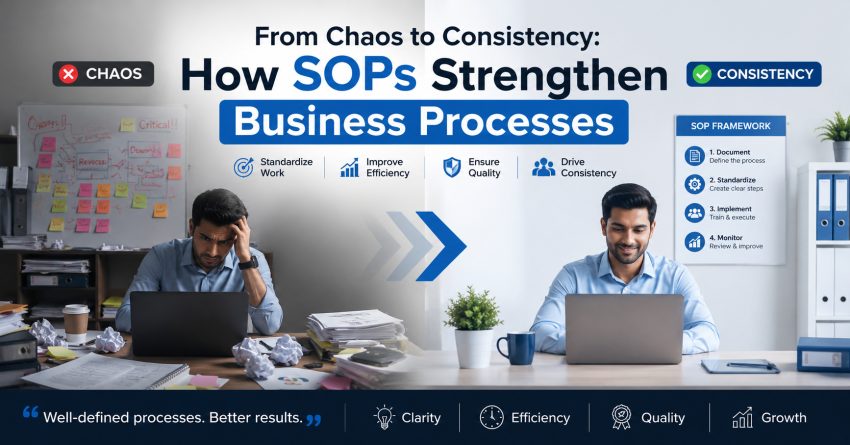
Increasingly, growing businesses find themselves becoming more complicated in terms of performing daily operations. What was adequate before in terms of informal communication and individual knowledge may not work anymore as the team grow, or when there is a new branch of a company that opens, leading to increased customers’ demands. The lack of standardization leads to non-compliance, mistakes, lags, and overall low efficiency. The solution to all these problems is to have a properly documented standard operating procedure.
What are SOPs?
A standard operating procedure (SOP) is a formally written procedure that includes instructions about performing a routine task. This type of document is a great reference point for employees and assures that each activity will be done consistently by any member of the team.
There can be many SOPs for different types of business activities such as finance, HR, procurement, production, customer service, etc.
Promoting Uniformity in Procedures
Consistency is one of the greatest benefits offered by a standard operating procedure. In the absence of standard procedures, the staff members may perform the same task in various ways, causing differences in the output of the job.
The process of standardization promotes uniformity in the process, which leads to consistent quality and customer satisfaction. Standardization becomes even more important for firms that have multiple departments or branches.
Enhancing Efficiency and Productivity
The employees perform better when they know how to act and have well-defined descriptions of the jobs assigned to them. The standard operating procedure eliminates any confusion and provides structured information on how to accomplish the tasks.
The teams do not waste time explaining procedures and making mistakes that can be avoided. Moreover, a good SOP eliminates duplication of efforts and makes the process more efficient.
Supporting Employee Training
One of the most significant challenges for growing businesses can be training new hires. If there are no documented procedures, then a lot of knowledge relies on the experience of the staff members, which can cause inconsistencies.
A holistic standard operating procedure can be applied as a training tool to set expectations, offer step-by-step instructions and establish consistent processes for employees. This helps in getting the on-boarding process started faster and assists new hires in getting productive faster.
It also helps to minimize reliance on individual personnel because it enables the knowledge of the organization to be recorded in a structured way.
Better Compliance & Risk Management
There are many industries which have strict regulatory and quality requirements. Businesses have to prove that the processes are followed consistently and that the processes are documented correctly.
SOPs help ensure compliance by establishing clearly defined responsibilities, approval processes, documenting needs, and quality control procedures. They also mitigate operational risks by reducing the chances of human error and ensuring that critical procedures are carried out properly.
SOPs should be regularly reviewed and updated to ensure that they continue to meet regulatory requirements and keep pace with business practices.
Driving Continuous Improvement
The SOP cannot be rigid. The organizations should review their SOPs from time to time in order to find out ways of improving their effectiveness in the changing requirements of business.
Improvement of the existing SOP can be done in accordance with employee input, performance indicators, customers’ information, and technological changes. With the help of continuous improvement, SOPs will remain current, efficient and in harmony with organizational goals.
Those organizations that have their SOP as “living documents” will be ready to face new market conditions and keep on performing efficiently.
How to Create a Culture of Accountability
Clear documentation of procedures sets out accountability, roles, responsibilities and outcomes. Staff are aware of what’s expected, managers have better oversight of staff performance, and management has greater visibility into operations.
This transparency fosters teamwork, enhances problem-solving, and establishes greater overall organizational structure.
Conclusion
As a business grows, so does the complexity of handling the business. Inefficiencies, inconsistencies in service, and increased operational risks can become potential issues if processes aren’t standardized. When a standard operating procedure is well-designed, it will provide structure to help convert disjointed processes into repeatable, consistent procedures.
Frequently Asked Questions
Q: What is a Standard Operating Procedure (SOP)?
A Standard Operating Procedure, or SOP, is a written document that explains how to complete a routine task consistently, correctly, and in line with business requirements.
Q: Are SOPs useful for small businesses?
Yes. Small businesses can use SOPs to organise work early, train employees faster, improve customer service, and create a stronger foundation for future growth.
Q: How can a company measure whether its SOPs are effective?
A company can review error rates, turnaround time, customer complaints, compliance observations, employee feedback, and process exceptions to assess whether SOPs are working effectively.
Q: Why does a business need SOPs?
SOPs reduce process confusion, improve consistency, define responsibilities, and help teams complete important tasks without depending on verbal instructions.
Also Read: How Standard Operating Procedures (SOPs) Improve Accuracy and Reduce Errors