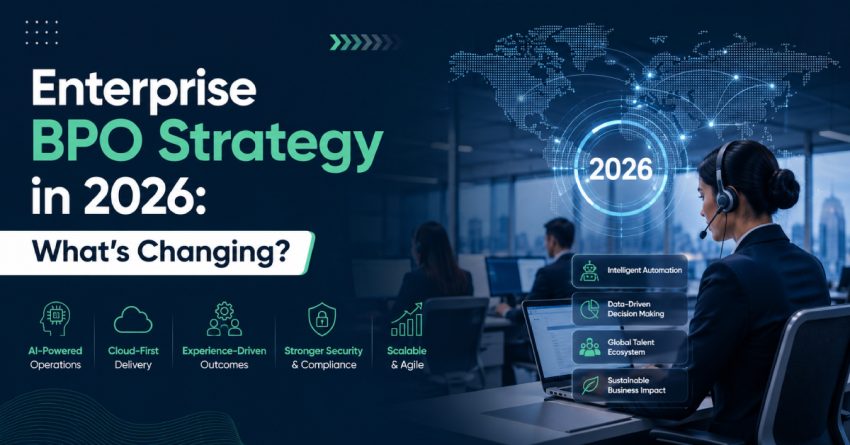
BPO has moved far beyond its traditional role as a cost-saving solution. Businesses are now leveraging outsourcing as a tool to enhance their agility, improve the experience of their customers, improve compliance, and accelerate their digital transformation in 2026. Firms are now encountering economic pressures, shifting customer demands, and rapid advancements in technology, and thus the strategies related to BPO have become less focused on the short-term benefits that may arise and more focused on the long-term value it brings.
The current business process outsourcing services help companies optimize their process flow and provide them with expert knowledge, advanced technology, and versatile resource pool. Enterprises are, therefore, rethinking the significance of outsourcing in their business growth.
Key Trends Reshaping Enterprise BPO Strategy
Moving Beyond Cost Optimization
Organizations have traditionally only seen the benefits of outsourcing in the sense of cutting their costs. Cost efficiency is still a key factor, but modern companies demand so much more from their outsourcing partner.
Businesses are now looking for providers who can drive process efficiency, provide industry knowledge and innovation. Today, business process outsourcing services are more commonly integrated with the strategic business plans of companies, allowing them to enhance their performance without the need for rigidity in a volatile business world.
Greater Focus on Digital Transformation
Digital technologies are becoming an integral part of all processes of outsourcing. Technologies like artificial intelligence (AI), robotic process automation (RPA), cloud computing, and big data analytics are helping the providers of Business Process Outsourcing (BPO) to deliver faster and smarter services.
Outsourcing partners are not only doing repetitive tasks for businesses, but they are helping them automate their processes and generate meaningful business reports. This technology-led solution can help businesses increase their efficiency and decrease manual workloads.
Expanding Specialized Outsourcing
Many organizations are opting for specific outsourcing models that concentrate on specific high-value functions of the business, rather than outsourcing entire departments.
Specialized business process outsourcing services, with domain expertise and digital capabilities, are becoming a natural fit for managing finance and accounting, human resources, procurement, compliance management, customer support and data analytics.
| Traditional BPO Model | Enterprise BPO Strategy in 2026 |
| Cost-focused outsourcing | Value-driven strategic partnerships |
| Manual process execution | AI-enabled intelligent automation |
| Limited technology integration | Cloud-based connected ecosystems |
| Fixed service delivery | Scalable and flexible operations |
| Transaction-focused support | Outcome-driven business solutions |
Traditional BPO vs. Enterprise BPO in 2026
Building More Resilient Operations
Strengthening Risk Management and Compliance
The regulatory landscape is continuously expanding in various sectors and compliance has become a critical element in outsourcing plans. For the best BPO companies, governance, compliance monitoring and standardized operating procedures are now part of the service offering.
Organizations can work with seasoned business process outsourcing services providers to bolster their internal controls and minimize operational and regulatory exposure.
Prioritizing Data Security
Sensitive business information is currently a critical priority as more and more critical business processes are transferred to outsourced environments.
Companies need to scale their business according to the seasonal demand, expansion of the market, mergers, and the altered customer expectations. Seasonal demands, expansion of the market, mergers, and altered customer expectations can compel firms to urgently adjust their scales.
Supporting Business Scalability
The demands of business are ever-changing. Business organizations have to grow quickly in order to meet the demands that arise due to seasons, market expansion, merging, and changing customer demands.
The current options of outsourcing enable companies to either increase or reduce their capacity without having to make any substantial investments in terms of infrastructure. This scalability enables organizations to act on market opportunities efficiently.
Creating Long-Term Strategic Partnerships
In recent times, a shift has been noticed that stems from transactional to collaborative relationships between enterprises and outsourcing providers. More and more organizations are engaging outsourcing partners in business planning, digital transformation and process improvement projects.
Unlike services delivery, modern BPO services providers play a role in innovation, operational excellence and continuous improvement. This teamwork strategy enables companies to create resilient and future-proof operations.
Conclusion
Enterprise BPO strategy in 2026 is defined by innovation, flexibility, and strategic collaboration. As a result, business organizations are shifting from conventional outsourcing practices to technology-based partnerships that increase efficiency, ensure compliance, and facilitate further business growth.
By implementing advanced business processes outsourcing solutions, enterprises can optimize their operations and accelerate digital transformation.
Frequently Asked Question
Q: What is Business Process Outsourcing (BPO)?
Business Process Outsourcing (BPO) is the practice of hiring a third-party service provider to manage specific business functions such as customer support, finance, HR, payroll, or IT services.
Q: What are the different types of BPO?
The main types of BPO include back-office outsourcing, front-office outsourcing, IT outsourcing, finance and accounting outsourcing, HR outsourcing, and customer support outsourcing.
Q: What is enterprise BPO?
Enterprise BPO is a strategic outsourcing approach where businesses partner with service providers to improve operations, adopt digital technologies, and support long-term business objectives.
Q: How is modern BPO different from traditional outsourcing?
Traditional outsourcing mainly focused on reducing costs, while modern BPO emphasizes digital transformation, automation, innovation, scalability, and long-term business value.
Q: How does BPO help reduce business costs?
BPO reduces hiring costs, infrastructure expenses, technology investments, training costs, and operational overhead while improving productivity.
Also Read: How Build Operate Transfer Outsourcing Supports Long-Term Strategic Planning