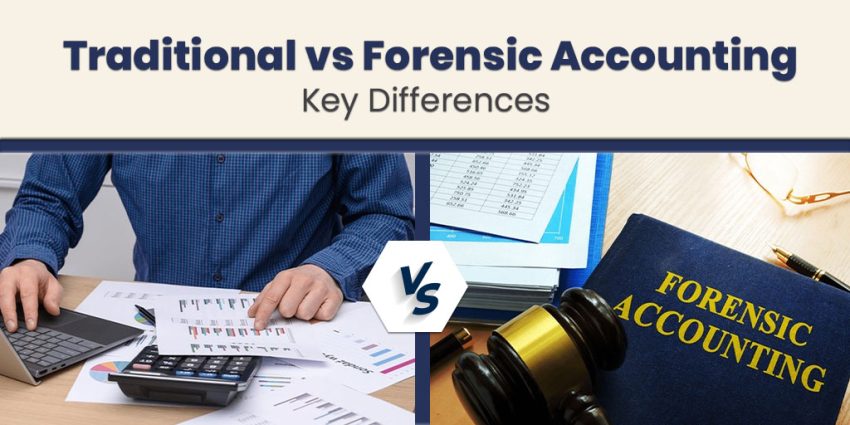
Accounting is often seen as the language of business, helping organizations record, analyze, and report financial information. However, within the broader field of accounting, there are specialized branches that serve unique purposes. Two of the most important among them are traditional accounting and forensic accounting. While both deal with financial data and accuracy, their goals, techniques, and applications differ significantly. Understanding these differences is essential for businesses, investors, and legal professionals alike.
What Is Traditional Accounting?
Traditional accounting is the systematic registration, categorization, and generalization of financial transactions. Its primary objective is to provide a concise and precise image of the financial position of a company using the statements, i.e. balance sheet, income statement and cash flow statement.
Traditional accountants make sure that the standards of accounting, such as Generally Accepted Accounting Principles (GAAP) or International Financial Reporting Standards (IFRS), are followed. They undertake day-to-day bookkeeping, tax preparation, budgeting and financial reporting. The management decisions, relations with investors, and compliance with the statute are based on their work.
Traditional accounting is in essence, all about documenting what occurs in a business; that is, keeping track of the transactions, making sure that they are accurate and transparent.
What Is Forensic Accounting?
Forensic accounting however transcends normal financial reporting. It is a combination of accounting skills and investigative skills to unravel financial fraud, misconduct or legal controversies. The word forensic suggests the appropriateness of the use in the court- i.e. the result of forensic accountants may be used as evidence in the court of law.
The irregularities that forensic accountants investigate include embezzlement, money laundering, insurance fraud, financial reporting, and misappropriation of assets. They examine financial documents to trace concealed transactions, restructure financial activities and offer expert evidence in courts as necessary.
To put it in a nutshell, forensic accounting deals with finding out why and how, and not merely registering it.
Key Differences Between Traditional and Forensic Accounting
The fundamental distinction is in the intention and method. Conventional accounting is more financial management conscious accounting that is based on precision as well as compliance. Forensic accounting is inquisitive and focused on uncovering, examining and preventing fraud or financial offences.
Conventional accountants work using standard forms of documentation and procedures, but forensic accountants can be faced with missing or doctored data. They require analytical skills, cynicism, and skill in reading between the lines that can point to an act of fraud.
Whereas the traditional accounting findings are applied in reporting and audit activities, forensic accounting findings tend to be applied as evidence in courts or arbitration cases. Forensic accountants engage with law enforcement, legal workers and regulators – the interface between finance and justice system.
The Growing Importance of Forensic Accounting
Financial crimes and cyber frauds in the modern world are getting more sophisticated in a complex corporate environment. This has led to a great increase in the demand for forensic accounting. Forensic accountants have been employed by organizations to perform preventive audits, enhance internal controls and to enforce ethical conformity.
Conclusion
Although the main aim of both traditional and forensic accounting is financial accuracy, their tasks are different in terms of scope and purpose. Traditional accounting guarantees transparency and compliance in finances, which is the foundation of healthy business practices. Forensic accounting, in its turn, serves as a protective measure–it safeguards businesses against fraud, financial malpractices and court battles. Collectively, they form a strong frame, which sustains financial integrity as well as corporate accountability in the contemporary business environment.
This content is meant for information only and should not be considered as an advice or legal opinion, or otherwise. AKGVG & Associates does not intend to advertise its services through this.
Also Read: The Ethical Use of Forensic Accounting Tools in Investigations